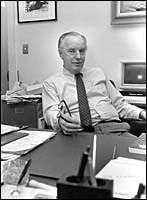
In the first issue of the Providence Business News, published May 5, 1986, a letter from Publisher Roger C. Bergenheim and then-Editor Peter Kadzis told readers they hoped the paper would “bring a new voice to Rhode Island.”
“To the extent to which you can predict these things, it seems clear that Rhode Island is poised for a new era of growth,” the letter continued. “And that growth will come from the same forces that over the last five years have made the Northeast an increasingly attractive place from which to conduct business… Perhaps the single most important project in the state at the moment is Capital Center in downtown Providence. Its very existence is a testament to what can be accomplished for the good of all with the right degree of dedication and hard work.”
Seifert Systems Invests in Energy Efficiency to Strengthen Operations
For manufacturers, energy is more than just another operating expense. It plays a critical role…
Learn More
Now, 15 years later, Southeastern New England’s business community has indeed expanded – and evolved – and Providence Business News (PBN) has grown along with it, doubling its staff over a decade-and-a-half.
In a recent interview, Bergenheim remembered the early days.
“Nobody was doing hard news in the weekly format,” he said. “Providence was poised for growth — there was starting to be a buzz about Rhode Island as an up and coming place for business.”
Bergenheim said the experience of his father, PBN co-founder Robert C. Bergenheim, former publisher of the Boston Herald American, was invaluable in getting the project off the ground.
PBN wasn’t the first paper the pair founded — each left other jobs (Roger Bergenheim left his job in advertising at the Boston Phoenix and Robert Bergenheim gave up his publishing of the Boston Herald American) to create the Boston Business Journal in 1981.
“It was ideal because Roger’s experience in newspapers had been in advertising and mine was in editorial, so our specialties didn’t overlap,” said Robert Bergenheim.
The shift to a small paper after more than 30 years of working in the dailies was “different. . .a major change, but it was quite exciting,” Robert Bergenheim said. “When I was at the Herald, we did every kind of survey imaginable. The public said they weren’t getting what they needed on the business/financial side. I knew the big guys had their eyes on Boston as a market.”
So father and son decided to shift their talents southward to Rhode Island.
Once PBN debuted, “it seemed as though we gained the respect of the business community rather quickly,” said Roger Bergenheim.
Competing for advertisers proved to be a little more difficult. With competitors like The Providence Journal, Ocean State Business and Business Fortnightly in the mix, “you had to barge into the party – uninvited,” said Roger Bergenheim.
“I think what won the day for us was a strong editorial product — what was written, how it was written and the frequency with which it was published,” said PBN Vice President and Director of Advertising David C. Dunbar. “People see value in it.”
Dunbar said PBN’s renewal rate is 73 percent, slightly higher than the national average for business publications of about 70 percent.
Putting it Together
Editor Franklin S. Prosnitz has set the tone in the newsroom for the past eight
years.
“I envision us as a conduit for information,” he said. “Our mission is to be the business information resource for the business community. We realize we can’t do it all through the paper, although that is our primary product.”
PBN’s Web site was revamped last year and is now updated several times each day with breaking news. The paper’s series of summits (now in its second year) are also an important way in which PBN strives to address the various issues that impact the business community.
“We identify some of the critical areas in doing business — health care, telecommunications, technology, financing, human relations – and we try to bring some of the best local experts to the panels,” he said. “There are a number of ways to get the message out.”
“The fact that we cover a niche — the business community — should not be misinterpreted to mean that we work for them,”
PBN Managing Editor Michael Pare said.
Many members of the PBN staff have worked for daily publications, but Pare said that developing story ideas for a weekly is a little different.
“Reporters are filing stories every day that won’t necessarily be seen by the public for several days,” he said. “That changes the way a story is written. We need to take a more analytical approach.”
The production department places the paper’s advertisements when they are received, and once a story is filed, it is laid out in production and artwork, rubrics, headlines and cut lines are added.
“We generate the newspaper in about a day and a half,” said Debra Lamp, PBN’s production manager for the past eight years.
Once a page is laid out on the computer, it is printed and proofread by the editors and sent back to production for corrections, if needed. Corrected pages go back to editorial for another look. It is a process that can go on – in “generations,” Lamp called it – six to seven times per page.
The map keeps everybody in advertising and editorial on track.
Advertising coordinator Jan Sherman described herself as “the one that everybody gets mad at when I change the map.”
Anytime there’s a page configuration change — for example if the size of an ad changes — Sherman revises and circulates copies of a new “map.”
Like reporters, each person in advertising sales has a specific coverage area, or “beat,” such as health care, government or office supply.
“If we’re doing our jobs up here, we’re putting ads in the paper that help the reader do better business,” said Dunbar.
It is Circulation Director Stephen Dolce’s job to make sure that PBN finds its way to subscribers and to the 600 single-copy outlets in Southern New England. Dolce said that PBN’s readership of 37,500 has increased 35 percent over the last four years.
Dolce also coordinates the Newspapers in Education program that, through sponsorships by area businesses, gets PBN into the hands of high school seniors and business majors for use in reports or projects.
“As far as we know, we’re the only business newspaper in the country that has this program,” he said. “It’s a fun thing for the students.”
Director of Development Carol M. Carson describes her job as “mounds of details.” And rightly so: Carson is the coordinator behind every Book of Lists party, Summit or other special event.
“The Book of Lists party I work on all year,” she said. “Summits take a couple of months. I’m working on some piece of all of them all the time.”
The events that Carson plans often benefit non-profit organizations, such as the Providence Public Library (where the last two Book of Lists parties were held), the Providence Children’s Museum (site of the 2002 Book of Lists party) and Dorcas Place (which helped sell tickets for the 15th Anniversary party).
“That’s a really neat part of what we’re doing,” she said. “It’s about PBN, of course, but there’s also an element of community outreach as well.”
This fall, PBN will present – along with Cox Business Services – the first-ever Business Excellence Awards.
Through events such as the awards and the Book of Lists parties, “we’re reaching out for a way to have more fun and to recognize that our readers’ lives aren’t all about business,” said Dunbar.
PBN’s own business side relies on the talents of Business Manager Gail Ricci, who handles accounts payable, accounts receivable, billing and payroll.
Ricci could not narrow down the thing she likes best about her job, a position she has held for eight years.
“I like everything,” she said. “I enjoy coming to work every day. I don’t think a lot of people can say that.”
As forecast in that first issue of PBN 15 years ago, Capital Center has grown and changed – relocating a train station, adding a sparkling park and new mall — with more proposed additions on the way.
PBN has grown and changed too, with its Web site component, Summits and continued efforts at outreach.
But the paper’s philosophy remains the same.
“The main thing is to have editorial integrity and have advertising and editorial separate and not have them influence each other,” said Roger Bergenheim.
“The niche of the business journals across the country is they focus on small business and what is local,” Robert Bergenheim said. “The trick is to stick to your niche… When you get to the point when people ask ‘What does the Providence Business News think?’ you’ve done your job. You’ve got to be fair and accurate and stick to it.”