Jr.
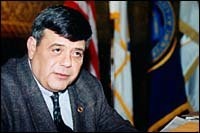
1. Providence Mayor Vincent A. Cianci, Jr.
We’re guessing that the mayor of our capital city is looking forward to 2001
— or is he?
It had to be a difficult year for the man who so deeply loves Providence and is now the city’s longest running mayor.
Seifert Systems Invests in Energy Efficiency to Strengthen Operations
For manufacturers, energy is more than just another operating expense. It plays a critical role…
Learn More
It was, after all, the year of Plunder Dome. Federal Bureau of Investigation officials spent much of the year in City Hall, pouring over tax records — ultimately handing over indictments to several low-level members of the Cianci administration.
The heat was turned up later in the year when the FBI indicted Cianci’s former
chief of staff, Frank Corrente. Corrente has yet to go to trial, an event that
surely has the potential to be the story of 2001 — and perhaps bring Plunder
Dome to some sort of conclusion.
For his part, Cianci has consistently denied any wrongdoing with regards to the Plunder Dome investigation. He has done his best to push forward — unveiling his ambitious “New Cities” proposal, a plan to develop hundreds of acres in now desolate sections of the city. A new Public Safety Complex is also being built on the outskirts of downtown and a new Hilton Hotel is expected to break ground across from Providence Place.
Cianci has also already announced his plans to run for reelection.
But for all the silver linings, there are so many clouds swirling around the capital city. The turmoil at City Hall has also spread to the police department.
2. Alan Hassenfeld
The top executive at Hasbro, Rhode Island’s beloved toy maker will be watched closely in the coming year. As 2000 drew to a close, the news out of the Pawtucket-based company was of lower than expected earnings, layoffs, cutbacks – an online division gone sour. The company’s stock price suffered. The early word has been that Rhode Island operations will be hurt only slightly, or will actually benefit when changes at Hasbro play out. But the company’s Rhode Island operations have been reduced dramatically through recent years. Like so many manufacturers, it employs far fewer Rhode Islanders than it did in its heyday.
In a slower economy, with consumer confidence down, Hasbro may face a tougher climb to regain its once lofty stature. Hassenfeld, no doubt, will make some key and difficult decisions in 2001 — dictating where Hasbro stands and how important Rhode Island remains to the company.
3. Gov. Lincoln Almond
Will this be the year that the governor gets the green light for the container port at Quonset Point/Davisville?
Almond sees the development of a container port at the former U.S. Navy base as a critical economic development initiative.
The state is currently in the middle of yet another feasibility study regarding
the proposal – one that Almond hopes will put to rest any lingering environmental
questions. But those environmental questions — as well as concerns from residents
of North Kingstown are real and have slowed progress on the port proposal. Almond
will be challenged in 2001 to reach some sort of real accord with those who oppose
plans for the container port.
Almond scored high marks early in the year when he appointed Thomas Schumpert to replace John Swen at the Rhode Island Economic Development Corporation. The governor also enjoyed several other economic initiatives, including significant expansions by the likes of CVS, Fidelity and Cox Communications.
But the state’s business climate remains difficult, with higher energy costs and high taxes, and rumblings of a federal tax cut could mean more problems because of our piggy back income tax.
PROSPECTS: With only two years left on his term, Almond will be expected to demonstrate some of the toughest leadership of his tenure, especially with a downturn in the economy and challenges to the state’s tax revenues. Quonset Point, educational reform, the environment, container point, all our quality of life issues, airport expansion are but a few of the issues where the governor will be called upon to demonstrate his leadership and ability to bring about consensus among several constituencies.
4. Ronald V. Gallo
The president and CEO of the philanthropic Rhode Island Foundation made much
news in 2000 –and his organization appears poised to be a major player in economic
development projects in 2001.
In 2000, the Rhode Island Foundation purchased $2 million in stock in Neighborhood
Health Plan of Rhode Island — planning to convert the for-profit operation to
a non-profit corporation controlled by the community health centers of Rhode Island.
With an endowment of $400 million, the foundation is expected to increase its
investments in the community. That was apparent late in 2000, when it unveiled
a $10 million assistance package to DownCity Providence that will be managed by
a new nonprofit organization called DownCity Partnership, Inc. The package includes
a $9 million revolving loan fund at market rates for future development in the
downtown’s old core.
PROSPECTS: Depending upon how well the foundation’s investments do in a slower market, will determine how much resources the foundation has available for a variety of projects, from continuation of technology education and arts programs, to continued downtown development.
5. Senate Majority Leader William V. Irons
Bill Irons pulled off a coup in 2000 — unseating his former ally, Paul Kelly,
as leader of the Rhode Island Senate. Now, Irons must deliver on his promise of
open government and a proactive approach to economic development initiatives.
Thus far, business leaders have given Irons, a long-time insurance professional,
high marks for pushing pro-business initiatives. He supports a port at Quonset
Point and efforts to restructure Rhode Island’s antiquated tax system.
During the 2000 legislative session, Irons supported a proposal that would have provided tax benefits for the state’s wealthier business leaders – a proposal that never made it to a full vote. Tax breaks for the wealthy is an issue that has drawn strident opposition from advocates for the poor.
But proponents counter that by allowing for such benefits, companies are more likely to remain in Rhode Island and expand – creating new jobs.
“I believe that economic stagnation hurts those at the bottom most,” said Irons. “It reduces their opportunities.”
PROSPECTS: As the leader of the state Senate, Irons will be looked upon as among the most powerful statewide political figures, having the strength to help move critical issues through the legislature – or to assure that they don’t. We look to Senator Irons as a key element in assuring that the business agenda gets a fair hearing in both the senate and house.
6. Tom Schumpert
The director of the Rhode Island Economic Development Corporation won high
praise for his handling of the state’s latest health insurance crisis when he
was at the Department of Business Regulation. Specifically, his work to recover
money from Harvard Pilgrim — following the insurer’s abandonment of the Ocean
State — was lauded. Now, Schumpert appears poised to focus on the development
of a port at Quonset Point, as well as capitalizing on the growth of the telecommunications
industry here.
PROSPECTS: Schumpert has acknowledged in the past that because his is an
appointed post, his days are essentially numbered. It will be interesting to note
his progress in the year ahead — and perhaps to project where he could emerge
in the not-to-distant future.
7. Donna Cupelo
With all the talk — and action — surrounding fiber optics and broadband
cables, it makes sense in the coming year to keep a close eye on the president
and chief executive officer of Verizon’s Rhode Island operation.
Cupelo appears to be a rising star within the former Bell Atlantic hierarchy, having served from 1995 to 1997 as vice president and general manager of NYNEX’s central and western Massachusetts business unit.
PROSPECTS: Cupelo herself sees her industry changing faster than a proverbial speeding bullet. What we think about today, will be even faster. Verizon, and its various previous incarnations, has always been a major player here.
8. Slater Center Directors
No where is the potential for innovation, for job creation, more apparent than in Rhode Island’s Slater Centers of Excellence.
In 1997, the Rhode Island General Assembly established the Samuel Slater Technology Fund. The idea was to support technology commercialization and industry cluster development. In each of the program’s first two years, the legislature appropriated $3 million, of which $1 million each year was specifically set aside to fund “Research Centers for Excellence.” The Rhode Island Center for Cellular Medicine in affiliation with Brown University and Lifespan; and the Ocean Technology Center, in affiliation with the University of Rhode Island, were the first centers to go on online. And as a result, several companies have blossomed.
Four more Centers of Excellence have followed, including the Center for Biotechnology and a Center for Sensors and Surface Technology at the University of Rhode Island; a Center for Design Research at the Rhode Island School of Design; and a Center for Computer Graphics at Brown University and the Fraunhofer Institute.
PROSPECTS: For the continued development of new businesses from the various centers, for greater attraction of venture capital funds to the new projects.
9. Gary Sasse
The executive director of the Rhode Island Public Expenditures Council, a non-profit agency that closely follows the ins and outs of the state’s economy, could play an especially critical role in 2001. Sasse and RIPEC believe there may be no better time than the present for the state to get off the “piggyback tax,” the antiquated approach that puts Rhode Island at the whim of the federal government. Sasse has long argued about the need for a restructured tax system and with people like Irons seemingly in agreement, this may be the year to examine other possibilities.
PROSPECTS: RIPEC will lead the charge not only when it comes to piggyback tax reform, but in reform of a number of critical tax and spend issues, including property and corporate tax reform. Sasse is well respected in the business community and throughout state government, and in such a critical year becomes an invaluable resource as the state struggles to continue to grow as the national economy continues to slow.
10. George Vecchione
The president and CEO of Lifespan, the state’s largest health care network,
is clearly one to watch in 2001. Earlier in 2000, the proposed merger of Lifespan
and Care New England was pulled off the table – and later, we learned that both
the Visiting Nurses Association and Hospice Care of Rhode Island are looking to
rework their respective arguments with Lifespan, ostensibly in an effort to break
any formal partnership. So where does that leave us in terms of health care? Are
larger, merged entities with consolidated services the way to go – or can independent
operations survive in an age when federal programs are so routinely cut? Vecchione
talks of improved finances at Lifespan. It will be interesting to see if his projections
hold true and where he takes Lifespan from here.
PROSPECTS: Vecchione will not only be challenged to keep the Lifespan System in tact and growing, but also to address continuing labor problems within the system, and deficits within its hospitals.
Honorable Mention
As is the case each year, several folks were considered for the Top Ten, but missed the cut. That doesn’t mean they aren’t worth watching closely in 2001. Among them are Christopher (Kip) Bergstrom at the Rhode Island Economic Policy Council; Rhode Island’s entire Congressional delegation; Ruth Simmons, the incoming president at Brown University; Michael Cheston, the incoming director of Rhode Island’s airports; Ron Machtley, president of Bryant College; Former Providence Mayor Joseph Paolino, Jr., who owns several buildings and parcels of land downtown; Philanthropist and developer Arnold Chace, Ron Battista at Blue Cross Blue Shield of Rhode Island, and the Providence Performing Arts Center marquee.