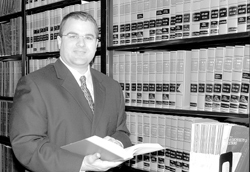
Attorney highlights firm’s local community work
Brian J. Lamoureux
Beyond Cash Donations: How New Forms of Giving Are Transforming Not-for-Profit Accounting
Evolving Funding Landscape for Not-for-Profits Not-for-profit organizations are being asked to do more with less,…
Learn More
Position: Associate attorney, Brown Rudnick Berlack Israels
LLP of Providence
Background: Lamoureux joined Brown Rudnick five years ago. His practice
generally focuses on commercial, telecommunications, zoning, bankruptcy matters,
surety and bonds, and employment/labor litigation. He serves on the Brown University/Fox
Point Early Education Center board of directors, and is actively involved in
other community service efforts.
Education: Law degree from Syracuse University (1999); two master’s
degrees, one from University of Rhode Island (1996) and the other from Syracuse
University (1999); and a bachelor’s degree from Providence College (1994).
Residence: West Warwick
Age: 31
The Rhode Island Bar Association is currently recruiting lawyers and firms for public service work in the state. The R.I. Bar Association does not require public service, but there are about 1,500 Rhode Island attorneys that volunteer for pro bono and other public service legal work through the bar association’s program, Bar Association Director of Public Service Susan Fontaine said.
As the bar association launches its public service recruitment effort, PBN is spotlighting Lamoureux as an example of a lawyer making a difference in the community.
Lamoureux is active in the Brown Rudnick Center for the Public Interest, which celebrated its three-year anniversary on April 24. The center encompasses all of the firm’s pro bono legal work, charitable giving, community involvement and public interest efforts.
The Brown Rudnick Charitable Foundation recently awarded $151,000 in Relationship Grants to eight nonprofit, inner-city education organizations in Boston, Hartford, New York City and Providence, including a partnership with a Reach Out and Read program, which gives books to children in need. In Providence, the Plan/Ready to Learn Providence was given a grant for creation of two new HeadsUp! professional development courses for child-care providers and educators.
Q. Why did the firm start the Center for the Public Interest?
A. In 2000, the firm established a foundation with the goal in mind to provide all sorts of community service, pro bono and other types of services. In 2001, the firm formed the Brown Rudnick Center for the Public Interest, it’s really an umbrella in which all the firm’s community service work – pro bono, charitable giving, all of that stuff – is coordinated on behalf of the foundation. Around that time, the spring of 2001, each office had focus groups deciding which areas we want to focus on, and inner-city education was our focus. We thought, what better way to make a grand impact on the community than getting to them while they’re young. So we provide assistance to inner-city children on all sorts of levels – social and educational – and I guess a good example of that is Reach Out and Read, which is a local and national outreach organization that provides books for children. We are involved with the McMichael (child education) Center where we read to kids, and we provide financial support. It’s great for people like us to be able to get out of here, to put the pens down and shut the computers off, and have that type of interaction.
We give grants to these types of organizations. It is something I got involved in three years ago, which is how I met Brown Fox Point, an accredited early childhood education center whose primary mission is to provide a culturally and economically diverse learning environment.
Q. How did the firm begin a relationship with Brown Fox Point?
A. When we launched the center in 2001, we had a call to action day, where folks in our office went out into the community and performed community service. Through an existing relationship one of our paralegals had with Brown Fox Point, about six or seven of us went over there and volunteered to do spring cleaning. I cleaned garbage cans, I raked up playgrounds, straightened up books, put away toys. We did a whole bunch of activities that just needed to be done – and that they greatly appreciated. Then it just so happened that they had an opening on their board, and I was asked to be on the board of directors. It’s a fantastic experience for me to go from arguing a case in the 1st Circuit Court of Appeals up in Boston in the morning, and then go to the East Side and walk amongst children up to my waist, and be able to make decisions that impact their lives and to try to help them.
Q. How have you helped Brown Fox Point?
A. I think having my legal experience on the board. Though I don’t have any children, the board believed it was important to have someone with a legal perspective when the board makes decisions. I provide pro bono work to the board and the school – and the reason I am able to do that is because Brown Rudnick not only allows us to do that, they encourage and reward their attorneys who do pro bono work. It is only because of that environment that I am able to do that.
Q. The firm requires pro bono hours?
A. We are committed to doing 50 hours a year, but we have contributed $6 million in free legal work through the center. In addition to the billable work I’m expected to do, the firm expects me to do good things for the community.
Q. How does the firm decide who to give free legal services to?
A. We evaluate each client on a case-by-case basis. Most of our clients are either indigent individuals who just can’t afford a lawyer, or nonprofit organizations, charitable organizations.
Q. A law firm does not have to do any community work, so why does Brown Rudnick dedicate time to that? What does the firm get out of the community work it does?
A. I knew you were going to ask that. I’ll give you my answer, and then the firm’s answer, though I believe they are one in the same. I focus so much of my day on solving problems for people who pay me, or pay our firm. I feel that because of that, there are so many people who need our skills and expertise, and can’t afford it. From a moral perspective, it is our obligation to use those skills. I, and the firm, also realize that we are very fortunate to have the skills that we have, and the resources we have, and it would be an absolute shame not to reach out to the communities that support us and give us the opportunity to work where we do. I can’t stress enough – the thrust to do community work comes from the firm. There is an amazingly nurturing environment for it, and a substantial feeling of, you need to give back, even though you are serving our clients, you need to give back. It’s at a point where it isn’t even discussed, because it’s so ingrained in the infrastructure in the firm.
Q. The community work also lends the firm a good image.
A. Of course. There is always a beneficial effect of doing good, but the motivation goes much deeper than us just hoping that our name gets out there because of it.
Q. Since the foundation developed, has the firm been inundated with organizations that need assistance?
A. We have awarded about $500,000 in grants since the foundation started. We have the Insight Foresight program, where the firm awards monthly grants to entities that need them for certain items. For example, Brown Fox Point received the first one of $2,000 to purchase supplies and a learning table. We have provided grants in similar amounts about every month for different organizations that need things like computers and supplies. You can’t imagine how far $2,000 goes in some of these organizations. The recipients usually have some relationship with someone at our firm, so we aren’t just giving out money, we are also fostering those relationships.
I can’t stress enough how easy it is for us to be involved with the community in this firm. You would think in a prestigious, international law firm, there would be little attention paid to these things. After being here for five years, this concept of the community involvement is so ingrained that it’s just a given that people here will be involved.