complex.
What makes Quonset/Davisville look so good as a potential feeder port?
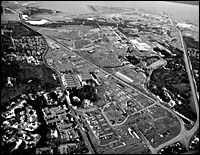
According to William E. Ellis, program manager for port development at the Port Authority of New York and New Jersey, the former Navy bases in North Kingstown have three important qualities – a 3,000-acre commerce park, access to the large New England market, and room for future growth.
That’s why the Port Authority of New York and New Jersey is looking to make Quonset Point/Davisville part of its Port Inland Distribution Network, a plan that would link ports in New York, New Jersey, Connecticut and Rhode Island via waterways.
Beyond Cash Donations: How New Forms of Giving Are Transforming Not-for-Profit Accounting
Evolving Funding Landscape for Not-for-Profits Not-for-profit organizations are being asked to do more with less,…
Learn More
"This is definitely an economic development opportunity," Ellis said. "(Quonset Point/Davisville) is good because it already has the infrastructure in place."
The idea, controversially tossed between the Rhode Island Economic Development Corporation board of directors and board members for the Quonset/Davisville Management Corporation, is being touted by port authority officials as a way to reduce both truck traffic and pollution along Interstate 95.
"The roads are getting more congested and it’s getting harder to move things," Ellis said. "This is a future strategy, a more viable option that takes boxes that currently go by truck up I-95 off the road. It’s a method that reduces the environmental pollution and the congestion."
Ellis said it is also a good economic development decision.
"The feeder port brings economic benefits by way of local jobs," he said. "There are warehouse workers, dock workers, and other jobs without serious environmental impacts."
The idea, however, hasn’t fully been accepted by the region’s shipping community.
"This isn’t something that is going to be instantly successful overnight," Ellis said. "Gradually I think that people will take advantage of it. Volume is needed, because a truck needs only one container to be competitive, but a barge needs many boxes. We have that volume so in my opinion it’s only a matter of time."
The idea also isn’t being fully embraced by many in Rhode Island’s environmental community, who instead see the proposal as a scaled down version of the state’s previous recommendation for a deep-water container port at the site – an accusation EDC officials adamantly deny.
"This is not a scaled-down version of a container port in any way, shape or form," said EDC spokesperson Clare Eckert. "There is no dredging that needs to be done if this comes to pass because barge vessels would bring the cargo, not larger vessels. That’s one of many reasons why the two are so different."
Still, Ellis said, while the proposed port is intended to be only a stop on the feeder network it doesn’t preclude the possibility that ships would want to call there in the future.
"I don’t see this as a baby step," he said. "But I can’t say that at some point something larger might make sense. In my opinion, that is pretty far down the road, which is good because for us it would be competition."
Environmental groups, like Save The Bay, are concerned about the impact of more than 100,000 containers being barged into Quonset and then "trucked" out using roadways that run through the local communities, which would come with the smaller feeder port proposal.
"The resulting traffic and air pollution impacts must be evaluated and clearly communicated to the public," said Christopher Hamblett, director of advocacy for Save The Bay.
Only two weeks into the "discovery process," Eckert was reluctant to discuss specifics of the proposal including container storage, transportation and costs associated with the project.
"Right now we are in the gathering stage. To get into specifics right now is premature," she said. "New York may have the answers, but we don’t have them yet."
The PANYNJ has in fact been studying the issue for more than a decade. According to Ellis, the organization has spent years preparing for the switch to barge traffic by deepening their channels, investing in its terminals, and creating the plans for the Port Inland Distribution Network.
He said the plan is a direct response to consumer demand.
"It’s the consumers that are driving this growth, not the shipping community," he said. "The folks in Rhode Island, and Massachusetts are using roadways in New York, New Jersey and Connecticut to get their goods. This is not us shifting our problems up to Rhode Island. Their problems have been our problems for some time."