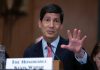
Kenneth K. Wong
POSITION: Director, Urban Education Policy (UEP) program, in the education department at Brown University, where he is the Walter and Leonore Annenberg Professor in Education Policy.
Rhode Island's Market Has Changed. Developers, Builders, Investors and Sellers Must Change With It.
By Emilio DiSpirito IV License Partner | Engel & Völkers Oceanside Leader | The DiSpirito…
Learn More
BACKGROUND: Kenneth K. Wong came to Brown University last year, bringing more than two decades’ experience and a national reputation. At Vanderbilt University, where he had worked since 2001, he founded the National Research Center on School Choice, Competition and Student Achievement in 2004. From 1988 to 2001, he served on the education faculty at the University of Chicago, and from 1984 to 1988, he in the political science department at the University of Oregon. Wong has written two education policy books, co-authored a third, and edited others – and, since 2003, has co-edited the journal Education Evaluation and Policy Analysis.
EDUCATION: B.A. in political science, 1979; M.A. in political science, 1980; and Ph.D. in political science, 1983, all from the University of Chicago.
RESIDENCE: Providence
AGE: 51
For more than 20 years, Kenneth K. Wong has focused on urban education, conducting research on the politics of education, federalism, policy innovation, accountability, governance, reform efforts, charter schools, finance and other issues.
Now, as director of a new master’s program at Brown University, Wong has brought his expertise to Rhode Island. The 12-month program, which aims to ready students for careers in policy development and analysis in urban public education, started this fall with eight students.
PBN: What led to your interest in education?
WONG: I have always been interested in equal educational opportunity. That’s why my dissertation was on Title I schools and the implementation and effectiveness of Title I schools. I started out visiting some fairly challenging inner-city neighborhoods and trying to understand how schools function in those neighborhoods. Education allowed me to test out different ideas and hypotheses, because there is so much variation. I liked to connect the variation with the way they implement education reform to the larger political context.
PBN: Why do you think urban schools are functioning at a lower level than suburban schools?
WONG: One is that there’s a certain degree of self-selection going on, social and economic stratification. Residential choices often create a concentration of poverty and racial segregation in urban systems throughout the country.
At the same time, I think for too long the school systems, particularly urban school systems, have been insulated from the municipal government system. … They’ve created their own culture; they keep track of what they are doing. So there’s a lack of close connections with the general public. There are, right now, about 12 or 14 urban school systems that are changing that – Boston is one, and Providence is another. The mayors are actually getting more engaged and trying to make sure that the school system will be a part of this larger community context. So that whatever the school district is doing then, it will get validated and supported and double-checked ….
The third reason, I think, is that in urban education, we serve a disproportionate percentage of the at-risk population, and politically speaking, the disenfranchisement … is well documented in lower voter turnout.
PBN: Can you tell me about the new master’s program and how it aims to work on these problems?
WONG: This program is Brown’s statement of its commitment to be a part of this discussion of urban school improvement. I think [it] will fill a national gap, in terms of providing the next generation of policy analysts who will have the capacity and knowledge and skills in analyzing data and information, and at the same time be very sensitive to the urban context. So what we have is the marriage of research and policy and practice.
PBN: How does that play out in the curriculum?
WONG: The expectation is that through this program, [students] will be exposed to not only field-based knowledge – how does an urban system work, what is the urban context, what is the relationship between poverty and learning – but we also want to empower them with the analytical skills. They are taking classes on research design – that is, how do we know [that] what we are studying is the right way to collect information, what is the validity of that information, and how can we run … make sure that the information we collect is accurate. They are also learning the economics of education, because we feel that they need to use multiple lenses to really analyze education policy.
My hope is that we will have UEP graduates doing exciting leadership work.
PBN: What are some solutions?
WONG: We should not lower the expectations. We need to clarify the academic goals and make them into a measurable set of goals. Often, districts have very ambitious goals, but they are not developed into ways that they can be measurable.
Another challenge is the peer pressure, because there is research that shows if you are doing well, you will lose the popularity contest, particularly in the high schools and particularly among girls. But there are ways the school can create a support network. They could create more opportunities for academic fairs or even cross-school and cross-district collaborative work. You can … soften the dominant peer culture and make it more diverse.
PBN: What about leadership?
WONG: [One approach is to] think of the principal as the CEO of the building. The principal would be asked, at times, to show that they are making progress on an ongoing basis. …
The other way I look at improving the system is to play a proactive role. Instead of just requiring schools to comply with all of the mandates, let’s think about school-improvement teams. Let’s pool resources.