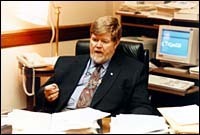
of East Greenwich. (PBN file
photo)
Ten years have passed since Rhode Island last drew its district lines, and as
the state legislature sits poised to embark on the process once again, it also
faces the challenge of shrinking its size.
It’s expected that 25 legislators could be eliminated in the downsizing, while still others face elimination as a result of the redistricting effort. The combination is one that has one local watchdog group closely monitoring the measure, and state legislators trying to keep the process as open as possible.
Seifert Systems Invests in Energy Efficiency to Strengthen Operations
For manufacturers, energy is more than just another operating expense. It plays a critical role…
Learn More
“This is an incredibly difficult process,” said Sen. J. Michael Lenihan, D- East Greenwich, Warwick, Exeter, North Kingstown). “There is no way to get through this process, even with the best of intentions, without causing pain to somebody.”
J. Phillip West, executive director of Common Cause Rhode Island, and secretary of the Fair Redistricting Coalition, a group composed of civil rights, government watchdogs, and religious groups, that is observing the redistricting process very closely, agreed the process is a difficult one. In fact, he said, the coalition is using the acronym DOS to describe what it things are the important aspects – Diversity, Openness, and Standards.
“The situation has become volatile because there is so much as stake,” he said. “It has made many fearful of crossing the leadership and adds another element of violability to what is already a high stakes game.”
With the Senate Judiciary Committee unanimously approving the creation of Reapportionment Committee last Tuesday evening (June 19), the focus has shifted to redistricting. The commission will have a total of 16 members — 10 members coming directly from the House and Senate and the other six being appointed by the legislative leadership.
The Coalition for Fair Redistricting would like the new lines to be drawn as close to municipal boundaries as possible – something Lenihan said just isn’t possible in all areas. In fact, Lenihan himself represents a district that spans four communities.
“There will definitely be a crossover,” he said. “One senator will represent 27,600 people and I think a lot of our towns in the state don’t have that population. Therefore they have to be combined.”
Another concern is that the new districts represent the changing demographics of the state. Earlier this year the U.S. Supreme Court ruled in a North Carolina redistricting case that legislators could take race into account during the redistricting process as long as it was not the predominant factor.
“Minorities have historically suffered in the redistricting process,” West said. “In Providence districts have been stretched outside of the city and it is my belief that if they had not been stretched it would make it likely that a Latino person would be elected. It’s not just a minority issue, but that is a concern.” The reapportionment bill, introduced by Senate Majority Leader William V. Irons, D-East Providence/Pawtucket was also amended prior to its passage to allow more public involvement. Added were additional public hearings across the state and the use of technical software, that will let members of the public literally draw where they think the lines should be.
“I think that this provision sends a clear signal,” said Angel Taveras, head of the Fair Redistricting Coalition. “Having the software available to the public sends a clear signal that the General Assembly is very, very, serious about including the public.”
Still, members of the coalition, along with some senators are concerned that the bill is too vague. Modeled after a similar bill passed for the last redistricting effort a decade ago, the new bill doesn’t specifically identify standards that the reapportionment commission must follow.
“I think the devil is definitely in the details,” West said. “The leadership is clearly committed to a more open process, but the question is what kind of standards will they accept.”
Lenihan, who also proposed legislation regarding the reapportionment committee, said though his bill is similar to Irons’ it includes more specific references to courts cases, and general law.
“If you look at the two bills you will find no conflict between them, except that the bill I have is more specific,” he said. “The more references to statute the more likely that the results can be appealed. That’s important.”
And while some parts of Lenihan’s bill were included in the passage of the Irons’ bill, specific standards were not.
“I don’t think the policy should be set by us,” said Sen. Joseph A. Montalbano, D- North Providence and Pawtucket, at a recent Senate Judiciary Committee hearing. “Not including a policy doesn’t preclude the commission from following previous standards. It just lets them decide.”
Montalbano, who served as vice chair of the last redistricting commission 10 years ago, said his intention is not to limit how the process is done, but instead to give the commission more freedom.
“The committee will include not only experts in the fields, but it will have its own attorney who will advise,” he said. “If someone feels there is a violation, certainly that will be addressed, but I don’t think we should be setting policy.”
The most important thing, all agree, is that the public be involved in the process.
“It’s absolutely critical that the general public understand what is being done and how it’s being done, even if they aren’t happy with the results,” Lenihan said.