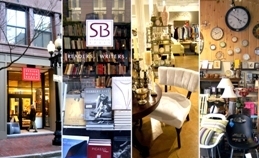
Shop in downtown Providence today, and you can browse through a large collection of hard-to-find books, take your pick of blue, pink, silver and blond wigs at a specialty store, or shop for upscale home furnishings – all without leaving Westminster Street.
After three decades of decline, the retail market in downtown Providence is turning around, and it’s attracting a wide array of merchants.
“The trends are looking really positive right now,” said Ari Heckman, director of marketing and retail leasing at Cornish Associates LP, which owns 50,000 square feet of retail space downtown. “We have a mix of specialty retail, there’s a home furnishings cluster, and this year, we’re adding four high-end clothing stores.”
Rhode Island's Market Has Changed. Developers, Builders, Investors and Sellers Must Change With It.
By Emilio DiSpirito IV License Partner | Engel & Völkers Oceanside Leader | The DiSpirito…
Learn More
The home furnishings cluster – which includes Design Within Reach, Butterfield and Bowl & Board, all on Westminster Street – is “a big segment of retail right now,” Heckman said. “Once Design Within Reach decided to come downtown, it spurred activity, and with the residential projects, it makes sense.”
The new wave now, Heckman said, is specialty apparel. American Apparel opened last fall on Weybosset Street, Queen of Hearts is slated to open this week on Westminster, and Clover is due to open next month.
“Clover carries designers that are up-and-coming, that only a few stores in New York and a few stores in Boston carry, so it signifies this higher fashion coming to Providence,” Heckman said. “And Queen of Hearts is a small boutique being opened by two local Providence designers. It’s another example of our local design community rallying downtown.”
Providence once had a vibrant downtown retail district, anchored by The Arcade and big department stores such as Shepard’s, now occupied by the University of Rhode Island; and The Outlet, home until recently to Lupo’s Heartbreak Hotel, and soon to become condos.
As the city fell on hard times, however, and the big suburban shopping centers opened, most of the downtown retailers shut down. Vacant storefronts became ubiquitous. Of the retailers who remained, many catered to a lower-income clientele.
Then, in 2003, Cornish Associates refurbished the Alice Building, attracting three retail tenants for the ground floor that began to change the climate downtown: Symposium Books, tazza and Design Within Reach. That, Heckman said, was the beginning of the turnabout.
“The vacancy rates have been going down and down and down,” he said. “With more people moving in every day, the opportunity grows greater by the day.”
Figures from the Providence Foundation show that while in 2003, about 28.4 percent of the city’s total retail space was vacant – about 130,000 square feet – by 2005, the available space had dropped to about 67,000 square feet, or 14.6 percent, and this year it’s down to 66,000 square feet, or 14.4 percent. (By comparison, the National Association of Realtors last month predicted the nationwide fourth-quarter retail vacancy rate would be about 8.1 percent.)
Several obstacles have hindered the resurgence of retail in downtown Providence, business and real estate owners in the area say – most notably, the shortage of parking, the lack of customer spillover from the mall and the “seediness” of certain areas.
Retailers on and near Washington Street said the presence of drunken and disorderly people who loiter in the area is a problem for them.
“I wonder if our customers are scared to come in,” said Michael Sypniewski, co-owner of Worn Again Vintage on Washington Street.
The situation has worsened since a bus stop was set up just across the street, Sypniewski said. People drink, sleep and urinate at the bus stop, he said, and those same people drift over to his store.
“I’ve had to wake people up and ask them not to sleep in front of my store,” he said.
Michael Chandley, owner of Cellar Stories, a 25-year-old used bookstore on Mathewson Street, off Washington, said the area has gotten better in recent years but it still needs some cleaning up.
“I think that it’s an evolution issue,” said Heckman, of Cornish Associates. “It’s a matter of time before the more seedy operations – the strip clubs, the spas and some of the lesser bars – get pushed out.”
Sypniewski said he believes the new residential developments will do the pushing, especially on Washington Street. Specifically, he mentioned the Dreyfus Hotel, AS220’s residential project, which will include a restaurant and will be located next to the troublesome bus stop.
Heckman said adjustments to the bus system also could help. “I think they should consider other ways to not have all the traffic come into downtown,” he said.
Parking is another concern for many downtown merchants, though not everyone agrees it’s an issue.
Michael Morrace, an employee at New Image, a 19-year-old clothing store on Westminster Street, said the downtown needs more parking lots, “so people could come and not be afraid of getting a ticket.”
But Joseph R. Paolino Jr., of Paolino Properties, a major downtown landlord, contends that parking isn’t as big an issue as it’s made out to be.
“I think there’s an illusion of a parking problem because anytime people have to pay, they get angry about it,” he said. “Unless you give someone free parking in front of their door, they’re never going to be happy.”
Heckman agreed. “Our tenants have succeeded because, if people want to come and shop, they will find a way.”
Providence Place, whose advocates in the 1990s said the mall would bring people to the city and have a positive effect on downtown retail, is widely viewed as having had a negative impact.
“The mall took shoppers,” Cellar Stories’ Chandley said. “It hasn’t been an aid to downtown.”
But Heckman said the mall’s impact wasn’t all negative.
“I think that in the short term it may have made the job more difficult, to populate downtown with retail,” he said. “At the same time, it renewed people’s confidence in downtown. It showed that you could be a successful retailer here.”
The solution, he said, is to find a way to link the two.
“I think we – downtown and the mall – need to do a better job of connecting the two areas so people can go back and forth easily,” Heckman said. “Ultimately, I think it needs to be a citywide effort.”
Yet the downtown is also starting to gain its own appeal, Heckman added – as evidenced by the influx of higher-end retailers, such as Clover and Queen of Hearts.
“The reason they’ve decided to come here instead of the mall is, they understand their customers want to spend time among local architecture and among the restaurants,” Heckman said. “They want the more urban experience that they have been able to get in Boston and New York, but have not been able to get in Providence.”