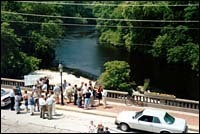
for budget announcements on a
Pawtuxet River bridge.
For the first time since its founding a dozen years ago, the all-volunteer Rhode Island Rivers Council has found its way into the state budget and gained support for its effort to promote the state’s 18 watershed areas.
That awareness, officials hopes, will help them continue anti-pollution efforts, stimulate recreational activity along the rivers, and spark economic development.
Seifert Systems Invests in Energy Efficiency to Strengthen Operations
For manufacturers, energy is more than just another operating expense. It plays a critical role…
Learn More
Standing on the Pawtuxet Bridge, overlooking the waterfall that separate the cities of Warwick and Cranston, the rivers council members joined local watershed representatives to announce the receipt of nearly $52,000 from the state in the 2001-2002 budget. The announcement came as the group officially designated three new watershed areas.
Mike Cassidy, chair of the Rhode Island Rivers Council, said the group will use the money to help the state’s 18 watersheds and raise awareness of the state’s rivers.
Established by the Rhode Island General Assembly in 1991, the group has received minimal funding in the past, but has still been able to establish a Rivers Policy and Classification Plan and then use that plan to officially designate local watershed areas.
Three new watersheds – the Pawtuxet River Authority, the Kickemuit River Council, and the Woonasquatucket River Watershed Council- were awarded official designation at the ceremony held Friday, June 15.
“We are thrilled,” said Cassidy of the funding. “While we have been able to develop plans for out state rivers, we wanted to give the groups the finances and resources to move forward with those plans. We are finally able to do that after 12 years.”
Two other watersheds – the Saugatucket River Authority, and the Wood-Pawcatuck Watershed Association have already received designation. The watershed councils are charged by the Rivers Council to carry out state policies to improve, protect and preserve rivers and their watersheds for the environmental economic and social health of the communities they serve.
“At the most basic level, watershed councils are serving a critical need because these groups, made up largely of volunteers who deeply care about the land and water health in their communities and in Rhode Island are our main actors for implementing watershed restoration,” Cassidy said.
To receive recognition as a watershed by the Rivers Council, groups must: advocate for the entire river and its associated watershed; promote public education; maintain a strategy for participation in public policy deliberations affecting the watershed; include a representative from each of the communities within the watershed area in its council, be incorporated or chartered.
“It’s because of these groups that amazing things are happening on the state’s rivers,” said Scott Millar, administer of the Office of Sustainable Watersheds, at the Rhode Island Department of Environmental Management. “They are bringing attention to the river and its watershed, and stimulating even more economic development around the river. They are re-connecting people to the rivers that run through their communities.”
According to many of those involved, the new funding will go a long way in accomplishing the goals of individual watersheds, as well as the Rivers Council as a whole.
“All of these watersheds are currently struggling, most of them having only part-time help,” Millar said. “This will help them in building their capacity, and continuing to develop and implement plans to further promote the state’s rivers.”
Cassidy agreed.
“While we have been able to develop and in some ways implement plans, we wanted to give these groups more opportunity,” he said. “Financing definitely helps.”
According to Guy Lefebvre, executive director of the Pawtuxet River Authority, the Rhode Island Rivers Council could see even more funding through a triple match from the University of Rhode Island.
“This could be even better than we thought,” he said.
For Lefebvre strengthening the Pawtuxet River and surrounding areas has become a labor of love.
“Between 1900 and 1930, this river was the second most canoed river in the country,” he said. “We hope to see just as many canoes on it in the future.”
And while the rivers may provide a focus for passive recreation, they also have become focal points of economic development.
“These rivers that were once used as industrial sewers have become a great asset to the communities,” said Kevin Flynn, planning director for the city of Cranston. “I feel very strongly that these urban rivers have a great potential when it comes to future development. They are a wonderful opportunity for recreation and passive enjoyment as well as having great potential for future development.”
The Rhode Island Rivers Council is expected to officially designate the Blackstone River later this year.
(Photo, Brian McDonald)