PROVIDENCE – A major clinical trial led by a Brown University neurologist has found that robotic aids and therapy with specially trained personnel can give stroke patients a small but meaningful gain in limb movement, even several years after the stroke.
The study, published online in the New England Journal of Medicine, builds on recent research that has defied the long-held view that stroke survivors, who typically get rehabilitation therapy only for about six months, won’t get any better after that.
Stroke patients with disabled arms who got 12 weeks of therapy with a robot called the MIT-Manus had higher quality-of-life and arm function measures, and they not only did better at tasks such as eating with a fork and knife or tying their shoes, but also at walking, climbing stairs and other physical activities, the study found.
“There are about 6.4 million stroke patients in the U.S. with chronic deficits,” said Dr. Albert Lo, assistant professor of neurology at Brown, who designed the study and was the article’s lead author. “We’ve shown that with the right therapy, they can see improvements in movement, everyday function, and quality of life. This is giving stroke survivors new hope.”
The study involved a three-year randomized control trial by the U.S. Department of Veterans Affairs, with 127 veterans enrolled at VA medical centers in Baltimore; Gainesville, Florida; Seattle and West Haven, Connecticut.
All the participants had suffered a stroke at least six months earlier – on average, 4.7 years before – and had moderate to severe impairment of an arm. A third had had multiple strokes. Their average age was 65 and all but a handful were male.
The patients were divided into three groups: One worked with the MIT-Manus, designed at the Massachusetts Institute of Technology, three times a week for three months; one did similar exercises, but without the robots; and one got no therapy for the impaired limb.
The patients in the no-robot therapy group, who got substantially more intense workouts than the typical rehab – 1,024 upper-arm movements per session – also reported across-the-board progress (the control group, as predicted, made no progress), but the greatest improvements – an eight-point jump on the Stroke Impact Scale and a three-point improvement on the Fugl-Meyer Scale, which measured arm mobility – were among the robot-assisted patients.
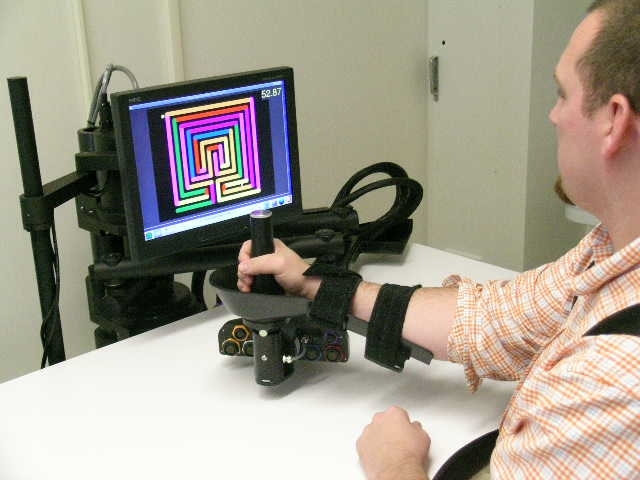
With the MIT-Manus, users sit at a table with their affected arm attached to the device, and they move a cursor on a screen and try to perform tasks with their arm. The robot senses their movements and gives them extra help if needed.
“The robots provide ‘power steering’ for the arms – just enough assistance to allow people to move,” said George Wittenberg, a neurologist at the VA and the study’s lead investigator in Baltimore.
The therapy is based on the principle of neuroplasticity – the ability of the brain to “rewire” itself to compensate for injuries to neurons responsible for a particular function. The team attributed the gains in other physical activity to patients becoming more active.
“We believe that by gaining more function and better control of their affected arms, patients were able to get out and do more, translating their motor benefits into additional meaningful social activity and participation,” said Lo, who is also a neurologist at the Providence VA Medical Center.
Stroke is the leading cause of disability in the United States. Nearly 800,000 cases are reported annually, and there are about 6.4 million stroke survivors. Each year, about 17,000 veterans are hospitalized for stroke, and three in 10 are left with severe disability.
To learn more and see a video of the MIT-Manus at work, go to the Brown Web site.