Lloyd Manufacturing.
Lloyd Manufacturing Corp.
President: Michael J. Schaltz
Location: 130 Franklin St., Warren
Beyond Cash Donations: How New Forms of Giving Are Transforming Not-for-Profit Accounting
Evolving Funding Landscape for Not-for-Profits Not-for-profit organizations are being asked to do more with less,…
Learn More
Employees: 25
Year Founded: 1938
Annual Sales: WND
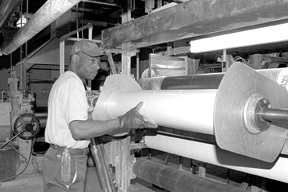
The soft, uncured rubber snaps, crackles and pops as rolling machines press out air bubbles. The thick, tar-like blob becomes thinner and thinner until long strips of flat rubber are cut and fed like uncooked pasta into a calender. The giant system of rolls thins the material again into a continuous sheet, fed onto a drum and heated until it is rubbery.
Lloyd Manufacturing Corp. has been producing custom rubber sheets for clients in many different industries for more than 60 years, and its mantra of “thin and tight” accurately describes the product and the way it’s made. For President Michael Schaltz, Lloyd’s main goal is complete customer satisfaction, and the small manufacturer is poised to accomplish exactly that.
“You very rarely find someone who asks to see a roll of your product, but the exciting thing is what the rubber does as it moves through” the process, Schaltz said. “Most of our sheeting is used as a gasket or seal or a component of a composite product, in the safety and health industries, automotive and defense, like the U.S. Navy.”
Lloyd manufactures a variety of synthetic and some natural rubber sheeting products to the specifications of the client; a die or cutting company usually cuts or prepares the sheeting for its commercial application; and the client uses the cut or prepared rubber pieces for the final application. The Warren-based company counts 3M, the Navy, Chrysler, Toyota, Honeywell, Mallory and Harley-Davidson among its clients.
“Our finished goods inventory is zero – just the way I like it,” Schaltz said.
While business isn’t always constant, clients are, he added. A small company might place an order for a certain type of rubber, but not have to order more for two years, he said. Any extra product made in the process is usually kept on stock shelves in the 100,000-square-foot facility, for when the client needs it.
“Lloyd doesn’t lose a lot of customers, but business comes and goes,” Schaltz said. He estimated that the manufacturer has 125 to150 active customers.
One element that sets Lloyd apart from larger commercial rubber manufacturers is its ability to produce thin-gauge precision tolerance rubber sheeting. For example, a commercial manufacturer might be able to produce a sheet of neoprene at a thickness gauge of 0.062 plus or minus 12.
“We run it at 0.062 plus or minus 4 or 5,” Schaltz said. Lloyd has the ability to keep the sheet more consistent with what the client needs. The lowest the company can go on thinness is 0.008; a commercial manufacturer has difficulty after a 0.062 gauge, he said.
“The more demand on the product, the better we do,” he said. Designers agonize over the gauge of each piece when there are eight or nine that go into a product, like a thermostat. If each one is off slightly, the end product will be off dramatically.
“When we have a high-performance end use, the requirement for end use custom parts goes up exponentially,” he said.
The customers get what they want, down to the color, strength, abrasion and thickness. In the case of a flapper valve, which in automobiles allows air to escape when the driver shuts the door, precision is vital.
“Our valve opens to let the air out, and it has to seat itself the right way every time. If we got the product out of spec, it wouldn’t set itself right, and we’d have an unhappy customer.”
Lloyd’s rubber sheeting is used in a variety of applications, from defense to dog brushes. The company manufactures thin sheets in which small holes are punched out – about the size a hole puncher makes – those small pieces are used as gaskets that seal a blood-testing device used by EMTs, called i-Stat.
An inhalation valve on a safety mask allows the wearer to breathe. A neck damn on an emergency mask keeps out toxins in case of a disaster. Rubber sheets added to a resin board are cut to make surge caps for electrical capacitors. There are five different rubber components used on a thermostat, and disks are cut and used as sterile seals for medical jars and specimen vials. Lloyd even makes neon fishing lures.
The process of making a sheet of rubber is much like baking a cake, Schaltz said. First polymer ingredients are added to a mixing container – the batch is much like tar. From a heating mill, the rubber is processed and put onto the calender, which sheets it out at the desired specifications and rolls it onto a drum. The drums are steam- or dry-heated to cure the rubber, and this is when the rubber takes on its designated properties.
Lloyd also supplies companies with uncured or partially cured rubber used for molding applications.
There are limitations to being a niche rubber sheet manufacturer. Schaltz said his machines couldn’t go any thicker than 0.140 gauge; some commercial manufacturers can go as thick as 3 inches. In addition, when clients request high priced polymers (components of the rubber), it becomes ineffective cost-wise to go to a specialized manufacturer, he said. Cost and equipment limitations are also a factor.
While Lloyd might have carved out a niche in Rhode Island since 1938 and amongst its competitors, the company is still impacted by industry-wide concerns. In early 2003, the company formed an alliance with J-Flex in England, to help the British distribution company expand its products.
“Am I concerned with overseas competition? Yes, because some of our customers are threatened by it,” Schaltz said. “We’re somewhat protected because of our nature, but I am afraid of European companies spreading their wings into the U.S.”
Health care, utilities and property taxes strain Lloyd just like other Rhode Island manufacturers, but Schaltz and his employees have made a commitment to constant improvement and have invested in the company.
In 2002, Lloyd had a laser gauge installed that electronically measures the entire sheet as it goes through the calender to ensure higher conformity in thickness. Schaltz also had a new engine and electric power source installed on the calender to replace the one that was original to the building.
“We try our best to keep business simple,” he said. “If we had objectives for (each aspect) of the business, it gets complex. We have specific objectives to quantify our performance toward that goal. We try not to bend the customer – they wouldn’t be here unless they had specific needs.”
Laura Ricketson can be reached via e-mail at ricketson@pbn.com.