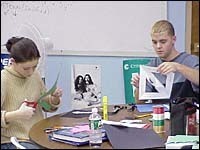
School's entrepreneurship program.
(Photo, CCRI)
The days when college graduates meander from job to job may be a convention of the past. School-to-work programs now in place at most Rhode Island high schools are trying to alleviate occupational indecision by helping students understand their career choices earlier in life.
Maryann Mitchell, a business teacher at Lincoln High School is in her fourth year of teaching a school-to-work class. She said it’s never too early to teach a person about his or her options.
Seifert Systems Invests in Energy Efficiency to Strengthen Operations
For manufacturers, energy is more than just another operating expense. It plays a critical role…
Learn More
“Everybody goes from school to work,” she said, “whether it’s from college to work or from high school to work.”
An elective class at Lincoln High School, Mitchell’s school to work class would be part of a student’s course requirement, if she had her way.
“The average person works 92,000 hours in a lifetime,” she said, “and if you’re unhappy for a good portion of those 92,000 hours, that’s a lot of frowning.”
Mitchell is one of the pioneers of school to work training in Rhode Island. In 1997, along with Robert Delaney, who was then the coordinator of entrepreneurship skills training at the Community College of Rhode Island, she implemented the course at Lincoln High School.
Delaney had had success with a similar program in Nova Scotia called Young Entrepreneurs Going Places, and when he joined the CCRI staff, the school had just received a national award to develop an entrepreneurship program. Funded through the Northern Rhode Island Business Education Alliance, the program has spread to nine area public high schools in Northern Rhode Island.
Delaney is now the development manager of workforce development at CCRI. He said school to work is not just an important program for aspiring entrepreneurs.
“The program provides students with the opportunity to make a choice to start their own business,” he said, but if they do not want to do that, “it gives them the skills that make them valuable employees, so when they enter the workforce they’re that much more ready.”
Jaime Nash is the current coordinator of entrepreneurship skills. His next step will be faxing a questionnaire to all Rhode Island high schools, encouraging them to offer entrepreneurship education if they don’t already.
“I think it’s going great,” he said of the program, “and frankly I’m a little surprised that it’s not going faster.”
In the southern part of the state, school-to-work training is approached a bit differently. Instead of having specific entrepreneurial classes, the notion of school to work is implemented into the curriculum of most required classes through teachers’ externships with area businesses and guest speakers.
Southern Rhode Island Collaborative Assistant Coordinator of School-to-Career Program Development Joseph Potenza said this has a similar positive effect on students.
“The point of asking a business person to be involved is to increase the competence of these kids who are eventually going to be knocking on your door for jobs,” he said. “The goal is a more educated citizenry and some of the tools you can use to achieve that can be found in the business community.”
School-based Coordinator for the program in Exeter, West Greenwich, North Kingstown and Coventry, Pam Betres was formerly a classroom teacher before she took this position two years ago. She said one advantage to the program is that students are no longer asking, ‘why do we need to learn this?’
“If you can help answer that question by having the students apply what they’re learning to the real world, then that’s wonderful,” she said.
Betres said the program is not robbing the students of their childhood as much as it is helping them make the most of their lives.
“I hate to say that we’re here to produce skilled workers,” she said. “We want to create well-rounded individuals who can apply what they’re learning to many aspects of their life.”
Nash agreed.
“Students are able to see what they’re capable of doing at such an early age,” he said. “It is a reality.”