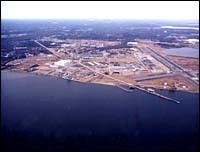
port at Quonset Point/Davisville
remains uncertain.
The controversial proposal to develop a container port at Quonset Point/Davisville has intensified in recent weeks.
Senate Majority Leader William V. Irons has written to Gov. Lincoln Almond, asking for an “upgraded and expeditious assessment of the feasibility of the container port.” In his letter, Irons expressed his support for the use of the federal “Environmental Impact Statement” process to evaluate the proposal and to make a decision on its acceptability.
Seifert Systems Invests in Energy Efficiency to Strengthen Operations
For manufacturers, energy is more than just another operating expense. It plays a critical role…
Learn More
Irons said such an evaluation should be completed by the end of June.
“As a person trained in engineering, I would never propose that a person or a company apply for a permit for an activity they are not sure they want,” said Irons. “The permitting process requires a substantial commitment of time and resources, and it should not be entered into lightly.”
Irons said the people of Rhode Island “do not need to have the port issue drag on any longer than it has.”
“I am, emphatically, not trying to slow the process down or derail it,” he said. “My commitment is to economic development. Rhode Island can no longer afford to be in last place on the East Coast in economic development. We must learn to act clearly, quickly, and prudently.”
Meanwhile, Sen. James C. Sheehan, a North Kingstown Democrat, held a rally at the State House earlier this month, protesting a container port proposal for fear of its impact on Narragansett Bay and the surrounding community.
Sheehan also criticized the Rhode Island Economic Development Corporation after reading the contents of an October white paper outlining plans for a container port. Sheehan called the white paper evidence that the governor and the EDC have long been drawing plans for a report — even while the merits of its very existence are still be debated.
Adding fuel to the controversial container port proposal was a visit last week by a consultant hired by the Town of North Kingstown and a group calling itself “Citizens for Rhode Island’s Future” to review in detail a feasibility study put together by R.K. Johns & Associates for the state.
When M. John Vickerman, founding principal of the Virginia-based TranSystems Corporation, a transportation consulting firm specializing in the planning and design of port and inter-modal facilities, reviewed “The Quonset Port Feasibility Study,” he found more questions than answers.
Vickerman, who was hired by the town of North Kingstown to review the feasibility study, said his most pressing questions after reviewing the study included the lack of commitments from shipping carriers, the fact that widespread automation and evolving technologies could reduce workforce needs, the capacity for rail to handle products and the overall reliance on advanced shipping technologies that have not necessarily been proven as feasible for a project the size of the proposed container port.
According to Vickerman’s analysis of the report; “The ability of Quonset Port to provide competitive rail service is questionable. For example, there is no discussion of what rail route would be used to serve the Midwest market and whether or not that route is capable of accommodating double-stack trains that carry containers one on top of another. This is an important issue to clarify as a means to providing service because, without double-stack clearance, the rail service will not be fully competitive with other East Coast ports which do provide this service.”
Vickerman also asserts; “The mode of operation depicted for the Quonset Port is
unique to the marine industry. The QPFS recommended automated terminal system
generally requires equipment and operations that have yet to be utilized and proven
in any North American terminal. For example, waterside rail-mounted gantry crane
moves per hour are noted by the QPFS to be between 50 and 70 moves per hour ‘at
the dock.’ Assuming this rate is for one crane, it is twice the average rate at
modern container terminals today. While it is common in our industry to market
cranes based on peak productivity rates, these rates are seldom sustained in daily
operations.”
In an interview with the Providence Business News last week, Vickerman
summed up his concerns regarding the port proposal.
“I am a little fearful of designing a port that can be all things to all people,” he said. North Kingstown Town Council President David Burnham offered the following coments:.
“We’ve objected to any large load center. We’re not no-port. We recognize that we have a port at Davisville — and we think activities there can be expanded. But we think a port should be part of the diversity of the overall Quonset Point/Davisville park — not its own monster with its own heartbeat.”