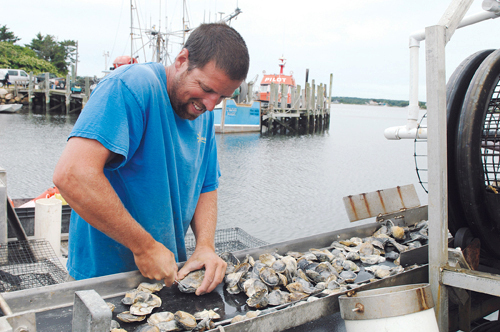
Fishing trawlers dock daily at Narragansett’s Point Judith Pond. The Block Island ferry departs year-round and recreational boaters enjoy the area protected from the Atlantic Ocean’s roaring waves. The 1,548-acre pond is also home to the largest concentration of shellfish farms, a small but rapidly growing local industry, in the state.
The potential for jockeying between oyster farmers and other potentially competing pond users has prompted the R.I. Coastal Resources Management Council (CRMC) to ponder rules that would limit the amount of shellfish farming in the state’s coastal ponds.
The council was scheduled to propose rules on Sept. 8 that would restrict aquaculture to 5 percent of each of the state’s saltwater coastal ponds. Because the state already bans fish farming, the rule would apply only to those that grow shellfish, the primary aquaculture industry in Rhode Island, or seaweed. The rule must go through a lengthy hearing process before it would take effect.
Because no pond is close to 5 percent usage, the rule would not put anyone out of business. Aquaculture in Point Judith Pond, the closest to the proposed cap, is at 2.8 percent. The limit, said a farmer who sat on the committee that proposed it, was put forward as a starting point for discussion and to placate critics who said aquaculture was expanding too fast.
“In the absence of any real data, we needed a number that we could work with to put people’s minds at ease rather than putting the whole industry on hold while we developed a number,” said Bob Rheault, a former Point Judith Pond oyster farmer who sits on the working group. (Rheault is also executive director of the East Coast Shellfish Growers Association.)
CRMC Aquaculture Coordinator David Beutel said pond users, particularly those using Point Judith Pond, noticed the aquaculture industry expanding exponentially. In 1996, there were 6 aquaculture farms in the state covering 9 acres. Today there are about 30 farms covering a total of roughly 100 acres, Beutel said. From 1996 to 2007 clam sales fell from 187,629 to 34,195, but the loss was more than offset by a surge in the production and sale of oysters. In 2007, the most recent year available, farmers sold 2.5 million oysters, up from 126,000 in 1996, according to the CRMC.
“There was a fear from a number of people that aquaculture was growing too quickly,” Beutel said.
The state responded by reinvigorating the R.I. Aquaculture Working Group. The committee of scientists, fishermen, oyster farmers and state officials came up with a 5 percent limit. Beutel stressed that the 5 percent is a cap, not a goal, and should not be interpreted to mean the state wants to see 5 percent of ponds used for aquaculture.
“It gives us all something we can work around,” Beutel said.
Rheault, who holds a doctorate in biological oceanography, said the number came after he did some “back-of-the-envelope” calculations to figure out how much aquaculture a body of water could hold without jeopardizing other wildlife.
Save The Bay South County Coast Keeper Dave Prescott said the organization considered 5 percent a good starting point but added that further research may suggest setting different caps for different ponds.
“Our biggest thing is it gives a number. It’s not going to be the end-all number but at least a number to start with,” he said.
A University of Rhode Island graduate student is working with the group to devise a model for Rhode Island waters. Rheault thinks the model paid for by the National Oceanic and Atmospheric Administration will show that ponds can actually support more than 5 percent aquaculture because shellfish generally act as natural filters, but he is making no promises.
Then, of course, there is the social aspect. Another graduate student is surveying South County property owners near ponds for their thoughts about aquaculture. There is some feeling among farmers that residents are less opposed to the idea than when Rheault first entered the business.
When Rheault proposed using 60 acres of Point Judith Pond for aquaculture in the late 1980s, people became upset, to say the least. Rheault wanted to move his oyster cages within the area every few months, keeping large swaths of water empty and available for public use.
Some locals, however, were not happy. They flooded the CRMC with more than 600 letters of objection, the town of Narragansett took an official stance against it and the U.S. Army Corps of Engineers held a packed public hearing.
“The pitchforks and the torches came out so quickly, I fell back and rewrote the application for a 2.3-acre, fixed conventional lease,” Rheault said.
The council granted Rheault and his company, Moonstone Oysters, the lease two years later on a 6-5 vote but told Rheault to return in five years for a renewal. When he did, not one person objected.
“I felt vindicated that the fears they had … were not really justified,” he said.
Dave Roebuck, owner of Salt Pond Oyster Co. in Point Judith Pond, faced similar criticism when he proposed his now 21.5-acre pond.
“Aquaculture is not new to this area but with any kind of change there’s some resistance,” he said.
“Some people who are against what I was doing originally have come up to me and said they didn’t really realize what was happening at the time but now don’t think it is a big deal,” Roebuck said.
The 5 percent rule, Roebuck said, would at least soothe waterfront owners from thinking the farms would expand indefinitely.
Another farmer said he was more worried about another rule tucked into the recommendations.
Chris Warfel of Sun Farm Oysters on Block Island is bothered by a change that would forbid the leaseholder and members of the public from harvesting shellfish not included in the farmer’s lease. Under the current rules, members of the public can enter the lease area and collect the species not on the lease, but leaseholders cannot.
Warfel said that the current system creates a mutually beneficial process. The farmer can grow his shellfish and the public can still take advantage of the area for some recreational use. If the state closes the areas to recreational use, Warfel is afraid there will be resistance to farmers continuing to use the areas.
“I think that’s problematic,” Warfel said.
Beutel said the rule was proposed to clarify who is allowed to take what. And he said it could have the side effect of keeping members of the public from inadvertently interfering with the farm. Plus, the rule would create a de facto protection area for spawning.
“It’s really, I would suspect, to the benefit of everyone,” Beutel said. •