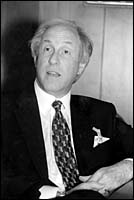
Name: John B. Day
Age: 50
Position: President and chief executive officer, Southcoast Health System
Background: Since 1996, Day has headed Southcoast Health System. Day had been president and CEO of St. Luke’s Hospital and St. Luke’s Health Care System since 1991. He joined St. Luke’s Hospital in 1978 and has served in a variety of administrative roles. He is a member of the American Hospital Association, the American College of Health Care Executives and the New Bedford Industrial Redevelopment Board.
Education: Bachelor of Arts degree in political science, Masters degrees in health-care administration and secondary education from George Washington University
Residence: Dartmouth, Mass.
Family: Married, two children
Southcoast Health System was formed in 1996 from the merger of St. Luke’s Health Care System in New Bedford, Mass., Charlton Health System in Fall River, Mass., and Tobey Health Systems in Wareham, Mass. In addition to its three community hospitals, Southcoast also includes an assisted-living facility, home health care and hospice, long-term care facilities, a wellness center and numerous outpatient medical services.
PBN: Describe how Southcoast Health System was created.
DAY: The merger was unlike many mergers that have occurred. We not only did a full asset merger of our parent corporation but we also did a full asset merger of our three hospitals. That means we have one hospital license, one board of trustees, one management team and one corporation for our three hospitals. So when our governing board makes one decision, that impacts all of us. In many other examples of mergers, each individual hospital has its own board, its own management team and duplication of services. By eliminating that and essentially going to one for everything, we have created the infrastructure, reduced our costs significantly and made it much easier to make decisions.
What progress has the system made in terms of efficiencies?
We’ve seen substantial growth in our inpatient and outpatient volume, and Southcoast has come together and formed an infrastructure that has allowed us to be very flexible and adaptable to the changing health-care environment. And by that I mean we’ve concentrated on bringing together our back-office support and consolidating it. We have one information system, one management team, and one fiscal department. By consolidating all those things, we’ve actually saved an awful lot of money. We’ve also invested heavily in new facilities, services and programs, so that I think in the end, we’ve done what we set out to do, which was make sure the needs of our communities were being met.
Southcoast was recently approved by the Massachusetts Department of Public Health to perform open-heart surgery. Will that be done at all three hospitals?
Our open-heart program will be taking place at Charlton Memorial Hospital in Fall River, but the cardiac program will actually be integrated throughout the other two hospitals as well.
Why did Southcoast apply for the license to perform open-heart surgery?
This is one of the most important things we’ve been able to bring to our communities in the last many years. The reason is that the incidence of heart disease is 25 percent greater in the South Coast region than it is in other parts of Massachusetts. It’s much higher than the national incidence of heart disease. We do not have any hospitals in our South Coast region that can provide open-heart services. So people have had to leave the community and go elsewhere for those services.
Where do they go now?
They go to Boston and some go to Providence. We actually have over 1,400 people each year leave our community to go outside the area to receive services that really should be provided locally. Nationally, 65 percent of all open-heart procedures are now done in community hospitals just like our Southcoast hospitals. So it’s now the rule as opposed to the exception. We’re hopeful, by bringing this new program to the Southcoast area with our brand new, highly trained cardiothoracic surgeons, that we’ll be able to help reduce the incidence of heart disease in our communities.
Those are surgeons recruited specifically for the new program?
Yes. They’ll be coming here in February and have actually (previously) started a community-based program just like the one we are doing here at Southcoast. We are partnering with an academic medical center in Boston, New England Medical Center. And so with their help and the help of our two cardiothoracic surgeons, we will be bringing a very high quality program to the community.
What is the financial investment in the program?
Over the next three years, we will be investing almost $9 million. But when you take a look at the fact that it is the No. 1 cause of death in our area, I think you can see that it’s an investment well worthwhile and it’s something that we should be doing.
Do you think the program is important from a reputation point of view?
There’s no question that having open heart as part of your portfolio of services is a very good thing. There are lots of additional benefits that will come with it in terms of attracting high quality staff to become part of our system.
Is Southcoast Health System profitable?
We actually had a profit this year. The last two years we actually had an operating loss, but this year we had an operating gain of approximately $10 million.
How was Southcoast able to come back from two years of losses to turn a profit?
Well, I think we’ve seen the results of the merger. By eliminating the duplication of costs that used to be at three hospitals, we’re essentially doing everything at one. As an example, we don’t have three information systems, we have one. We have only one management team. We manage by function, not by site. So if you’re responsible for a specific area within the Southcoast system, you’re responsible for that regardless of where it takes place at all of our sites, whether it’s in the hospitals or in an outpatient setting. In the first three or four years of our merger, we eliminated about $35 million worth of costs as a result of coming together.
How much has the Balanced Budget Act of 1997 cost the Southcoast Hospitals Group in terms of Medicare reimbursement?
The original Balanced Budget Act had a negative $20 million impact on the Southcoast system as a whole. But as a result of the (Balanced Budget Refinement Act of 1999) and implementation of a new outpatient reimbursement system, we currently are getting paid roughly our cost by Medicare.
How are the system’s long-term-care facilities faring financially?
We have three nursing homes and one assisted living center, and our long-term facilities as a whole are profitable to the system. We have a large aging population in our communities, so it’s important to provide different types of settings for folks. Two nursing homes are in Fall River and one is in New Bedford and the assisted-living center is located in Dartmouth.
Some health systems are shedding non-hospital facilities. I take it that’s not the case with Southcoast?
Well, Southcoast is investing in our core business, which is composed mostly of our hospital operations. Over 90 percent of our revenue comes from the operation of the hospitals, so they clearly are very important to us. But we also have other components of our system. We have two home health-care agencies that are part of our system. Both of them now, under the new reimbursement system, are operating profitably. So these are important components to our system and they help meet the needs of the communities they serve.
How much uncompensated care do the hospitals give?
The philosophy of a not-for-profit, and of the Southcoast hospitals, is that we take care of anyone who needs care, regardless of their ability to pay. We’ve actually seen uncompensated care go from about $7 million down to about $4 million in recent years. But the reason for that is that in Massachusetts, more people are eligible to sign up for the MassHealth (Medicaid) program. That means that there are fewer folks who come under the uncompensated care. So that’s a small distinction from what may be happening in Rhode Island.
What are Southcoast’s plans going forward?
We’ve gotten what I refer to as a merger dividend from coming together over the last five years and seeing the reduction of cost, the strengthening of our infrastructure and foundation and the development of new programs and services. So in addition to open heart, you will see us looking to increase the number of medical-surgical beds, because we’ve seen such a huge increase in our inpatient volume. You’ll see us investing in our emergency rooms and our surgical programs, in our ancillary services and other new programs and services that the community needs that aren’t currently available here.