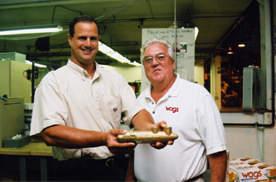
Paul Almberg, co-inventor with Clyde Bargwanath.
Product: The Water And Gas Safety (WAGS) valve
Inventors: Paul Almberg, Clyde Baragwanath
Rhode Island's Market Has Changed. Developers, Builders, Investors and Sellers Must Change With It.
By Emilio DiSpirito IV License Partner | Engel & Völkers Oceanside Leader | The DiSpirito…
Learn More
Location: Manufactured at Taco Inc. in Cranston
Year invented: 1992 (It’s been on the market for a year.)
What it does: The WAGS valve acts as a safety for hot water heaters. When a heater fails, the valve shuts off the water and the heater to prevent water from leaking and damaging homes.
Annual Sales: WND
Can your furniture float?
Each year, more than five million hot water heater tanks fail in homes across the country, inflicting thousands of dollars in damage and ruining basements, walls and ceilings, furniture and personal belongings. Two Rhode Islanders have invented a solution to safeguard against the damage and at the same time, give peace of mind to homeowners. It’s called the WAGS valve.
Paul Almberg, a Cranston resident and gas company employee for 14 years, and Clyde Baragwanath, a Wakefield resident and retired gas company employee, invented the Water And Gas Safety (WAGS) valve 12 years ago while working nights at what was then the Providence Gas Company. Almberg, a former plumber, was frustrated that there was no way to prevent a failing water heater from ruining basements and homes if the homeowner was unaware of its failure. He began jotting down ideas for a solution to the problem.
“It was an idea that was intriguing to me,” Almberg said. “When I would go to change a water heater, and every one of them goes at some point, the people were always very upset, asking me, ‘is it going to do the same thing again?’ Clyde and I were good friends and were both working at the service department, so we learned how it all works.
“One night at 12 a.m. we were just talking and I told him about my idea,” he said. “We just started brainstorming and writing stuff down on napkins.”
The two began working out their invention on paper and building the valve in their basements at home during the day.
Baragwanath, originally from Michigan, worked for the company for 25 years, and said that the two of them would replace an average of five water heaters in a single week. “We’d see lots of water damage and steam in the basement.” The two of them knew there had to be a way to prevent the damage in case of failure.
“We saw a need” for something like this, Almberg said.
The problem with water heaters, Almberg said, is that failure is inevitable. Most homeowners aren’t lucky enough to be home when the failure occurs, in time to shut off the water supply. The WAGS valve, when triggered by only a small amount of water leaking, will shut off both the water and the power to the tank. Although its safety features work best for propane and natural gas heaters, the device will shut off the water and power for any kind of tank.
With propane and natural gas heaters, there is an added safety threat when the tank fails. Because there is a pilot lit on the tank, when the tank fails, it can blow out the pilot light, allowing gas to escape into the home and onto the floor. The main burner tries to fire because of the flow of water coming into the tank and there is no safety to shut off the unburned gas until the main valve safety shuts off a few minutes later.
With a tank that has a faulty temperature gauge, the heater’s wiring can’t sense the water’s temperature and keeps heating the water, until there is steam coming out. The steam condenses and will eventually collect as water in the pan below the heater, which will also trigger the WAGS valve, Almberg said. Even tanks that have a drainage pipe leading from the collection pan to the outside of the house are susceptible to a large leak, Almberg said. During the winter, if that pipe freezes, water will no longer be able to escape, leading to a possibly catastrophic failure.
How it works
The WAGS valve, a brass device that looks somewhat like a submarine, sits in the collection pan outside the tank. The valve is connected to the hot and cold water source, then to the water heater. If a leak occurs, a water-soluble disc in the WAGS dissolves, releasing a powerful spring-loaded piston that closes the flow of water to the tank. In heaters powered by gas, this reaction also breaks a fuse that will shut off the gas supply to the heater. The WAGS valve is entirely mechanical and requires no power source. After Baragwanath and Almberg had their idea, and had put in many hours working on the valve in their basements at home, the next step was to make a prototype and try to market and sell it. The process, however, would be a lengthy and daunting one.
“We realized after four years, after hunting through some patent databases, that we’d never seen anything like it [on the market],” Baragwanath said. Although there was a device out there that in theory did the same thing, it needed to be plugged in and still only shut the water off.
“It’s the only valve that shuts off the water and the gas,” Almberg said of their invention. The two men spoke with family and friends and eventually went to Steve Fielding of Fielding Manufacturing in Cranston, which specializes in zinc die-casting and injection molding. “We wanted to pay him to build the prototype, and once he saw it, he was as excited about the project as we were,” he said. Together the three formed Aquagard, LLC.
After adding one more person to Aquagard, Mark Miller, a design engineer with patent experience, who streamlined the design to make it easier for manufacturing, the group took their prototype to Taco Inc. in Cranston. Taco changed the design, from an upright unit to its present shape, and the group licensed the WAGS valve to Taco. Then the group began the patent-gathering process, with Miller in charge of the patents.
“The first attorney told us it was unpatentable,” Baragwanath and Almberg said, because of all the previous and failed attempts by others to produce the same device. The group applied for a number of patents (for each of the unique elements of the WAGS) and was at first denied. With a second attempt, 14 of the patents were approved.
In order to then sell their product in the United States and Canada, the men had to get code approval of the product from different regulatory bodies in both countries. With the exception of a few remaining states out west, the WAGS valve has received approval. Almberg said he expects the remaining states to grant approval this fall.
“What an education it’s been,” Baragwanath said of the process.