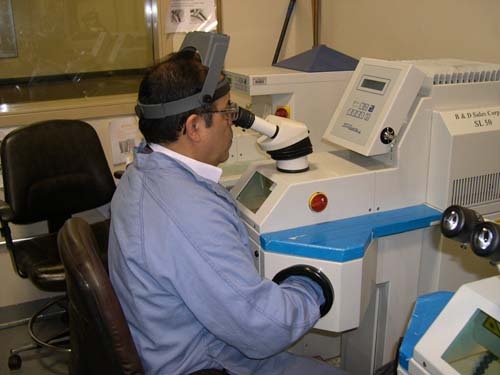
Thanks to a dedicated work force, Tiffany & Co.’s Forest Hill manufacturing facility in Cumberland has emerged as the jewelry maker’s largest factory in the world – both in terms of number of employees and in production of products, according to Michael Kane, vice president of manufacturing.
“We’re hiring people right now, we’re looking for 20-25 people,” Kane said, at a special “Breakfast at Tiffany’s” event held March 29 at the Providence Place mall for workers at the 300 Maple Ridge Drive facility who were recognized for working at Tiffany & Co.’s local production facility for at least five years.
The Forest Hill plant, which opened in 2001 with 125 employees now employs 450 workers, building upon a successful initial experimental operation that was opened in Warwick in 1999. It is now the largest of Tiffany’s six manufacturing factories in the United States – two in Westchester County, N.Y., one in New York City, and two in New Jersey. Tiffany has grown the amount of internally manufactured products for each of the last seven years and, at the same time, increased the product assortment available in its retail locations, said Carrie N. Callahan, spokesperson with Tiffany & Co. New England, explaining why the Rhode Island factory has become the jewelry company’s largest.
“Quality is paramount to everything we do,” Kane, 49, said, praising the skill of workers who can be found in Rhode Island, as well as their ability to adapt well to Tiffany’s demanding production system.
John Grady, the executive director of the Rhode Island Manufacturers Association, called the success of Tiffany & Co.’s Cumberland facility one of the good stories to be told about manufacturing in Rhode Island. “I’ve gone on plant tours, they’ve automated as much as possible on the production line; it is a very efficient operation. They keep their bottom line as low as they can, and they’re making money,” he said. “Tiffany is very big on training their employees.”
“There are a lot of good stories to be told in this state,” he said. “The key is being as lean as possible and really doing a lot of employee training.”
Among the jewelry items produced by Tiffany in Rhode Island are precious metal pieces in silver, platinum and gold, including heart pendants, rings, wedding bands, charms and diamond settings. All of the items produced locally are sent to Parsippany, N.J., which is Tiffany’s world shipping headquarters.
Peter Englehart, 45, group director of Tiffany & Co.’s retail stores at the Providence Place mall, Mohegan Sun and in West Hartford, Conn., was pleased to honor the employees at the Providence store, saying that many of the workers come in to shop – and to show their family members the items that they’ve worked on. “All the workers have great pride in what they do,” he said, adding: “The facility has just reached 165 safe days without an accident.”
For Frandesco Perez, 59, from Glocester, Aldo Gonzalez, 60, from Wrentham, Mass., Vicente Gomez, 36, of Providence and Antonio Olivera, 26, from East Providence, the Breakfast at Tiffany’s event was an unusual way to begin their workweek. The “milestone” honorees all voiced enthusiasm for the jewelry company as a place to work, as they looked for examples of their own work in the glittering store display cases.
Mike Curtis, a manager at the Forest Hills facility, echoed Kane’s assessment of why production in Cumberland has prospered.
“The talent is here in Rhode Island,” he said. •