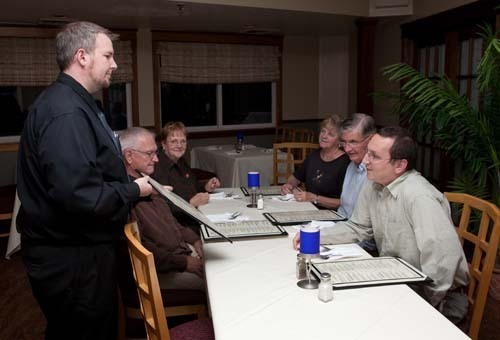
There is a fellow I know who does not like to wait for a table at a restaurant. He has recounted numerous times about going out with his wife, arriving at their chosen place for the evening only to be told there would be a wait for a table of 45 minutes or more.
Immediately, my friend turns on his heel and heads for the parking lot. In his words, “Twenty minutes is my limit!”
Everyone has his or her own internal clock when it comes to waiting for a table when dining out. Restaurants are in the business of return business. The overhead expense of attracting new customers for an initial visit is substantial. And the marketing effort does not end when the customer walks in the door.
One of the most critical parts of the dining experience is what I refer to in my speaking engagements as “greeting and seating.” The length of time until we are seated given to us by the maitre d’ or hostess is a vital piece of information that will be long remembered when (or if) we recommend the restaurant to friends.
The savvy restaurateur runs his or her dining room with the precision of a military maneuver crossed with a ballet. And again, the advantage goes to local diners who have the choice of literally thousands of owner-operated restaurants, with the proprietor on the premises in many cases doing the greeting and seating. I had the pleasure of observing one such dining room general recently.
It was a busy Friday night at Pinelli’s Café at Night in West Warwick. I was chatting with the hostess and with owner Bill Pinelli, a longtime friend. Both excused themselves every few minutes to attend to arriving diners, some with reservations and some without. As I watched the scene unfold, I became engrossed in the drama playing out before me. Parties of all sizes were given an amount of time after which their tables would be ready. I glanced at my watch to track their waiting time, which ran between 25 and 35 minutes.
“An expert maitre d’ can gauge how long a table for four should take to dine – from an hour to an hour and a half, and be able to plan the flow of reservations and walk-ins accordingly,” he said.
Kevin Welch, general manager of the Village Inn in Narragansett and its attached restaurant Amalfi, concurred. “Today, customers expect service to be at a higher level. You have to pay attention to your dining room. A [well-run] restaurant should be able to turn its tables three times during a busy night. You can’t lie to your customers, so telling everyone the same amount of time because it appears to be what they want to hear will cost [you] business.”
Welch has a strong opinion on one policy used by some of his colleagues in the business. “I don’t understand restaurants that do not take reservations for parties of fewer than six or eight patrons. If there is a party of four standing in your lobby with money in their pocket, why would you turn them away or make them jump through hoops?” he said. “And if I am in that party, why would I ever return to your restaurant?”
He confided, “ I have experienced the embarrassment of being asked with my party of three to relinquish my table to a party of four. I will never return to that restaurant.”
Welch continues, “I have seen people in these restaurants ask strangers to join them to make a table for six. I have encountered the elaborate schemes diners invent to try to beat the system. … It’s worthy of a ‘Seinfeld’ episode.” •
Bruce Newbury’s Dining Out radio show can be heard Saturdays at noon on stations throughout New England. His e-mail address is bruce@brucenewbury.com.
Seifert Systems Invests in Energy Efficiency to Strengthen Operations
For manufacturers, energy is more than just another operating expense. It plays a critical role…
Learn More