of OSHEAN. (PBN file photo)
A ceremony marking Rhode Island’s K-12 students’ entry onto Internet2 offered a glimpse at what technology experts believe will become an educational standard.
“If today’s demonstration of high quality and easy-to-use video conferencing can be used as a guide for what we can expect the other 25 school sites to have available to them, I’d expect that imaginative teachers will find ways to fully exploit this technology’s potential fairly quickly,” said Susan Lusi, assistant commissioner of elementary and secondary education.
Rhode Island's Market Has Changed. Developers, Builders, Investors and Sellers Must Change With It.
By Emilio DiSpirito IV License Partner | Engel & Völkers Oceanside Leader | The DiSpirito…
Learn More
The technology enabled participants at the Rhode Island Department of Education (RIDE) office in Providence, the Rhode Island Network for Educational Technology (RINET) office in North Kingstown and Rogers High School in Newport to take part in a three-way real-time video conversation.
Lusi called the endeavor “a story of partnerships and philanthropy. This network that schools depend on relies on Verizon’s data lines, equipment managed by our partners at RINET, the time and effort of our expert friends from URI, Brown, several state agencies, others here at RIDE, and, most importantly, the voluntary participation of over 400 schools and districts.”
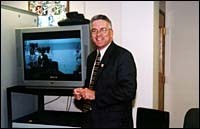
Each participating site was equipped with a small camera, microphones and a computer. The view on the monitor automatically bounced to the party currently speaking. Participants in each of the three locations were able to enjoy a video quality picture and the benefits of a real-time discussion.
According to Joseph Pangborn, director of information systems for RIDE, 12 school sites currently have video conferencing capabilities via Internet2. Orders have been placed for 12 more, and with the system’s core router already in place, Pangborn anticipated that those will be installed by the end of the summer.
Internet2 is a not-for-profit consortium, led by over 180 U.S. universities, developing and deploying advanced network applications and technology, accelerating the creation of tomorrow’s Internet. With participation by over 60 leading companies, Internet2 recreates the partnership of academia, industry and government that helped foster today’s Internet in its infancy.
Internet2 is not a separate physical network and will not replace the Internet. Internet2 brings together institutions and resources from academia, industry and government to develop new technologies and capabilities that can then be deployed in the global Internet. With close collaboration with Internet2 corporate members will ensure that new applications and technologies are rapidly deployed throughout the Internet. Just as e-mail and the World Wide Web are legacies of earlier investments in academic and federal research networks, the legacy of Internet2 will be to expand the possibilities of the broader Internet.
The collaboration involved the JASON project, which broadcasts scientific explorations from locations around the world to the University of Rhode Island (URI). In the past, elementary and secondary school students have been bused to URI to participate in the project.
The new collaborative by RIDE, RINET and OSHEAN delivered live interactive broadcasts to Kickemuit Middle School in Bristol, North Kingstown High School, Thompson Middle School in Newport, West Warwick High School and Westerly High School, eliminating the need to take students out of their classrooms.
Students involved in the Times2 after school program at Thompson Middle School (who, on this day, met at Rogers High School) were able to ask questions of former JASON project argonauts (student explorers) Jeanetty Daddieh and David Mangiante, who were at the RINET office.
“The JASON project was a test case for sharing content on this network from higher educational institutions to our K-12 schools,” said Donna Cupelo, president and chief executive officer of Verizon Rhode Island. “Now we need to build on this momentum and identify more programs of equal content and value to share within the Rhode Island educational system.”
George Loftus, executive director of OSHEAN said that Rhode Island is the first state in New England — and only one of 10 in the U.S. — to have Internet2 capabilities.
With no recurring costs or dial-up fees, Loftus believes that Internet2 will have a significant impact as an aid to education and professional development.
“That’s where we’re going to see big wins,” he said.
“As a corporate and community partner, Verizon views its support to programs that showcase the use of technology and communications as one of our highest priorities,” Cupelo said. “We honestly believe that the power of the network and its integration into education is paramount to the success of the 21st century.”
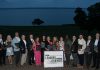
At the demonstration, Cupelo presented a check for $30,000 to Loftus, who accepted it for OSHEAN.
The Verizon Foundation (the philanthropic arm of Verizon Communications) supports a variety of programs that focus on improving basic and computer literacy, bridging the digital divide, enriching communities through technology and creating a skilled workforce.
During 2000, the Verizon Foundation and its predecessors — the Bell Atlantic and GTE Foundations — provided grants totaling $70 million.
OSHEAN will apply the Verizon Foundation funds to payment of 2001 Internet2 fees for all its eligible members, which include elementary and secondary school subscribers of RINET, a nonprofit corporation that supports the technological needs of its K-12 educational community.