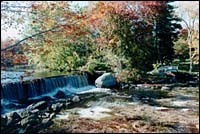
watershed.
Powered only by volunteer efforts for more than a decade, the Rhode Island Rivers Council has continually broken barriers when it comes to recognizing one of the state’s greatest natural resources — its rivers.
Established by the Rhode Island General Assembly in 1991, the group has received only minimal funding since its inception, but still has been able to create a Rivers Policy and Classification Plan and use that plan to officially designate local watershed areas.
Seifert Systems Invests in Energy Efficiency to Strengthen Operations
For manufacturers, energy is more than just another operating expense. It plays a critical role…
Learn More
“We managed to produce something consistent with something that would have been done with Environmental Protection Agency money, without any money” said Ken Payne, former chair of the organization, and a current member of the state policy council. “What we did was a wonderful success story. It was much different than what happens with the normal planning process. What we did was a highly participatory model. We took all of these good things and used them as a building block.”
The Rivers Council is not a regulatory body — according to its charter. Its functions are planning, coordination, and empowerment.
According to its charter, “The basic duties of the Rivers Council are: to develop a Rhode Island State Rivers Plan; to advise state agencies and municipalities concerning programs and measures to improve and protect river quality and to promote river use consistent with the Rivers Policy; to foster public involvement in river planning and decision making through public education and promotional activities and to designated watershed councils as bodies corporate and politic with specified powers, duties, and responsibilities.”
The group fulfills its roll with almost no funding. Though it was created by the General Assembly, hard economic times persuaded the Appropriations Committee not to approve a budget for the group, Payne said. So for the last ten years it has only had one paid employee – a member of the state Department of Administration.
“To have only one staff person and still get something done is a huge accomplishment,” said Michael Cassidy, current chair of the council and director of planning for the city of Pawtucket. “A lot of hours went into this and what we have come out with reflects all of the state’s watersheds.”
According to the Rivers Council, the state has 18 watershed areas, though only two have received the official designation — the Wood Pawcatuck Watershed and the Saugatucket River Heritage Corridor.
In order to recognized as a Watershed Association by the Rivers Council, groups must: advocate for the entire river and its associated watershed; promote public education; maintain a strategy for participation in public policy deliberations affecting the watershed; include a representative from each Rhode Island community within the watershed area in its council; be incorporated or chartered.
Payne said these regulations were adopted over a long period of time, and a lot of public input.
“We went around the state and had a series of regional workshops where people could comment on the information,” he said. “Based on the input we revised any previously established rules. Then we went back for another set of public workshops before sitting down with the Coastal Resource Management Council, the Rhode Island Department of Environmental Management, and other groups — each with their own watershed experts. Then we had a final document that we went to the public with – but by that time we had had so much public input that hardly anyone showed up for the public hearing.”
And though he makes the process seem almost simple, Payne said it took nearly seven years to complete, with the plan finally being adopted as an element of the State Guide Plan in January of 1998. The first official watershed designations came that same year.
“We always had a very high degree of local interest in protecting water resource and so we always had good participation,” he said. “This was an infusion of people from around the state talking about issues that are important to them, they didn’t need to rush.”
Now with a firm set of guidelines, the Rivers Council is once again soliciting applications for official watershed designation. Kevin Nelson, a principal planner for the statewide planning council, and administrator for the Rhode Island Rivers Council, said he expects at least three applications by the March 5 deadline. New watershed designations are scheduled to be announced at this year’s River’s Day celebration in June.
The Pawtuxet River Authority is expected to be one of this year’s designation applicants. The organization, which includes 27 river miles, and more than 240 square miles of watershed, was created by the General Assembly in 1972.
While Executive Director Guy Lefebvre said the organization already has many of the powers associated with the “official” watershed designation, he is anxious for his group to become recognized by the Rivers Council so that the state’s watersheds organizations will be able to work collectively.
“It’s an opportunity to bring our organizations together and discuss how we can work together,” he said. “We need one voice on watershed affairs that includes advocacy and experience.”
Elizabeth Scott, deputy director of the Office of Water Resource at DEM, and a member of the council, said the designation also provides individual organizations with a voice when it comes to their watersheds.
“The most significant benefit to an organization receiving this kind of designation is that they have standing to present testimony in all state and federal proceedings when it concerns their watershed,” she said. “The primary goal of this council is to stimulate the grass roots watershed groups to advocate for themselves on a local basis. In addition we need to be a coordinating body, working together in an effort not to duplicate efforts. We need to share information and be a resource.”
But as the organization continues to grow in number, members agree that funding becomes essential.
“Getting the plan done without funding was a great accomplishment for us,” said Cassidy. “We aren’t asking for money to reward ourselves, but instead to promote and protect our watersheds. We want to get some funding so that we could pass it along to our designated watersheds to help them do their jobs.”
Payne agreed. “The liability of doing it on our own is that we never embedded in the minds of people a need for an appropriation,” he said. “The consequence of that is as you move towards implementation where an appropriation is critical, there is no history.”
And while the group may have created history with their decade-long planning process it is hoping not to have to wait as long for funding.
“Funding is a big question for us,” Nelson said. “The council has not been able to provide funding to local watersheds and we feel that is part of the job. We are hoping to get some funding this year, but we don’t know.”
One thing is clear — the group is not giving up.
“No matter what happened during this whole process, the group never stopped meeting,” Scott said. “Together, it’s always continued, even if it’s at a low level. I think that will definitely continue.”