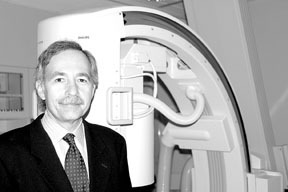
Medical Center, which is based in Woonsocket.
Medical center making significant advances
Beyond Cash Donations: How New Forms of Giving Are Transforming Not-for-Profit Accounting
Evolving Funding Landscape for Not-for-Profits Not-for-profit organizations are being asked to do more with less,…
Learn More
Gary J. Gaube
Position: President and CEO, Landmark Medical Center
Background: Became president and CEO in 1999, after serving as chief
financial officer at Landmark since 1988. Prior to that, he was the chief financial
officer of Buffalo General Hospital Health System in New York.
Education: Bachelor of Science in management and a Master of Science
in accounting at State University of New York Binghamton
Residence: Woodstock, Conn.
Landmark Medical Center is a nonprofit health care network serving northern
Rhode Island and neighboring Massachusetts communities. The Woonsocket unit
is a 214-bed, acute-care hospital, and the Fogarty unit in North Smithfield
includes its occupational health department and MRI unit. Landmark also owns
the Rehabilitation Hospital of Rhode Island in North Smithfield.
Q. Talk about the labor agreement Landmark reached earlier this month.
A. I think in health care today the employee part of our business
is extraordinarily important, especially with the shortage of nursing. To have
a workable agreement like we do now for the next three years is very important
for us. I think it’s a fair agreement on both sides. There was movement in wages
and there was movement on our part and the union’s part on health benefits.
It’s important for us to have a work force that’s fairly paid. One, because
of the demands we put on people in health care, but also to be competitive in
the market, and our market is one that really goes from Providence to Boston.
Q. Landmark recently broke ground on a $6 million radiation unit, which
will make you only the third hospital in Rhode Island to offer radiation therapy.
Talk about the importance of offering that service.
A. Probably in the past 75 years or so, developing radiation therapy
will be the most significant thing we will have done for the delivery system
up here. Because the incidence of cancer is so high in northern Rhode Island,
to be able to bring radiation therapy finally to the market it just a godsend.
We will be the only radiation therapy between Providence and Worcester, which
is a huge distance.
Q. Landmark began offering cardiac catheterization services a couple years
ago through a partnership with Beth Israel Deaconess Medical Center. How is
that going?
A. The lab has been open almost exactly two years and has been very
successful. I know there were people who questioned whether we’d have enough
volume, and we certainly have. We’re on an annual run rate of about 700 cardiac
caths a year. We’ve done well over 1,000 so far and have had no mortality. The
patients are happy that they can stay nearby to get their cardiac cath. Our
finances have improved to allow us to go to those next steps, which would be
interventional cardiology – angioplasty or stents – and open-heart surgery.
We are in the process of working with our partner, Beth Israel and Harvard Medical
School, to secure our first full-time cardiac surgeon. He’ll be here to set
up the program and help us do all the difficult things with regard to policies
and procedures that the health department demands.
Q. What’s the time frame?
A. I would say that in early fall of ’04 we should be in good position
to start that program.
Q. Last year a state Department of Health report measuring clinical care
at the state’s hospitals found Landmark to be below average in treating cardiac
patients, a finding you disputed. Has that prompted any changes in clinical
protocol here?
A. Yes, we have had a dramatic turnaround. As I said almost a year
ago, we’ve always delivered good clinical care here, always. That was a documentation
matter. I think when you see our numbers as reported by the health department,
you’ll see us being at the top or very near the top in all categories. We’ve
made improvement in delivering that care, but more important, it was an information-capturing
issue.
Q. Landmark lost $17 million in 2000 and 2001 but trimmed the net loss
to less than $2 million in fiscal 2002. What led to that improvement?
A. The employees are everything. If you can’t get the team to buy
into what you’re trying to do, it won’t work. Some of the ideas that we had
were kind of radical, especially in 2000. We lost $12 million and we’re about
to start developing cardiac surgery here? But the employees bought into this
plan and I think now there’s some positive momentum. Secondly, we took a look
at our operations and looked at some outside benchmarking, both regionally and
nationally, and tried to achieve those. We also had to become a better hospital
clinically, and we did change. The emergency room doctors we have now, those
docs are outstanding. We’ve gone from about 80 or 90 patients a day (in the
ER) to about 120 a day. We’ve never lost our focus on the community. We’ve tried
to bring them services that they need in a compassionate way.
Q. Do you have an estimate for fiscal 2003 (ended Sept. 30)?
A. We should break even.
Q. Earlier this year you acknowledged that Landmark was in discussions
with Roger Williams Medical Center about a possible merger and construction
of a new hospital. Are those talks ongoing?
A. Just some background on that. At the beginning of the year, Roger
Williams and Landmark were in front of Blue Cross (& Blue Shield of Rhode
Island) with requests for (reimbursement) rate increases. In that process, Blue
Cross made suggestions to us about ‘Would you consider putting a new hospital
together?’ So we did actively participate in those discussions, and are still
listening to what Blue Cross and Roger Williams might have to say. I think the
idea of a new hospital in Rhode Island is a great idea, I really do. Certainly
the dollars for a new hospital are very, very significant. You know, we have,
as Roger Williams has, tried to focus on our mission and go forward with the
programs in front of us. I think where this thing is now is it’s still being
evaluated by Blue Cross. They’ve hired some really top-notch consultants and
they’re trying to make a decision as to whether or not it would be feasible
to build a new hospital. I do think there will be changes in the delivery system
in Rhode Island; whether it be northern or southern Rhode Island, there will
be changes. There has to be.
Q. Blue Cross is finishing a feasibility study?
A. Right. They commissioned a study back in early spring. I know it’s
not complete yet. When you consider where we all are in the delivery system
in this state, if you can make improvements and still maintain the delivery
system where it’s needed, for instance in northern Rhode Island, that’s a good
thing. But there are some significant hurdles that need to be overcome.
Q. Are the discussions only between Roger Williams and Landmark, or are there
others?
A. I don’t think it’s limited to that. I know we were contacted early
on with Roger Williams, but I think there’s been open conversation with a variety
of hospitals in the state, and not just in northern Rhode Island, but throughout
the state.
Q. Where would the money come from to build a new hospital?
A. I think there are a variety of sources that are out there. There
is the general public itself, and businesses whose employees would be impacted
by the new hospital. There’s the bond market, but certainly the bond market
is not a charitable organization. You’re going to have to make sure the new
institution is going to be self-sufficient financially. And then there are sources
like outside partnering. There are a variety of ways where outside people could
come in and help finance a new structure by partnering with local hospitals
to help build something different.
Q. Blue Cross has a large cash reserve. Would it have any financial role
in the construction of a new hospital?
A. I think only if they saw a value to their subscribers. It’s a very
delicate role, because Rhode Island is so small and because we have a limited
number of third-party payers, it’s difficult to have one come out over the other,
not just as payers, but also to have a payer helping one hospital over another
hospital. That’s a sensitive issue. If you’re on the receiving side that’s great,
but if you see resources being delivered to some competitor you’ll take issue
with it. So it’s not an easy question.
Q. Anything else you’d like to mention?
A. We’ve talked about these programs. We are not going to become a
major tertiary hospital or a teaching magnet; we don’t have any aspirations
to do that. These programs are meant to help us with our market and also provide
additional resources so we can continue the primary care mission of this hospital.
We just want to keep doing what we’ve been doing for 150 years. As our industry
changes, you have to make changes too, and if you don’t, you’ll close. It’s
as simple as that.
For the complete current issue, visit our subscription Web site, or call (401) 273-2201, ext. 227 or 234.