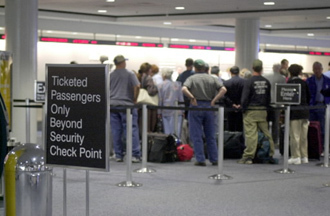
gather at checkpoint.
To say that U.S. airports are dragging their feet on meeting the year-end deadline requiring all checked luggage to be screened for explosives is an understatement. Most airports reportedly do not even have contracts for the extensive construction needed to install the machines.
But Boston’s Logan International Airport is a notable exception. Logan in June became the first major airport in the country to have a bag-screening plan approved by the Transportation Security Administration. The Massachusetts Port Authority in late August OK’d a $146 million budget to complete an ambitious construction timetable in time for the Congressionally mandated Dec. 31 deadline.
“What we are doing has never been done before in this amount of time,” Massport CEO Craig P. Coy said in a written statement last month. “While I can’t guarantee that the deadline will be met, I can guarantee that Logan will continue to lead the country with an arsenal of aggressive security initiatives.”
Beyond Cash Donations: How New Forms of Giving Are Transforming Not-for-Profit Accounting
Evolving Funding Landscape for Not-for-Profits Not-for-profit organizations are being asked to do more with less,…
Learn More
The $146 million represents the construction costs alone; the four explosive detection system (EDS) machines must be acquired later through the TSA, likely for more than $1 million each.
Security procedures at Logan came under fire after the two Boeing 767 airplanes that crashed into the World Trade Center Sept. 11, 2001, left from the Boston airport.
Massport has hired AMEC, a UK-based company that provided construction work for the installation of bag-screening machines at Heathrow Airport in London in 1990. In the wake of the 1987 Lockerbie airplane bomb in 1987, the UK passed a law requiring all airports to screen 100 percent of passenger bags.
At Logan – which handles as many as 5,000 pieces of luggage an hour – most airlines have their own baggage systems, according to Steve Pressler, an AMEC executive vice president and head of the company’s aviation division. Bags are shuffled from the check-in desk down a conveyor belt into a sorting system, which routes each bag to its gate.
To comply with the new federal requirements, a “spur” conveyor belt will divert bags through 11 new bag-handling rooms, where they will be scanned by the machines before returning to their original belt.
AMEC began construction in early July and has been working seven days a week. Pressler said the work includes construction of the 11 baggage structures that will house the new scanning machines, along with 4 power substations and an overhaul of Logan’s existing baggage system.
Pressler said AMEC has 35 supervisors on site at Logan, and a number of subcontractors are working on the project as well.