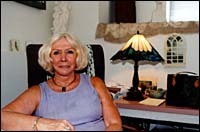
staff do everything by hand.
(Al Alexio)
Company: Castique, Inc.
Owner: Marion Manning-Lovett
Location: 42 Ladd Street, East Greenwich
Type of business: Designer and manufacturer of garden statues
Employees: 6
Year founded: 1995
Annual revenues: $1 million
Marion Manning-Lovett is at a crossroads in her business. She has to decide now, whether the statue manufacturing company she started six years ago is going to grow larger — or get smaller.
Beyond Cash Donations: How New Forms of Giving Are Transforming Not-for-Profit Accounting
Evolving Funding Landscape for Not-for-Profits Not-for-profit organizations are being asked to do more with less,…
Learn More
It’s a decision that Manning-Lovett didn’t expect to be making, and one that comes with great consequences. If she grows larger, she will most likely have to move much of the company’s manufacturing overseas – a concept she is reluctant to embrace. And if she decides to shrink, she could lose the business she has worked so hard to build.
“This is a really tricky place to be,” she said. “We didn’t plan this. I think we either have to get larger or we have to cut our product line. It really is a tough place to be.”
Yet, Manning-Lovett is excited.
Her company, Castique, and its products have been featured on the QVC Shopping Network, appeared in Yankee Magazine, and are sold in a variety of catalogues and retail shops, locally and nationally — all of which are far from the kitchen sink where it all began.
“It’s kind of a miracle story,” she says of her first statue, an angel created in memory of her son’s friend Paul, who was killed in an accident in 1992.
“At the time of Paul’s death, his mother placed a poem in the local paper,” she said. “The poem really touched me and inspired me to make this angel for Paul. It’s still called Paul’s Angel.”
Manning-Lovett continued to make the angels, and after attending her first gift show in Boston, knew that she had a hit.
“I went to the show and sold more than $8,000 worth of merchandise in just over a half an hour,” she said. “I knew then that we had a decent product.”
And while Manning-Lovett had never run a manufacturing business before, she soon realized that she couldn’t keep up with the demand working from her home.
“Manufacturing is not easy,” she said. “I didn’t know anything about it. Everything we do is by hand, so we really had to learn.”
But she has learned. When Providence Business News first met Manning-Lovett two years ago, she had three employees and was working out of the Pontiac Mills in Warwick. Today, the company is based in East Greenwich, and while it only has six full-time employees it can at any given time have close to 12 part timers.
The company’s products, which include stone Buddhas, Venus deMilos, angels, farm animals, gargoyles, angels, and forest creatures, are the work of company employees and local artists.
“Most of our products are the work of Rhode Island School of Design artists,” Manning-Lovett said. “But there are a lot of fine artists working in a variety of places, including Home Depot. We are very particular about the people we work with.”
One of Castique’s major challenges is making sure the company’s ideas and products remain their own. Manning-Lovett points out one incident when she was at a flea market in North Kingstown and discovered someone selling her products.
“They were waiting until we left at night and then bringing a truck to the dumpster,” she said. “There are a den of thieves in any business. We have seen other companies selling our designs, but in different colors. It’s a hard thing to keep up with.”
What’s helped the company’s growth, Manning-Lovett said, is the increasing popularity of gardening.
“Everything is changing,” she said. “The public is doing gardening, inside and out. I think that the New York Times said it best when they said, ‘the garden is to the millenium what the patio was to the 1950’s ..the household altar of our time.'”
Where the company has found success, Manning-Lovett said is serving a niche market. But she knows that to remain competitive, especially in cost, changes will most likely be needed.
“When we started this business we wanted to provide affordable art,” she said. “We still want to do that, but we might have to go offshore with our production. It’s very sad, yes, but it’s economically what we would have to do to compete. I would like that not to be our next step, but it might have to be.”
Whatever her next decision is, Manning-Lovett said she will continue to work on her statues and her business because as she says, “a life without passion is like a garden without flowers.”