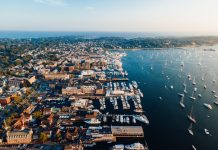
With more than 400 miles of coastline, Rhode Island has long been a place to be for the boating community, in sailboats, yachts, speedboats, fishing boats and pleasure cruisers. But with its 600 miles of rivers and streams, the Ocean State in recent years has also had a growing appeal to different kinds of boaters – kayakers and canoers. ”The number of people using local rivers for recreation is growing,” said Denise Burgess, program director at the Wood-Pawcatuck Watershed Association. “My office is right on (Pawcatuck) River and on a nice weekend in the summer it’s like a highway out there with canoers, kayakers and fisherman.”
Statewide, watershed officials say they are seeing a resurgence of interest in the state’s rivers, mainly for recreation. Bob Billington, executive director of the Blackstone Valley Tourism Council said every year there are more people on the Blackstone River, which spans 45 miles.
Beyond Cash Donations: How New Forms of Giving Are Transforming Not-for-Profit Accounting
Evolving Funding Landscape for Not-for-Profits Not-for-profit organizations are being asked to do more with less,…
Learn More
”People are really starting to discover it,” he said. “Since it became a National Heritage River, it’s really been something that people want to learn about.”
Also, Billington said, the river, which once attracted a variety of mills and other industrial processes, is once more a focal point for economic growth. In the past year, a new riverboat service was launched, and Billington said he has had inquiries from other business interested in starting up along the banks.
”There is always fresh interest among entrepreneurs wanting to create business along the Blackstone,” he said. “Paddle Providence and Blackstone Canoe and Kayak both have both expressed interest in starting rental services in the area.”
Byron Kirk, manager at Finn & Feather Hunting and Fishing Lodge in East Greenwich, said the sale of Kayaks has more than doubled in the past few years.
”They are easy to handle,” he said. “They are light weight, relatively inexpensive, and are easy for people to maneuver.”
Kirk said kayaks, which range in price from $299 to $1,200, are easy for people to use alone.
”They are perfect for people who want to go outside and do some boating,” he said. “They are easier to handle than a canoe and it’s a good way to get some exercise.”
Donna Baer, executive director of Paddle Providence, a non-profit agency based in Providence, which offers free kayaking and canoeing to inner city children, said the benefits from the sport are two-fold.
“The sport can be used as a recreational alternative,” she said. “But it can also be used as a tool to educate people about pollutants and ways to protect our rivers.”
Teresa McKinley, executive director of the Narrow River Preservation Association said kayaking has become a “premiere” sport along the Narrow River, principally in Narragansett.
”The Narrow River is a benign river without great depth and strong currents,” she said. “It lends itself to outdoor recreation. It’s very user friendly.”
McKinley said kayak appeals to a wide range of people from the single boater to the family looking for an outdoor activity to do together.
”The skill levels needed to start out are minimal,” she said. “It doesn’t take a lot of technical expertise and it’s something that families can do together.”
Baer agreed.
“It’s easy to learn and almost anyone can do it,” she said. “We take people as young as seven and have had people as old as 99. It also enables people to become intimate with surroundings and in Providence it also gives people a different view of the city, that you don’t normally see.”
Burgess said kayaking is appealing to nature watchers, as it provides a variety of different views.
”It is a time for personal reflection,” she said. “It puts you in a real wilderness setting and in our case takes you through totally undeveloped areas where you will see a lot of wildlife. People enjoy it because you are able to quietly observe everything.”
Last year, in response to the growing interest in kayaking, the state Department of Environmental Management published a guide to kayaking the Rhode Island coast. Many of the river organizations also have their own guides which provide people with some tips on where to put their kayaks, as well as providing suggested routes of travel.
”We produced our first map last year,” said Guy Lefebvre, executive director of the Pawtuxet River Authority. “We want to create a place where people know where they can park, and how they can best use the river.”
The Pawtuxet River boasts more than 26 miles of waterway and Lefebvre said the organization spent a number of years cleaning debris and trash from the river to make it more appealing to residents. Today, he said, the river has become a draw for economic development and for residential use.
All agencies agree that part of the success of Rhode Island rivers is due to recent heightened awareness in their importance. In 1998 Gov. Lincoln Almond declared Rhode Island River’s Day, the first of it’s kind in the nation. Scheduled for Saturday, June 17, the day is a way for local communities to ban together in the celebration of the state’s rivers. Activities include kayaking and other types of boating, river clean-ups and historical tours.
”The idea is to set aside one day for people to stop and realize the importance of our rivers,” Billington said.
McKinley said the celebration really helps residents understand the connection between the river and the quality of life they have.
”There is an instant relationship with the quality of life,” she said. “One of the points I can’t stress enough is that part of what your home is worth, the life that you lead is directly related to the health of the river. It’s all too easy for people to take the river for granted, so the idea is to encourage people to pause and look around.”