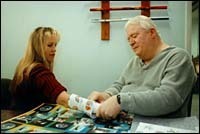
is Barbara Calise with Robert Coffey,
owner
Company: Pru-Lesco
Owner: Robert N. Coffey
Type of business: Sublimation specialists
Location: 541 Pawtucket Ave., Pawtucket
Number of employees: 21
Year founded: 1928
Annual revenues: between $3 and $5 million
When Robert N. Coffey bought Pru-Lesco in 1979, the sublimation process wasn’t
even defined in the dictionary.
Seifert Systems Invests in Energy Efficiency to Strengthen Operations
For manufacturers, energy is more than just another operating expense. It plays a critical role…
Learn More
Founded in 1928, the company was traditionally a manufacturer of promotional
goods used by large manufacturers as giveaways. But when companies began using
less expensive types of products, like key chains and pens for promotion, Pru-Lesco
was forced to change.
Most of that change occurred after Coffey took over the company and found a
new market manufacturing metal picture frames and plaques — many of them with
printing on them.
"I saw a lot of potential in this company," he said. "Now, we
do in a month what used to take us a year to do. It’s always a risk when you
change, but it has been very good for us."
Coffey began printing on metal using the process known as sublimation – a dry
image reproduction process using dye crystals which, under heat and pressure,
convert from a solid to a gas, without entering a liquid phase. According to
Coffey, the process differs from all other printing methods in that the transferred
image, as a gas, is deposited into the substrate molecules rather than onto
the surface.
For example, conventional printing methods such as screen printing, or hot press,
are applied in a liquid state, one color at a time to the surface of a material
while sublimation deposits all colors at once – in perfect registration — completely
dry and ready for shipment.
"We were really ahead of our time," he said. "It still wasn’t
in the dictionary even ten years ago. Basically what we do is print the mirror
image of a design graphic, usually supplied by the customer, on to their products."
After Coffey found success with the metal industry he set out to conquer another
medium – plastic. After much research and collaboration with resin manufacturers,
Coffey said Pru-Lesco finally found a plastic that not only easily handled the
necessary heat, but also accepted sublimation dyes and displayed colors with
great vibrancy.
"One of the earliest purchases that we made was a grinding machine,"
Coffey said. "Because to get the right product we made a lot of trash.
We would grind up the plastic that we made mistakes on and sell it back to the
supplier."
Soon after the company had fine-tuned its products, national and international
companies came knocking. First, Coffey said, it was Elan – a well-known ski
manufacturer from Yugoslavia. Pru-Lesco began working with the company on sublimation
ski tops. Other big names like Nike, Burton snowboards, Macdonald’s, Hallmark,
and Brine Lacrosse sticks followed.
But how do these companies find Pru-Lesco? According to Coffey, it’s through
the Internet and trade magazines.
"We don’t sell too much locally," he said. "In fact I would say
we are a well kept secret. People normally find us by looking up sublimation
on the Internet, which is interesting because ten years ago it wasn’t even there."
Because of the company’s high-profile clients, Coffey doesn’t let anyone but
his own employees into the factory itself. Though the office, located on the
second floor of an old mill building in Pawtucket, is decorated with many of
his client’s products, Coffey said he just can’t run the risk of letting strangers
in the factory itself.
"We are a closed factory," he said. "We have clients that compete
with each other and I think they would feel less confident if the factory weren’t
closed to viewing. Our clients don’t have a problem with it, because if we don’t
let them in, then they know we aren’t letting anyone else in either."
Always looking for new product, Coffey said the company recently unveiled its
latest design – graphically enhanced splinting material specifically designed
for children. Under the guidance of an orthopedic surgeon, Dr. Gregory Austin,
Coffey said the company has been developing the product for more than two years,
testing it at local hospitals.
"Up until this point, orthopedic surgeons have had essentially one choice
in splinting material," Coffey said. "And that choice was white. What
we have begun to offer is a colorful alternative. Four-color reproductions of
fanciful figures on the splinting material that makes the cast more attractive
to kids, and thus has a beneficially emotional effect as well."
Coffey has chosen a different route in marketing his new product, opting to
skip catalogue advertising and go directly to the hospitals themselves.
"So far the reaction from people is to ask why this hasn’t been done before,"
he said. "I think that it a good step in the right direction."
Coffey doesn’t expect to stop here. In fact, he said the company is always looking
for new plastics to work on and is currently collaborating with GE on a material
known as Tedlar – which is resistant to ultra violet rays.
"When we seek out new products we are often too far ahead," he said.
"But we are still always looking."
Learning from experience Coffey said he never imagined being in a business like
this, but intends to follow through on the ride.
"I have a very strong passion for this business," he said. "As
an entrepreneur I believe you have to have a passion for the process"