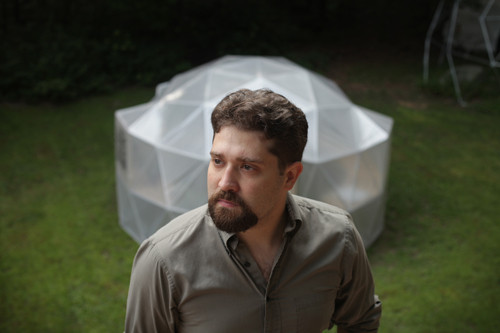
Justin Goslin was a student studying mechanical engineering about 10 years ago at Worcester Polytechnic Institute and, as Mother’s Day approached, he had to find a gift for his mom. So he went to his favorite area of study – geodesic domes – and came up with an unusual, but practical idea.
He fashioned a geodesic dome that she could use as a garden trellis, a structure that is still standing in her yard and is now covered with flowering vines for a gazebo effect. “The hummingbirds love it,” he said, noting that a spectator inside the structure can see the birds feeding on flowers “just inches from your face.”
And that is how his foray into the business world began.
After graduating from Worcester Polytechnic in 2003 with a bachelor’s degree, he worked for several years as a hydraulic systems engineer at Electric Boat in Groton, Conn., but health problems eventually forced him to quit and find another way to support himself.
He founded Sunrise Domes, one of the few businesses in the United States at which geodesic domes are made, he said, based on the innovative principles promulgated by well-known American inventor Buckminster Fuller, who patented the geodesic dome in 1954.
Resembling an igloo, a geodesic dome is shaped like a half sphere and is made of a complex framework of self-bracing triangles, all of which can be covered with vinyl fabric and anchored to the ground. Foundations are not necessary for most uses, and soil anchors are included in most dome assembly kits.
Goslin pointed out that the spherical shape of the dome has less surface area than a rectangular structure would have and thus requires fewer materials to make. “Buckminster Fuller was way ahead of his time, and he knew materials would be scarce in the future,” Goslin said.
“I saw right away the potential for it,” he added. “It is inexpensive, light-weight and super-strong. In the research we did, we found that not many people were making them. They have so much potential, and they’re so cool, I just couldn’t give up this idea. Everybody seems to know about geodesic domes, but there are very few of them out there.”
A dome with a 20-foot diameter is the most common, Goslin said, but he can make domes in almost any size. His regular offerings run from 8- to 30-foot diameter domes, but he spoke of making several 40-foot and even a 46-foot dome at customers’ request.
One person can assemble a 20-foot dome in about four to six hours, Joslin said. “We supply all the hardware. There is no welding involved and all a person needs to put one together is a wrench and maybe a step-ladder,” he explained. Floors can be fashioned out of wood pallets covered with plywood.
They can be used for “anything imaginable,” Joslin said – greenhouses, garden sheds, carports, storage shelters, offices, aviaries and animal pens, even doghouses. A dome can even be converted into a house, with straw bales as insulation and stucco on the exterior.
He spoke of a 40-foot dome he recently shipped to Ireland, where an “eco-camping group” will use it as the centerpiece of its lakeside campground for workshops and classes.
Joslin built a dome for a South County customer for use as a horse barn. Cost was about $2,000, far less than the price of a rectangular structure, Joslin noted. “We live in a rectangular world, and sometimes building domes is like putting a round peg in a square hole, but we’ve tried to make these structures very practical,” he said.
Windows, benches built into the frame, doors and fully automated ventilation systems can be added, and so can electricity. “Most people do add electricity,” Joslin said. “It doesn’t take much electricity and it’s definitely worth it.” The dome can be wired “just like you can wire a house,” he said, but some folks simply run an extension cord from home to dome. •
COMPANY PROFILE
Sunrise Domes
OWNER: Justin Goslin
TYPE OF BUSINESS: Manufactures geodesic domes
LOCATION: 116 Money Hill Road, Chepachet village in Glocester
EMPLOYEES: 4
YEAR FOUNDED: 2007
ANNUAL SALES: WND
Seifert Systems Invests in Energy Efficiency to Strengthen Operations
For manufacturers, energy is more than just another operating expense. It plays a critical role…
Learn More