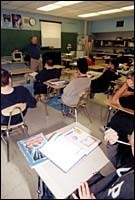
counting at Smithfield High.
Kyle Rowles wants to go into business for himself someday. The Smithfield High School senior is getting a head start as a member of the school’s Academy of Finance, a program that allows Rowles to take accounting courses at a college level.
But Rowles is not alone in his ambition to learn about personal finance at an earlier age than most students. About 250 students from 11 different Rhode Island high schools attended the Academy of Finance Student Conference at Bryant College last month.
Featuring career workshops presented by various finance-related fields, the conference was the first of its kind in the area and was considered a major success by local teachers.
Rhode Island's Market Has Changed. Developers, Builders, Investors and Sellers Must Change With It.
By Emilio DiSpirito IV License Partner | Engel & Völkers Oceanside Leader | The DiSpirito…
Learn More
"I think the presentation really gave kids a lot of positive ideas for possible careers in finance," said Kevin Gormley, director of the Academy of Finance at South Kingstown High School.
The Academy of Finance is a nationwide program boasting over 16,000 members in grades nine through twelve across the country. Initially designed to prepare students for the real world directly after high school, participating in the Academy of Finance now is similar to having a major in college. Students must complete several classes in the concentration as well as an internship at a company related to a career interest. Many students also take classes at local colleges, earning up to 12 college credits by the time they finish high school.
Smithfield High School senior Brett Kimball said the weekly three-hour accounting course he took at Bryant was not easy, but he already feels more prepared for college.
That’s the most frequent feedback Michael Densmore, business department chair and director of the Academy of Finance at Smithfield High School, has heard from alumni of the program, which started four years ago.
"I’ve had a lot of kids come back and tell me how much easier their freshman year in college was than their roommates’," he said.
Dana Costantino, who is also a senior at Smithfield, seemed to sum up the attitude of many students in the program.
"The Finance Academy gives us a chance to learn a lot about the real world," she said. "And it is challenging but we’re learning a lot more than the average student."
Although the program is not easy, it is so popular in some schools that there is a waiting list.
Donna Clemence, business department chair and director of the Academy of Finance at West Warwick High School, said by making the students apply to be in the program, the school is raising the bar on educational standards in general.
"The younger students are making sure their attendance is good and their grades are good," she said. "We’ve really elevated it to a higher level."
Clemence said the most encouraging aspect of the program is checking in on the students at their internships.
"Before they go into it they’re usually apprehensive, but they really blossom into becoming quite valuable to the companies they work for," she said. "The internships help them pace themselves and apply the course work to real life situations, so they’re not inundated with bookwork."
Donna Hutson, a business education teacher at Narragansett High School, is preparing for the introductory year of the Academy of Finance next fall. She said it’s never too early for students to get a taste of the real world.
"No matter what they do in the future, no matter what career these kids choose, finances are everywhere," she said.
Nancy DeLisle, business department chair at Westerly High School, agreed with her approach, but emphasized that enrolling in the program does not lock the students into a commitment they don’t want to be a part of.
"I ask my students to think about what they might want to do in college or after they graduate," she said. "Then we examine what it costs to live. A lot of kids graduate from high school and think that if they make $10 per hour they’re doing well.
"We simply show them what’s out there," he said.