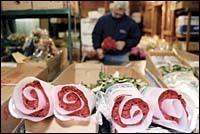
wrapped for shipment and sale.
It could cost a little more to say ‘I love you’ with flowers this Valentine’s Day.
For the first time in more than a decade, a five-cent tariff is being levied against roses coming from four South American nations. The increase in cost, which had mostly affected wholesalers and distributors, could trickle down to the consumer, just in time for Valentine’s Day.
The increase is the result of Congress not renewing an anti-narcotics trade program that used flowers to fight a growing drug trafficking problem.
The legislation was created to encourage people in rural South American countries to produce legitimate market goods like fresh flowers, instead of the coca leaves and poppies used to make the illegal drugs cocaine and opium.
Beyond Cash Donations: How New Forms of Giving Are Transforming Not-for-Profit Accounting
Evolving Funding Landscape for Not-for-Profits Not-for-profit organizations are being asked to do more with less,…
Learn More
An extension of the tariff program expired in December and as the issue continues to be debated on Capital Hill, some local wholesalers are already feeling the affects.
"I am expecting about a five percent increase," said Ron D’Orazio, cut flower manager and buyer for Bay State Florist, which has a wholesale location on Promenade Street in Providence. "What’s happening is that the issue is still up in the air with Congress and while we are waiting for them to make a ruling we are forced to add five percent to cover ourselves. It’s almost like protection."
Since the program expired, importers have been paying a 6.8 percent tariff on Colombian roses – a heavy price tag considering that 80 percent of the fresh roses sold in the United States come from Colombia.
"The vast majority of the people I speak to are just going to absorb the extra costs," Steve Neubauer, president of the Independent Florists’ Association, recently told The New York Times. "Given the state of the economy, there’s a great deal of sensitivity about price."
D’Orazio agreed.
"The flower business is very competitive," he said. "It is frustrating. These two weeks are the most difficult time of year, for the wholesaler, the grower, and the retailer. It’s the demands of the business, but when you are paying three, four, and sometimes five times more than you normally would it gets stressful."
It’s a stress Steve Carbone, who runs R.J. Carbone Company Floral Distributors in Cranston, doesn’t expect he will pass on to the consumer.
"Something like that adds up to a wholesaler like me," he said. "But I would think that 99 percent of retailers don’t even know about it, unless they are reading trade magazines. It’s not a line item on their invoices."
D’Orazio said tariffs aren’t the only thing impacting flower prices this year.
"The production in Colombia has dropped because of the cool weather," he said. "It’s supply and demand. On any given day you can have a million roses coming into the port of Miami and there aren’t enough buyers for them. Then all of a sudden you have only 800,000 coming in, and a demand of more than a million."
According to the American Floral Endowment Consumer Tracking Study, more than 103 million roses were sold last year on Valentine’s Day – a number many expect to top this year.
"I think it’s definitely going to be busier than last year," said Lou Pryer, owner of Peter Pots flower shop in Warwick. "That’s because the holiday falls on a Thursday. If it was a weekend people would go out, but because it’s a weekday you’re going to see a lot of at-work deliveries."
D’Orazio agreed.
"Thursday is a good day," he said. "Flowers won’t be a secondary purchase and that’s a positive thing."