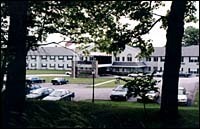
Village off Smith Street in Providence.
(Tom Croke)
Evidence of a health care system in disarray abounds. Hospitals are running multi-million-dollar deficits. Nursing homes are filing for bankruptcy. Soaring insurance premiums are crippling small businesses.
But perseverance, hard work and the implementation of solid business practices are likely to lead to success — even for a company so dependent upon the health of the health care industry.
Beyond Cash Donations: How New Forms of Giving Are Transforming Not-for-Profit Accounting
Evolving Funding Landscape for Not-for-Profits Not-for-profit organizations are being asked to do more with less,…
Learn More
Meet Peter and Diane Sangermano — who now employ 1,000 people at a Rhode Island-based company composed of 10 assisted-living facilities.
The Sangermanos started slowly.
Ten facilities, after all, was not part of some big master plan — not back in April of 1990 when the Village at Waterman Lake in Greenville opened its doors. Peter and Diane Sangermano planned on running one high-end assisted living facility. They knew it would be hospitality-driven. They knew people wanted comfort, wanted to feel like they were home.
That first facility was an immediate success. So the Sangermanos built another – and another. And the dream expanded. A dream fueled by demographics.
Americans were beginning to live longer – well into their 80s, according to the U.S. Census Bureau. And the New England region remains home to more seniors per capita than most areas of the country.
“A combination of things has driven our industry for 15 years,” said Peter Sangermano. “The demographics are driving it – the senior population is aging.”
Success spreads
And the Sangermanos’ business has been growing.
Today, the couple oversees 10 high-end assisted living facilities in Connecticut, Massachusetts and Rhode Island – all of them within about a two-hour drive from the company’s corporate office on the campus of The Village at Waterman Lake.
The Sangermanos employ nearly 1,000 workers at sites ranging from The Village at Willow Crossings in Mansfield, Mass., to The Village at Brookfield Common in Brookfield, Connecticut. In Rhode Island, there are Village facilities in Greenville, Providence and Warwick.
Walk into any Village facility and the feeling is that of a luxury hotel. The lobby is designed to look that way – the manager on duty acting as the concierge, so to speak. The tables in the dining room are arranged neatly, with sparkling glasses and linen napkins. A library offers shelves of classics and newer titles and a fireplace by which to read them. Residents walk by you in the parking lot, clubs in hand, headed for a putting green.
The approach at a Village facility is clear – cater to the guests.
“We made a decision at the beginning that we would always be hospitality driven,” said Diane Sangermano.
The facilities also partner with local hospitals and nursing organizations whenever possible – and in fact, they are intentionally located close to hospitals and emergency care resources. They have full staffs of nurses and specialize in Alzheimer’s care.
Linda Gershon, is a retirement counselor at The Village at Waterman Lake. It is Gershon’s responsibility to get to know the guests – and their families.
“I believe in the concept here,” she said. “We fill the gap. It is a very family-oriented place. Families can be as much a part of this as their parents.”
Gershon points out that it is not uncommon for one spouse to be in excellent health – both physically and mentally – while the other is beginning to see his or her memory slip.
“We understand everything from independent care, to nursing, to Alzheimer’s,” she said.
In many cases, the family-oriented concept is taken literally. Both Peter and Diane Sangermano are proud that so many of their workers have been with them for so long. Peter’s father, at 82, still works on the new construction projects.
“We have wait staff who have been with us since we opened our doors,” said Peter Sangermano.
New England by choice
The Sangermanos have been impacted by a slowing economy. Business remains strong, but new projects have been approached cautiously. With the facility in Meriden, Connecticut, complete, Peter Sangermano expects at least a short-term lull in development.
The next year or so should be slow, he said, but after that, the growth mode could be back in vogue.
The Sangermanos are content to be patient. They have learned from others.
“We have seen failure in companies that have grown so quickly and tried to build across the country all at one time,” said Diane Sangermano. “They have no way of managing their facilities.”
Some have gotten “too big, too fast,” said Peter Sangermano.
That is why the Sangermanos have confined their growth to New England – and expect to continue to do so in the coming years. The ability to travel to each facility within hours is considered critical. In fact, both Peter and Diane visit every facility at least once each month.
“There are other companies like ours,” said Peter Sangermano. “We have had opportunities to move outside the New England area, but fortunately we chose not to.”
The numbers suggest that the Sangermano’s patience will pay dividends.
The U.S. Census numbers continue to favor the industry. For example, the Census Bureau has developed three estimates, or three series, of population projections based on three different levels of mortality for persons aged 85-and-over. The estimates range from a low of approximately 18.2 million persons to a high of approximately 31.1 million persons by the year 2050.
In fact, the Census reports a dramatic increase in the number of persons aged 85 and older in the coming years. The “old group” is expected to experience a significant increase in population regardless of which series of estimates is considered.
Between 1995 and 2050, the 85-years-of-age and older population is expected to continue to grow. This age group is projected to increase 33.2 percent between the years 2000 and 2010.
According to the Assisted Living Federation of America, such facilities are commanding higher fees each year. And the use of the term “Assisted Living” for regulatory purposes continues to increase – with 30 states now using it.
In addition, 37 states allow such facilities to use Medicaid reimbursement, including Rhode Island.
Still, the bulk of the fees to such facilities are private funds.
Respondents to an ALFA survey reported an average daily private room rate of $73.97 in 1999, ranging from a minimum of $39.47 to a maximum of $206.11, and a median daily room rate of $69.83. By comparison, the average daily private room rate in 1998 was $68.48. The reported average daily semi-private room rate was $63.35 in 1999, compared with $58.67 in 1998. Of the responding residences, 77.2 percent reported a monthly rental-only payment, compared with 91.1 percent in 1998 and 82.7 percent in 1997. The remaining 22.8 percent also required an up-front fee such as an entrance, endowment, or lifetime lease fee which ranged from a $200 basic deposit to a lifetime lease fee of $200,000.
Peter Sangermano sees good things in the company’s future. The bad news is the same bad news so many others face.
“We’re impacted by what goes on in the hospital and nursing home industries all across the country,” he said.
But even in recent lean years the Villages have prospered. The Sangermanos have picked their spots – grown appropriately. Peter sees Rhode Island as being “at the forefront of seniors’ issues.”
“When we first started out, the health care industry did not really know what assisted living was all about,” he said.
And now they do. And even in the midst of a health care system in disarray, there is room to succeed. Just ask Peter and Diane Sangermano.