we've done a good job
in telling our story.'
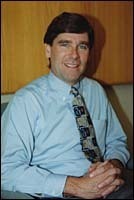
Name: Patrick L. Muldoon
Age: 46
Seifert Systems Invests in Energy Efficiency to Strengthen Operations
For manufacturers, energy is more than just another operating expense. It plays a critical role…
Learn More
Position: former President and CEO, South County Hospital, 1996-2000
Background: President and CEO, North Adams Regional Hospital and Northern
Berkshire Health Systems, 1988 – 1996; senior management positions with Horizon
Health Systems, Cranston General Hospital and the American Osteopathic Hospital
Association
Education: Bachelor’s in Health Services Administration, Providence
College; M.B.A., Loyola University
Family: Married, two children
Residence: Jamestown
Editor’s Note: After several weeks of tumult at the 100-bed South County
Hospital in South Kingstown, including meetings among doctor and trustees regarding
financial problems affecting patient care and culminating in a no confidence
vote by hospital doctors, Muldoon resigned on Oct. 24.
PBN: Why are hospital costs so high?
MULDOON: First, over the past three to four years health care costs
have moderated. We’ve been tracking pretty close to the rate of inflation, whereas
late ’80s early ’90s we were tracking double sometimes triple the rate of inflation.
You have technology, emerging technology on scanning and diagnostic equipment,
computers. You have an ever-increasing tight labor market. What we are paying
our employees is increasing at a fairly significant rate. So all of that gets
added into this market basket of goods for hospitals, and it is very expensive.
And hospitals are getting paid less than ever.
Reimbursement over the last three years has probably been the worst for hospitals
across this country. Everybody blames the Balanced Budget Act for all the woes
of health care, [but] I think it is significantly responsible for many of the
financial problems in hospital delivery today.
Does the average Rhode Islander understand the terrific financial pressures
hospitals are under?
I would say no. I don’t think we’ve done a good job, the hospital industry,
in telling our story, of the reasons. Hospitals are such complicated organizations.
Does this lack of understanding build divisiveness between management and
labor?
One of the real areas of contention in hospitals is what I call this balance
of costs and quality. For a very long period of time in the history of the United
States, hospitals were paid their costs. Whatever it cost and then some, they
were paid. Then Medicare went to a Prospective Payment System, to where they
were only going to pay you a certain amount per each disease category. Whether
you stayed 10 days or two days, hospitals would get that same amount. Then the
Balanced Budget Act decreased rates of reimbursement on the inpatient and outpatient
side, decreased medical education reimbursement, significantly decreased payments
to home care companies, which many hospitals are involved in, they decreased
nursing home payments. So management, working with the boards, working with
the medical staffs, has tried to adjust as best they can.
Rhode Island has several hospitals where the presidents are M.D.s – Joseph
Amaral at Rhode Island Hospital, Kathleen Hittner at Miriam and Robert Baute
at Kent, among them. Should doctors be running hospitals, or should they be
attending to patients?
First of all, the three people you mentioned, all are part of multi-hospital
systems, so yes, they are presidents of their individual institutions but they
are reporting to a central management team. I think it’s up to each community,
to each board of trustees to determine what skills they want at different levels
of the organization. The trend in health care today is that more physicians
may have M.D. after their name but they may also have M.B.A.
How do hospitals differ from other types of businesses?
The organizational structure. If you take a hospital and take Textron, [both]
have a board of trustees. At a hospital you have stockholders if you will, members
of the community. It’s a not for profit environment. At Textron you have stockholders,
people that have bought the stock. What’s unique about hospitals is you have
this other group of people, the medical staff. It’s really unique. At some of
the medical centers, those physicians are mostly employees of the academic medical
center. At a community hospital like South County they’re just practitioners
that come in and out of the hospital. And they have privileges. But they’re
also significant stakeholders in the operation. And in my example, or at South
County Hospital in recent weeks, they have significantly expressed an opinion
about the direction of the hospital. But yet they aren’t employees, they are
not members of the board. Some of them are corporate members. Actually, three
physicians do serve on the board. But it’s the uniqueness. It’s what makes hospitals
so complex.
Does this extra stakeholder group make a hospital CEO’s job harder?
It makes it significantly more difficult. It does make for a very complex organization,
to try and balance all of the priorities, to balance the strategic plan and
implementation. One that’s good for the community, one that the board has set.
One that considers the employees and being a good employer and also satisfying
the group of physicians that make up the medical staff. It is a very difficult
balancing act.
I understand the board of trustees wasn’t happy with your resignation.
Here’s my perspective of what happened and I’ll use an analogy like "The
Perfect Storm." What happened in "The Perfect Storm" is that
a series of smaller storms all kind of collided in a very unique [way], the
timing was just right or wrong, and the outcome was "Storm of a Century."
I think there are a lot of people right now sitting around South County Hospital
looking at each other and saying how did we get to this point? I am certainly
asking that question. There are a lot of things that got layered on top of each
other, some based in fact, many not based in fact but based in perception, that
just got piled up and people reacted emotionally.
What was the original squall?
Members of the medical staff raised a number of issues. Again, some factual,
some perception. They brought them to the board of trustees and I would say
at the outset that the board of trustees has been very supportive of me and
they remain very supportive of me. But emotions began to kind of direct the
medical staff. And there was a small core of members that felt they needed to
pursue a direction of change. [In] governance issues, how were physicians represented
on the various boards and committees of the hospital. Were there enough and
were their voices being heard. There were physician contracts that were being
negotiated, some of the physicians didn’t like the terms of that contract. And
it gets back to that unique relationship with the medical staff. I think there
is an attitude, a culture at South County Hospital that resists change. What
I hear consistently is, the good old days. So I think you layer all those things
up and you have an environment where catastrophic things can happen.
What were some of the other difficulties, the other "storms?"
Operational issues. Supply issues. Toothpaste and slippers, those have become
the rallying cry. One of our major vendors of supplies installed a new inventory
computer system. What happened is the software fell on its face so that what
they thought South County had and what we actually had were two different things.
We’d run out to Super Stop & Shop and buy some tubes of toothpaste, to get
us through the next day. Well, that became an issue of management was cutting
too tight on supplies when in reality the vendor who provided us the supplies
installed a new software program that didn’t work.
How did the nurses deal with the tensions?
Some of the nurses felt our staffing wasn’t where it should be. And what I
tried to do was to make the distinction between our staffing levels and what
our budget was. The reality is that this is a very tight nursing market. If
you look at the newspaper on any Sunday the ads go on and on and on for nurses
and CNAs. So it wasn’t that these positions weren’t in the budget, it was an
inability on our part to recruit enough nurses.
Did the fallout ever extend to patients?
I’d admit to times during the summer when it’s very busy at South County Hospital.
You’d think it’d be a Saturday night, and it would be Monday night. So it’s
very difficult to predict. I think all of us were disappointed that some of
the service side wasn’t as good, didn’t meet our expectations. A lot of that
is just the nature of the environment. Waiting times in the E.R., Maybe waiting
for a call bell up on the floor. Maybe the wastebasket didn’t get emptied three
times a day, it got emptied two times a day. Those types of things. I believe
the quality of care is quite good at South County Hospital, it has a very strong
reputation.
Can hospital endowments help?
There’s a thinking that’s it’s okay for the hospitals to run at deficits because
they have their endowments to rely on. My opinion on that is that endowments
should be used for very special types of investments that have a return to the
community. For South County Hospital, for instance, when we built our medical
office building, we used $1.8 million from the endowment to offset the cost
of building. This year, when we’ve had a particularly difficult year, it is
the cash flow from the endowment that has kept South County Hospital as viable
as it has been.
Editor’s Note: For fiscal year 2000, South County Hospital
officials have estimated a $1.5 million loss, its first in seven years.