Barker Steel Company Inc.
Owners: William H. Brack, president and CEO
Type of Business: reinforcing steel fabricator and distributor of concrete
building products and forming
Seifert Systems Invests in Energy Efficiency to Strengthen Operations
For manufacturers, energy is more than just another operating expense. It plays a critical role…
Learn More
Location: 30 Lockbridge St., Pawtucket (one of 11 locations in U.S.;
corporate headquarters in Milford, Mass.)
Employees: 450 company-wide; approximately 35 in Pawtucket
Year Founded: 1922
Annual Sales: WND
Barker Steel Company prides itself on relationships it has formed within the industry over the years, its commitment to providing customers a source for their reinforcing steel and concrete building materials and being an expert in everything it fabricates and distributes.
The privately held company was founded by Harold L. Barker, great-grandfather of current President and CEO William Brack, and began primarily as a reinforcing steel business in Somerville, Mass.
During World War II, Barker Steel did much miscellaneous metalwork for the Army arsenal down the street from the facility in Watertown. Brack’s grandfather took over the company in the 1940s, and it remained a small business until the 1960s, when Robert Brack took over, and began acquiring companies.
“In the 1970s there were opportunities to expand,” William Brack said. “We basically out-survived other people. It was growth through relationships. The owners of the other companies were selling their businesses; they were people he knew. It was a very natural evolution from market-based opportunities.”
In the last 30 years, there have been at least six acquisitions, the most recent one being the purchase of Dominion Rebar in Pawtucket in 2003. The company has grown to 450 people working in shops and offices in New Hampshire, four Massachusetts locations, New York, Pennsylvania, Maine, Connecticut and New Jersey.
Despite its size, however, Brack said it’s still a family business.
“The company spends a lot of time, money and resources trying to create a positive work environment,” he said. “Our employees really are like extended family members. This is a steady, good, old-fashioned business.”
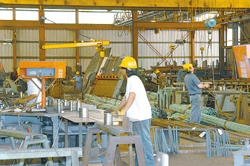
Barker Steel includes rebar, building products, forming and shoring and other products and services divisions. Eight of the facilities handle fabrication and distribution of reinforcing steel or rebar; the Pawtucket facility handles estimating and sales for rebar and building products, a construction service department (detailing and contract management support) and shop operations for rebar fabrication and forming (small light-weight steel panels used in construction to contain concrete). Barker Steel also sells construction accessories and safety equipment.
“Our mission is to be able to supply everything a contractor needs for concrete construction, except the concrete,” he said. “Some of our customers just want the rebar, others want the one-stop shop.”
Barker Steel also distributes “everything used in concrete construction,” according to Brack – chemicals used in sealant, all of the hardware and grouting, pallets of lime and even tools and gloves. The goal, he said, is to allow the contractor to be as efficient as possible in completing the project.
In the New England market, Brack said most of the projects for which Barker Steel supplies rebar and building products are public works projects (highway, wastewater treatment plants, bridges and schools), commercial construction and large and small residential projects. Customer orders range from just 20 pieces of rebar to 50,000 tons of it, like what was ordered for the Central Artery project in Boston (the company provided 65 percent of the rebar). Barker’s customers are general contractors, concrete subcontractors or people placing the steel.
Barker Steel incorporated its building materials business in 1984 when it acquired K-Ross Company in Lebanon, N.H. It was a natural evolution of the business, Brack said.
Many of the company’s customers are doing small projects in the scheme of things, he said, like 20- to 30-ton jobs, and having the building products, equipment and rebar in one location is time-efficient. They can also rent forming from Barker Steel, and get advice and building solutions from the staff.
While the majority of Barker Steel’s customers are working on small projects, the company is also providing 85 percent of the rebar for the Interstate 195 relocation project. The bridge portions of the project will use #18 bar, an inch-and-a-half in diameter, the largest used in the United States, Brack said. The New Jersey facility will put couplers on them to link the pieces of steel, and a New York contractor assembles the pieces into a cylindrical cage.
Reinforcing steel comes in 60-foot-long rods, and Barker Steel gets its rebar by rail from one of the three remaining mills in the country, Brack said. The company cuts them to length, bends them if a project requires it, bundles and ships them to the site. The company’s detailing group gets the engineer’s drawings for the project, determines the number of bars needed for the foundation or wall and the length and curvature of each piece. Every piece of rebar coordinates with the diagram that the contractor uses on-site.
Brack said the reinforcing steel business is a highly competitive one, but overseas competition isn’t much of an issue.
“Fortunately for us, from an ownership perspective, we wouldn’t do that, even if it presented itself,” he said. “Our business is really about location – we need to be able to service contractors’ needs, and we cannot fabricate steel in China to service the (Route) 195 project.” The rising prices of steel, however, have impacted the middle-market company.
“It’s been very difficult. What has happened in the last one to two years in the world economy and domestic economy in steel goes beyond anything people have seen before,” Brack said. “We’ve seen more than a doubling in cost of steel in a year, about 125 percent. We have contracts with people that we entered into a year ago,” and now the market has changed.
“We haven’t gotten to the point where we’ve had to cancel contracts, but the projects we have the most trouble with are the highway projects that go over a long period,” Brack added. “We are on allocation – we can buy this year what we bought last year, and everyone is on allocation – but if there isn’t enough steel to go around we’ll have to take care of the contracts that are paying us and we may not be able to service some contracts.”