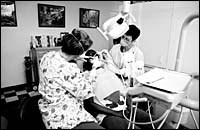
at the Joseph Samuels Dental
Center in Providence.
A bill now in the Rhode Island House Finance Committee would in some cases mandate that insurance companies directly pay doctors who don’t participate in their provider network.
Rhode Island’s two largest dental insurers, Delta Dental of Rhode Island and Blue Cross & Blue Shield of Rhode Island, now only pay dentists directly if they participate in their respective provider networks. If a subscriber sees a non-participating dentist, the insurer will pay the patient directly – not the dentist who provided the care.
And sometimes those direct payments to members are discounted, which means the patient is being penalized for choosing an out-of-network provider, dentists say.
Beyond Cash Donations: How New Forms of Giving Are Transforming Not-for-Profit Accounting
Evolving Funding Landscape for Not-for-Profits Not-for-profit organizations are being asked to do more with less,…
Learn More
The “assignment-of-benefits” legislation, introduced by Rep. Fausto C. Anguilla, a Bristol Democrat, is aimed at offering patients greater freedom to see the dentist of their choosing by allowing a health plan’s member to assign reimbursement payments to his or her dentist.
“There is currently a disincentive for consumers to choose an independent dentist because it will likely mean paying more out of pocket, and because it also means a billing and payment inconvenience,” Anguilla said.
Insurance carriers are staunchly opposed to the bill, claiming it would entice dentists to drop out of provider networks and ultimately result in higher dental insurance for consumers and employers.
About 95 percent of dentists now participate in either Delta’s or Blue Cross’s network. They agree to accept reimbursement rates lower than they would normally charge in exchange for the instant stream of patients that comes with inclusion in a network.
“The biggest benefit to a dentist participating in a network is that we pay them directly,” said Kathryn Shanley, vice president, external affairs for Delta Dental. “If you then say that anyone will be paid directly regardless of whether they participate, you’re eliminating an essential role of the network.”
Shanley disputes the notion that members who see non-participating dentists are reimbursed at a lower rate. She said 95 percent of the insurer’s 500,000 members are paid the same amount regardless of whether their dentist participates in the network, although a few Delta plans do penalize subscribers for choosing a non-participating dentist.
Because the participation rate is so high – Delta claims roughly 93 percent of the state’s 550-plus dentists participate in its network – the legislation would directly affect fewer than 50 dentists, Shanley said.
One of those is Dr. Joseph A. Russo of North Providence, who stopped participating in provider networks two years ago. His patients pay for services up front and are reimbursed later by their insurance company.
Russo said he would rather insurers pay him directly so his patients didn’t have to get in the middle. “Patients really don’t like getting involved in that process,” Russo said.
Dentists have said the bill would eliminate a major barrier to going independent, helping to erode what many dentists call a duopoly controlling Rhode Island’s dental insurance market.
“This could level the playing field a bit, and possibly allow more carriers to come into the state,” said Dr. Stephen T. Skoly, a Cranston oral surgeon. Skoly said more competition would lower premiums for employers and individuals and would make Rhode Island a more attractive market for dentists to practice – ultimately enhancing access to oral health care.
Although a handful of states have assignment-of-benefits legislation, Delta maintains that such laws have been successfully challenged in other states.
“It really isn’t the role of the legislature to tell a health plan how to pay,” Shanley said. “The marketplace determines that.”