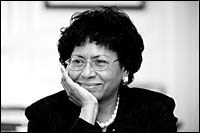
Name: Ruth J. Simmons
Position: President of Brown University
Age: 56
Beyond Cash Donations: How New Forms of Giving Are Transforming Not-for-Profit Accounting
Evolving Funding Landscape for Not-for-Profits Not-for-profit organizations are being asked to do more with less,…
Learn More
Education: Bachelor’s degree, summa cum laude, Dillard University in New Orleans; master’s and doctorate in Romance languages and literatures at
Harvard University
Background: Simmons began her academic career after serving as an interpreter for the U.S. State Department. Highlights include: director of
Afro-American Studies, and later associate dean of the faculty and vice provost at Princeton University; provost, Spelman College, Atlanta. Simmons was president of Smith College from 1995 until her appointment at Brown was approved unanimously by the Corporation of Brown University in November 2000. Simmons assumed her duties as president last July.
Residence: Providence
PBN: What did you expect to be your biggest challenge here when you accepted your position as president, and looking back over the past year, were you right?
SIMMONS: I think that I expected the biggest personal challenge to be that transition from a college to a university setting. And looking back, I think that I over-anticipated the difference. There isn’t as much of a difference as I thought there would be. The reason for that is, fundamentally, when you’re a college president, you’re dealing with educational issues: how well we teach, what we teach, what is that ‘value-added’ for students. There are big issues that are common to colleges and universities. That was surprising to discover how much the same those issues are, certainly, at the undergraduate level.
What has proved very different and challenging, of course – the other part of that equation, which is the graduate and professional equation – is the existence of a medical school, a large number of graduate students, Ph.D. students and all the research issues that accompany that.
Your Proposal for Academic Enrichment, which was approved by the Brown Corporation in February, targets faculty salaries and benefits, need-blind admissions, the creation of new faculty positions, library improvements and increased support for graduate students. How were you able to identify which areas need attention first?
One of the things that I certainly knew from all of my reading and meetings with faculty and students and administrators before coming to Brown is that there was a lot of planning that had taken place at Brown. I was not coming to Brown to invent planning. These discussions had been taking place in some instances for decades. As a consequence, I didn’t have to invent anything. I needed to listen . . . I really thought, frankly, that the faculty and others had already identified the issues. The problem they were having was convincing people they were the right issues and getting people to act on them.
Brown has a substantial endowment – the figure I have is $1.4 billion in 2000. How do you decide when the endowment should be tapped?
Sensible policy in recent years, across higher education, has been to reinvest as much as possible in the endowment, and that has led to fantastic growth in endowments. In order for Brown to remain competitive, obviously, we must have the same kind of policy. But here’s the thing: When you need to ensure the continuing strength and vitality of your core mission, your first obligation is to that. It’s not to grow your wealth. Your first obligation is to make sure that your students are well served and that the students who come along after that will be well served from the standpoint of the quality of education they receive.
One has to always keep at the back of one’s mind that an endowment is there to achieve that – it’s not there for us to look at periodically and to exclaim about how big it is. That’s not what it’s for. It’s there to protect our capacity to offer the best education. So I would say that how often you (draw from an endowment) very much depends on how your goals are being met and whether or not you’re satisfied with them being met at the requisite level. When and if you don’t think they are being met appropriately – and that you need additional resources – you should draw from that. That’s why people give to the endowment, because they want you to have the capacity to do that at some future point.
Tuition at Brown is approaching $30,000 a year for undergraduate students, and while the price tag of an education here is probably on the higher end, rising education costs are certainly not unique to the Ivy League. Is it simply becoming too expensive to gain a college education?
Well, first let me ask: Is $30,000 too much to pay for a car? Is $500 too much to pay for a round-trip train trip to Washington? You have to always consider tuition in the context of today’s economy and in relative terms to how costs have grown in the rest of the economy – that’s number one.
You have to also consider that education is doing something different today from what it was doing 30 years ago. Now, I like to remember, ages ago, when I was a student, education was a relatively uncomplicated thing: You had a faculty member, you had a desk and a chair and a reasonable library, but that was essentially it. That’s not the education that we’re providing now.
If the demand were created by the public for automobiles that had all kinds of enhancements on the automobile, then the price on the automobile would change, because you’d have to put those things into the automobile to be competitive. We now are in an environment in which parents and students want small classes. There was a time when we didn’t quibble very much about that, but now people want small classes because they know that that adds value.
They want sophisticated technologies, because to be able to enter the world and be successful they know that they have to deal with technologies. They want to be able to have the benefit of international scholars who teach them and they want to be able to travel internationally. They want to be able to do undergraduate research. When I was a student, nobody was doing undergraduate research at all . . . The cost of education has grown because we’re doing more, we’re offering more to undergraduates . . . I think that the value that colleges and universities deliver is disproportionately high when compared with the value that the public gets from other expenditures . . . To me, it’s well worth it. In fact, I’ve been known to say it’s a bargain.
Economists and state officials often tout Rhode Island’s colleges and universities as a tremendous boost to the business community, as a lure to attracting new businesses here. Do you see a part of Brown University’s role as being a catalyst for economic development in Rhode Island?
I certainly think that given Brown’s programs, its stature, and given the kinds of human resources it’s able to attract, it certainly should be a catalyst to economic growth and productivity within the region . . . It’s not unusual for businesses to be attracted to areas because of the presence of scientists and others who can provide the kinds of resources and intellectual capital that they need . . . Unfortunately, I think we are now in a position where some of the things we might do to attract additional interest to the area may be hampered by the fact that we have such difficulty in growing. That’s going to be the dilemma, I think, for our neighborhood, for the city and for the state.
You’re the first African-American president of Brown, or any other Ivy League institution. What sorts of pressures come with that role, being the first?
Having to do the job. That’s the biggest pressure. People look at you as somehow different but in the end, everyday that I get up, I have to do what any other president would do. I don’t get a break because I’m a woman. I don’t get a break because I’m a first and I don’t get a break because I’m African-American, gosh-darn it. If I thought that came with it, that would be fantastic. Then maybe I could come to work late, and maybe I wouldn’t have to work quite so hard and so on, but darn it, that’s what it’s like. Everyday I get up and I have to do the job of president. That’s what it’s like.
When you first accepted the presidency, much was made about the fact that you grew up in a disadvantaged part of Houston. What about the flip side to that – what about the advantages to that background?
The benefits are clear, and that is for me, poverty is not an alien thing. It’s something that I understand. Educational opportunity is not an alien thing. It’s not something that I sprinkle in my speeches because maybe I’ll get some bonus points for saying that maybe we ought to help the poor. I actually know what I’m talking about. There’s no doubt that there’s benefit to that, to actually know what the rest of the country is like – to know how kids grew up in some of these settings and try to make something of their lives . . . I can move across a spectrum of cultures without any feeling of displacement and fear.
You started your career as an assistant professor of Romance languages, teaching French. Do you ever miss the classroom?
I do.
Any chance you’ll teach here?
Well yes, there’s a chance, but frankly, here’s what you do when you’re president: I think about ‘What can I do for Brown that nobody else can do? What am I best at? What can I leave here that will be lasting? And how do I use what I bring to this in the most strategic way?’ . . . So, when I think about it, there are a lot of people who can teach well and who can probably teach much better than I can teach, but there aren’t a lot of people who can do what I do the way that I do it as president . . . Here’s what I imagine – which is always a fantasy for someone who’s been in the classroom – and that is I imagine in five years everything’s going to be perfect at Brown. I will have recruited everybody I want to recruit, the students will be gloriously happy, there will be no conflict and then suddenly everything is so perfect that I will go into the classroom where I will just sort of retire into history or something.
This is your first commencement as president here. In your remarks to this first class to graduate under your tenure, what do you hope to communicate to them?
I haven’t written it yet, but I’m sure I’ll be very emotional because I never want the students to leave. I mean, I know that they have to leave, but they’re leaving me here! There’s something always sad to me about that, because you never have another class like the one that you start with, ever . . . Somebody asked me once, ‘Why a college presidency?’ I think I responded that every year you get to send 1,300 people into the world that you’ve had a chance to lecture and try to persuade of the value of what you believe in, and you get to send them off and say to them ‘Don’t forget the following things.’ Not too many people get a chance to do that.