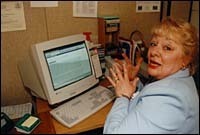
Providence. (Brian McDonald)
With records that date back more than a century and a filing system that spanned from her desk to a huge vault — Central Falls City Planner Elizabeth Crowley needed some high tech organization.
Calling herself “old school,” Crowley can remember using a typewriter to create huge files containing zoning ordinances, town council memorandums and municipal codes.
Beyond Cash Donations: How New Forms of Giving Are Transforming Not-for-Profit Accounting
Evolving Funding Landscape for Not-for-Profits Not-for-profit organizations are being asked to do more with less,…
Learn More
“Then if there was a mistake in the middle of the page I needed to start all over again,” she said. “It was very time consuming.”
Today life is very different for Crowley and other city and town clerks from around the state as many of them are embracing technology in their offices — indexing their records through a central database, scanning materials for storage and networking with other departments within town hall.
What the clerks are in fact doing, is bridging the digital divide that has long plagued the state’s municipalities.
“Previously all of our indexes were done manually,” said Valerie Perry who has been East Providence City Clerk for 10 years. “It took so much time. Then if somebody asked for information about a certain subject, it took even more time to retrieve it.”
Richard Pacia, one of the three owners of CompBase Inc., a Pawtucket based business that helps municipalities get their records on the computer, said for many time-saved is the selling point.
“We are living in a world where everybody demands immediacy,” he said. “Faxes, e-mail, and overnight mail have become the rule instead of the exception. The same thing is true with municipalities; residents want immediate access to the information and this a vehicle for that access.”
The cost varies from municipality to municipality depending on the number of records they are processing, said Jay Rosenfield, co-owner of CompBase. On average, he said, municipalities pay between $6,000 and $14,000 for an annual subscription.
It’s a cost Perry doesn’t mind putting in her annual budget. In fact, she said the system has caught on so well in city hall, she now shares the cost with two other departments.
“I don’t even remember what the initial cost was, but it costs us about $8,000 to maintain it,” she said. “If we had tried to do it on our own we would have had to hire someone and I am sure that the cost of that would have been far more than we paid.”
Crowley agreed.
“This has changed my budget, definitely,” she said. “But it has also changed it in the sense of staffing and what it would have cost to have a couple additional people in this office to do the work. I think over a period of time it will result in a cost savings for us.”
According to Rosenfield, the program allows individual offices in town hall to do their own research without depending on the clerk. For example, he said, if someone comes in front of the town council looking for a liquor license, a council member can type in the name and find out if that person has done any other business with the council.
“This has always been a research tool,” he said. “Before, if the mayor or town manager needed something they asked the clerk. Now they can do it themselves. They are saving a lot of time, and it’s much easier.”
Originally the company put all of the records on CD ROMs for individual municipalities, but now Rosenfield said, even more municipalities are getting on-line.
“With the infancy of the Internet we did everything on CD ROM,” he said. “But now more municipalities have high-speed Internet access right at their desk so we are using that medium.”
For Crowley, having residents of the city able to access information is even more exciting. And while the Central Fall Library keeps an updated copy of the CD ROM, Crowley said the Internet is definitely the next step for her.
“The more information you can get out to the public the less information that there is trapped in this office, ” she said. “That’s a good thing.”