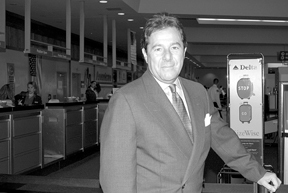
is upgrading facilities.
Airport chairman states case for longer runway at Green
Beyond Cash Donations: How New Forms of Giving Are Transforming Not-for-Profit Accounting
Evolving Funding Landscape for Not-for-Profits Not-for-profit organizations are being asked to do more with less,…
Learn More
James V. Rosati
Age: 53
Position: Chairman of the Rhode Island Airport Corporation board (RIAC)
Background: A banker for 22 years, Rosati left that industry and joined
Cookson America, running the conglomerate’s worldwide telecommunications group.
He left Cookson to form the Financial Partnership Group LLC, a financial services
company. Rosati is also a principal at Riparian Partners, an investment banking
firm in Providence.
Education: Bryant College
Residence: Narragansett
Q. What is the RIAC budget? And is that amount sufficient right now?
A. I believe it is about $45 million. I would say the $45 million is
sufficient to cover all of our expenditures.
Q. Recently, Jet Blue announced a Boston service. What needs to happen
to keep T.F. Green competitive with the low-cost, long-haul airlines?
A. Well, I think there are a number of things that we need to do at
Green. The airport is certainly at a pivotal stage in its development. The board
and myself are faced with many critical issues regarding the future. There are
really three items. We need to remain competitive, by developing facilities,
which allow us to attract additional low-fare air fare service and keeping our
rates, charges and fees in line with our competing regional airports. We need
to remain convenient by retaining our ease of access to and through the airport.
And Green needs to remain customer friendly.
Q. What types of facilities need to be developed to remain competitive?
A. There are several things. We’ve just gone through major revenue
for bonding to enhance the security systems, like putting the EDS (explosives
detection systems) machines behind the wall. We’re going to put ramps in, so
when you come to the concourse, you’ll be able to go directly to the baggage
area. We’re also going to add gates and ticket counters, which will put us in
a position to have the facilities available for additional flights. It is important
on the security side to open the area so people can get through easier, which
is certainly a high priority for us.
Another issue we’re faced with is the lengthening of the runway. A master
plan was started three years ago looking at the impact of where does the airport
go. I think that the consensus was clear that the 9,500-foot runway is what
we needed at Green. The only issue was at what point in time. The master plan
talked about some time out in the 2015-2017 area but because of competition
and changes to the economic condition and overall marketing opportunities, we
feel it is imperative that Green has a 9,500-foot runway. Manchester is at 9,250;
Logan is at 9,500 and Hartford is at 9,500. It is putting us at a competitive
disadvantage not to be on equal footing with our neighbors.
Q. What stage is RIAC at with the master plan?
A. Back last year, prior to me taking over as chair, the board requested
a 7,500-foot runway, approximately a 300-foot extension. I’ve requested the
FAA (Federal Aviation Administration) put a temporary hold on that review and
asked them to look at a 9,500-foot runway. We are in the process of putting
a purpose-and-need statement together and we’re hopeful by the end of the year
we will have sufficient data in a white paper to convince the FAA to look at
a 9,500-foot runway. We are working hand-in-hand with the FAA. I had a meeting
in Boston (recently) with the FAA, EPA, DOT and Amtrak to discuss this process.
Q. Can you speak to the changing dynamics of the airline industry?
A. People are looking now for point-to-point (flights). People no
longer would like to get on in Providence, go to another hub, wait in line again
and then go onto their destination. Carriers are looking for point to point
and also they’re increasing the size of their aircraft. So you have the dynamics
of the whole market changing and that’s why it’s important for us to look at
our competitive advantages or disadvantages, with not having a longer runway.
Q. If the report to the FAA requesting the longer runway is approved and
they agree to examine the 9,500-foot runway, what is the next step?
A. The public will be part of the process. As a result of the FAA
hopefully agreeing with it, they will do some environmental impact studies,
air quality, traffic, etc. and then they will have a series of public meetings.
In that process, the public will have an opportunity to speak to the issues.
Looking at the Greater Providence Chamber of Commerce report data, overwhelmingly
the population, certainly the business community, is looking for expanded service
and point to point. The business community is 100 percent for the expansion
as well as the Chamber.
Q. Again, assuming the FAA accepts the change, in your estimation what
is the timetable?
A. The (Environmental Impact Statement) process, on a quick track,
is probably 18 months to 24 months – could be a little longer. Once they come
back with a positive, then it is a matter of putting architectural and design
plans out and then start construction. We’re still several years away from actually
beginning construction.
Q. Where do you stand in regards to the inter-modal system?
A. The inter-modal is all part of the purpose and need and discussion
with the FAA. It will continue to be part of the process but I can’t tell you
at this point ultimately where we will end up.
Q. In your opinion, right now, what does the inter-modal include?
A. It will include the train station, a consolidated rental car facility,
bus service and a people mover. And one of the issues that has come up is the
connection of the people mover between the airport and the train station. Could
that be handled in a more economical way by using electric buses to transport
people, at least during the early phases? Could the people mover be added later?
No decisions have been made whether or not it (people mover) will be part of
it (the inter-modal station). The people mover is an open issue at this point.
Q. Do you like the idea of the inter-modal station and is that a need right
now to keep Green competitive?
A. If you look at the success of inter-modal systems, and probably
the most successful one would be in Baltimore, the percentage of passengers
that actually use it (in Baltimore) is probably less than 10 percent. And that
is one of the more successful in the country. Clearly from an optimized situation,
sure it would make a lot of sense but how much usage you would get early on
is questionable at this point. You would have to have train schedules that are
compatible with flights. For example, we have approximately 3,500 seats that
leave between 6 a.m. and 8:30 a.m. So for convenient rail, someone coming from
Boston or 128 to arrive here at an hour before a 6 a.m. flight, they would probably
have to leave around 4 a.m. To date, there are no compatible train schedules.
It brings up a whole number of issues. Are the trains equipped to carry luggage?
Q. Sounds like you are questioning the return on investment. If you put
so much money into a facility like this, will I get the money back?
A. I think that ultimately, if you look to the future and will the
public be traveling more by train than car. It makes a lot of sense. The question
is right now, economically, would it be better to phase it, maybe not? But no
decision has been made at this point whether to do it or not. The prime objective
is we need 9,500 feet to be competitive and we need to do everything we can
to have the FAA to agree to amend our EIS. We cannot put the state, and I do
say the state, at a competitive disadvantage.
Q. Aside the 9,500-foot runway, any other personal goals you would like
to accomplish as chair?
A. Well, I think my personal goals are to make Green, as I said earlier,
competitive, convenient and customer friendly. We received an award recently
that we’re one of the safest airports in the country. It’s important for us
to make what we have better – ease through the airport, customer friendly, give
people the flights to the destinations that they would like on a timetable and
just make it, overall, make it the most premiere airport from all different
avenues in the country.