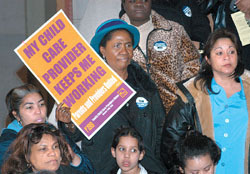
Parents, children and child-care providers attend a rally at the State House Jan. 20 to push for legislation that would unionize day-care providers and make them independent contractors for the state.
Under legislation, providers would not be state employees
Day-care providers held a rally at the State House recently to help draw support for a plan to unionize and become independent contractors for the state.
One Providence day-care provider, who only wanted to use her first name, Geralda, said benefits and a regular paycheck are critical in coping with seasonal slowdowns.
Seifert Systems Invests in Energy Efficiency to Strengthen Operations
For manufacturers, energy is more than just another operating expense. It plays a critical role…
Learn More
“I have to pay the same bills as everyone else; I have the same electricity to keep on,” said Geralda, who has operated her business for two years from her home.
She was among at least 100 other child-care providers, mostly women, who gathered on Jan. 21 for the rally. They want lawmakers to pass legislation that would make them all independent contractors for the state.
The Family Child Care Providers Act of 2005 would allow child-care providers to negotiate a legal contract with the Department of Human Services and the Department of Children, Youth and Families. The providers would not be state employees, however.
“This is so we can have a voice; it’s been very difficult,” said another Providence day-care provider, who did not want her name published.
She has been running her day-care center out of her home for five years.
She said she runs her day-care center from 6 a.m. to 11:30 p.m. It’s a long day, and there are supplies and materials she always needs, and sometimes there are lots of children, and sometimes none.
“It’s like a yo-yo; you have good times and you have bad times,” she said. “And I have to put money aside when I get that paycheck. (The state) doesn’t take out taxes, so we have to pay those at the end of the year, and we can’t pay into Social Security.”
Currently, the union, District 1199 of the Service Employees International Union, and state are in Superior Court over the state labor board’s decision to give providers the right to unionize, which the state is appealing.
If the legislation passes, union officials have said they are willing to drop the suit. But according to Jeff Neal, a spokesman for Gov. Donald Carcieri, the state is not interested in negotiating.
“Governor Carcieri believes the court case should go forward so we can get a final decision,” Neal said. “This will ensure that the state labor relations board doesn’t continue to create new state workers where they don’t exist. Unions negotiate with the employer, and the state is not the child-care providers’ employer – the individual parents who hire them are.”
Providers caring for children who qualify for child-care subsidies, however, depend on checks from the human services department, which pays for that care, said Matthew Jerzyk, an organizer for District 1199 of the Service Employees International Union.
Parents making $30,000 or less annually qualify for subsidized day care so that they can work. The provider must fill out paperwork for the child and send it to the Department of Human Services, which then pays the provider. There are approximately 32,000 parents in Rhode Island utilizing day-care services, and 35,000 children in the day-care system, with almost 14,000 eligible for the subsidy, according to R.I. Kids Count and a 2003 study from Bryant University.
“It’s never been about becoming state employees,” he said. “It’s about having a contract with the state and having a voice in the system.”
Among child-care providers’ major complaints are that they only get paid once a month, and even in those cases many times their pay comes late; there are not enough training opportunities; not being able to purchase educational materials in bulk like educators; and not being able to include their spouses on health care plans.
Forming a union and passing the act would allow them to settle some of these terms, Jerzyk said. But the state disputes the group’s need to unionize.
“We can’t lose sight of the purpose of the (child-care) program – to protect children,” Neal said. “The governor does not believe that the health and safety of the children is negotiable. He does not dispute their right to organize … but he won’t agree to a contract where providers would negotiate terms with the state. The state is not the employer.”