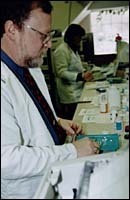
Mesnick of Cameron's
Pharmacy in Pawtuxet.
(Photo, Tom Croke)
The shortage of pharmacists has become a local — and national — problem.
Louis Luzzi, dean of the School of Pharmacy at the University of Rhode Island, said the shortage of pharmacists has been “brought on primarily because the pharmaceutical industry is hiring pharmacists by the fistful.”
Seifert Systems Invests in Energy Efficiency to Strengthen Operations
For manufacturers, energy is more than just another operating expense. It plays a critical role…
Learn More
“They’ve discovered that pharmacists can not only act as salespeople for the companies, but can monitor clinical trials and answer questions from other pharmacists and doctors across the country. In my opinion, that’s the major cause,” said Luzzi.
Luzzi estimated that a pharmacist just starting out at a major pharmaceutical company could make between $80,000 and $100,000 a year, plus “when a pharmacist works for a drug company, they don’t work nights or weekends.”
URI has one of only five pharmacy programs in New England (the others are at the University of Connecticut, the Massachusetts College of Pharmacy – which has two locations – and Northeastern University), and graduates between 80 and 90 pharmacy students each year.
A third of URI’s students are from Rhode Island, a third from the rest of New England and the balance from New York and New Jersey, Luzzi said.
“The applicant pool has always been ample and is growing,” he said.
Eventually, Luzzi hopes to increase the number of pharmacy students at URI, but first that will mean increases in staff and facilities, the plans for which, he said, are “in the works.”
“It goes beyond just pharmacists,” said Ed Quinlan, president of the Hospital Association of Rhode Island (HARI). “This is a situation that has been appearing in different parts of the health care industry. It’s a national – if not an international – problem.”
Quinlan said that while he didn’t have figures for pharmacists, a decline in applications to nursing schools has resulted in 400 unfilled budgeted nursing positions in Rhode Island.
To help turn kids on to careers in health care, HARI is partnering with area hospitals and universities, the state Department of Education and the state Department of Labor and Training to get information about careers in health care to students.
Through an externship program, middle school and high school teachers are invited into health care settings for two-week periods and have the opportunity to learn first-hand the Rhode Island skill standards for health care workers. Teachers then develop a curriculum based on their experiences and take what they’ve learned into their classrooms.
Health care accounts for 15 percent of Rhode Island’s economy, Quinlan said, and at a hospital, “over 60 percent of the operating budget is going to be people. You can’t automate health care. These are people.”
Mike DeAngelis, spokesperson for CVS, said the company employs 12,000 pharmacists in its 4,100 stores in 31 states.
The demand for pharmacists is high, DeAngelis said, because “the demand for prescription drugs is rising.” Heightened public awareness about the drugs available and the country’s aging population are factors, he said.
DeAngelis said employee retention and recruiting are priorities for the Woonsocket-based company, which expects to open or relocate 300 new stores in 2001.
CVS has refocused its recruiting efforts to a more nationwide scope, not just recruiting from those states where the company has stores. Also, CVS is developing a CD-ROM, which will be sent to pharmacy students as a promotional tool.
According to Catherine Cordy, acting chief of the Rhode Island Board of Pharmacy, there are 40 solely owned pharmacies in Rhode Island.
“The number has decreased over the years,” she said. “But it’s remained pretty constant for the last few years.”
“There are some places in the country where independent pharmacies are coming back,” URI’s Luzzi said, mentioning Maine and Mississippi as two of them. “The areas where chains and big business are suspect are areas where independent pharmacies can carve out a niche.”
Steven Mesnick, who said independent pharmacies are all but extinct in his native Massachusetts, is a pharmacist at Cameron’s Pawtuxet Pharmacy in Cranston.
Mesnick has worked in hospitals and chain pharmacies, but started at an independent pharmacy 30 years ago when he graduated from the Massachusetts College of Pharmacy. Now that he’s at Cameron’s, Mesnick said that he’s in independent pharmacy to stay.
“The opportunity to actually practice my profession is actually greater than in chain pharmacy,” Mesnick said. “The level of workload in the chains is utterly phenomenal. I can be more of the old style community pharmacist. We know our customers. With a chain, I don’t think there’s that connection. If there’s an issue, we know the patient and can head off problems before they occur. We know what the patient has had in the past. If we need to get in touch with their insurance or doctor, we know them. It’s a more personal connection.”
That level of service is “a competitive edge that we can provide, but quite frankly, that’s the kind of pharmacy I want to practice,” Mesnick said. “It’s why I’m here.”