INTERVIEW
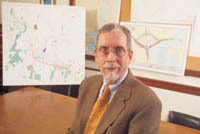
Edmund T. Parker Jr.
POSITION: Chief engineer, R.I. Department of Transportation
BACKGROUND: Parker joined the RIDOT 34 years ago as a bridge engineer. Over the years, he has held positions in traffic and highway engineering and was chief of design before he became the chief engineer – second in command at the RIDOT – three years ago.
EDUCATION: B.S. and M.S. in civil engineering from the University of Rhode Island; registered professional engineer.
RESIDENCE: Cranston
AGE: 58
The last few years have been a time of heavy road construction and redesign across Rhode Island, with highways undergoing long-needed repairs but also being updated to better handle today’s heavier traffic in Providence and in the suburbs. All told, nearly $1.4 billion in major construction projects are under way, including the relocation of Interstate 195. Ed Parker is overseeing it all.
Seifert Systems Invests in Energy Efficiency to Strengthen Operations
For manufacturers, energy is more than just another operating expense. It plays a critical role…
Learn More
PBN: The Route 195 project is now five years old – with about two years of actual construction. Could you give an update of where the project stands?
PARKER: We are about 50 percent done with the construction activities. Most of the big projects are [bid] out to construction, and we are keeping pretty much on schedule. We are looking to open up eastbound Route 195 in 2007 and westbound Route 195 in 2008.
PBN: What are the biggest obstacles to a project of this magnitude?
PARKER: The soils in the area are not the best for building. We have to be very careful in the foundations we build. The city is a built-up urban area, and there have been issues with contaminated materials in the area that were addressed in design and construction. All through the process, we have tried to minimize the impact on the motoring public as much as possible. To date, I think we have been very successful in doing that. Starting in 2007, there will be more challenges, because we have to start tying in the new roadway with the old roadway. The greatest impact is going to be opening and closing ramps. There will be adjustments that the public will have to make starting in 2007.
PBN: Is the project on time and on budget?
PARKER: It is definitely on time, and considering some of the surprises we have had in terms of escalation in steel and concrete costs, overall we are not doing too badly with the budget. Complete demolition and reconnection of city streets is slated for 2012, and the latest figures have the project at about $600 million.
PBN: What can people look for in terms of continued construction on Route 195 and Route 95 as the spring approaches?
PARKER: This year and 2007 will be the biggest construction seasons for Route 195. The highlight of the construction season will be taking the steel assembled in Quonset and shipping it up the river in late spring or early summer and putting it in place for the new Providence River Bridge.
PBN: A separate project associated with the Interstate 195 relocation is the new Washington Bridge. How is that project progressing?
PARKER: Sometime in late summer or early fall, we plan to move traffic onto a part of the new bridge. During the 2007 construction season, the remaining portion of the old bridge [eastbound] will be demolished except for a portion of the bridge planned for a pedestrian overlook. During 2008, the remaining portion of the new bridge will be constructed. At some point in 2009, we will probably have the highway bridge portion of the project done. The whole project is pegged at $43 million. Drivers will notice traffic will be shifted north and the four lanes in each direction will be wider.
PBN: Another project in Providence is to improve the Route 6/Route 10 interchange. What will this project entail and when will this start?
PARKER: Right now, we are finishing the environmental impact statement. The first draft of the EIS had a significant impact on some residential property. We made some alignment adjustments to shift the roadway away from those structures. One residence and one business are being impacted. We hate to take people’s private property, but similar to Route 195, the more construction we can do off of the existing alignment, the less impact on the motoring public. If we try to replace those bridges on the exact alignment that they are right now, it would take much longer, and there would be significant impacts on traffic. The reason we did this project was the condition of the bridges, which were built in the 1950s for much less volume. One of the big driving forces was based on the fact a driver on Route 10 north cannot get directly onto Route 6 west, adding traffic in the Olneyville area. Preliminary estimates have the project costing $220 million.
PBN: Overall, how would you rate the state’s current roadway infrastructure compared with 20 years ago?
PARKER: Certainly, we have more cars on the road than 20 years ago … causing an increase in congestion. There is a correlation between congestion and safety. The more congestion at an intersection, the more people tend to run red lights, leading to more accidents. There are mechanisms in place like the intelligent transportation system that connects traffic signals and updates drivers to accidents or congestion ahead. Information is available on the Internet and TV, and the next big step is to get the information directly into the car.