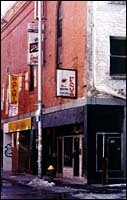
in downtown Providence.
Ask the ladies at Axelrod Music on Weybosset Street about Downcity’s past, and their eyes light up.
“My grandmother used to take me to Shepard’s Tea Room,” said Sandy Cabral, who is co-owner of the store, a downtown fixture for over 90 years. “That was the ultimate.”
Beyond Cash Donations: How New Forms of Giving Are Transforming Not-for-Profit Accounting
Evolving Funding Landscape for Not-for-Profits Not-for-profit organizations are being asked to do more with less,…
Learn More
Clerk Pauline Carreiro remembers going to shows at the Strand Theatre, where she saw everybody from Fats Domino and Jerry Lee Lewis to Brenda Lee and Buddy Holly.
Store manager Jackie Davies used to go to movies at the Loew’s State Theatre (today the Providence Performing Arts Center) when ushers still wore uniforms with cupcake hats.
“We’d move from seat to seat until the ushers would say ‘One more time and you’re out of here,'” said Davies.
Today, it is a very different Downcity.
“Then, it was safe to walk around down here,” Carreiro said. “Today, looking at it now, it’s a poor town.”
Walk down Westminster Street, and Downcity’s rich retail past is evident: huge buildings at the former sites of Shepard’s and Peerless, the Providence Arcade, the ornate Tilden-Thurber Building, the “Tri-Store Bridge” that still spans the alley that separated Shepard’s, Cherry & Webb and Gladding’s.
“The big guys were downtown,” said John Gounaris, professor of international studies at Johnson & Wales University and a former chief executive officer at Apex.
In recent years, a number of Downcity retailers and restaurants have left the deteriorating conditions of downtown for other Providence locations or have closed up shop for good: Gallery Flux, Miko’s (now on North Main Street), Lerner New York, Cityside Restaurant, CEO Gifts and Blimpie/Chowderhead’s.
Weybosset Street mainstay Ross-Simons moved to Providence Place when it opened in 1999.
“The mall is what’s altering the complexion downtown,” said Gounaris.
In his Apex days (the early 1990s) — and even before, Gounaris said — competition was everywhere but Providence: Warwick, North Attleboro and Swansea, at stores like Penny’s, Ann & Hope, Circuit City and Sears.
“Today, how could you possibly ignore Lord & Taylor and Nordstrom?” he said.
With its empty storefronts and a mostly weekday crowd, “the viability of it (downtown Providence) as a retail area is nonexistent,” Gounaris said.
The latest casualties: Hit or Miss and Chasen’s, which are going out of business, and the Bush Gallery and 10,000 Villages, which have moved to new locations on Wickenden Street and Thayer Street, respectively.
Mike Bryce, owner of the Bush Gallery, said that while tours on Gallery Night always gave his business a boost, “as far as general walk-in traffic during the day, sales were rare.”
The difference of being located on Wickenden Street has been immediate.
“My first two days here, I had two big sales,” he said. “Walk-in traffic in the first hour of unpacking was greater than a full day downtown.”
Gift store 10,000 Villages hopes to find similar success on Thayer Street, after being open on the first floor of the Arcade for six months.
“Downtown is not where you want to be for a retail environment,” said Phil Trotter, assistant manager. “There are a lot of empty stores down there. People didn’t come in to shop.”
Last fall, the Rhode Island Foundation announced the creation of a $9 million revolving loan fund, designed to aid the redevelopment of the six-by-eight-block commercial district bordered by Pine, Sabin, Dorrance and Empire Streets.
The fund will help cover some of the “up-front” costs of development, such as lawyers’ and consultants’ fees, according to Rick Schwartz, the Rhode Island Foundation’s director of communications. The money must be paid back.
“That would be $9 million that would keep revolving,” he said.
The foundation is still in the process of recruiting candidates for an executive director of a new nonprofit organization, DownCity Partnership, Inc., which will lead the project.
“We’ve hired an executive search firm, and have identified some candidates,” Schwartz said. “We’re hoping to have somebody on by July — not as soon as we’d hoped.”
Schwartz said the ideal candidate would have a background in urban planning, economics or development; someone “multifaceted, who can see the future for Downcity, and can sit down with theatre people and art people and planning people and say ‘Here’s how we could make it work.'”
The Rhode Island Foundation has also granted $1 million for the relocation of Traveler’s Aid from Union Street, possibly to the YMCA building on Broad Street.
“They’ve already received $100,000 of that for a feasibility study,” Schwartz said.
The study will begin the process of evaluating repairs needed on the 88-year-old YMCA building on Broad Street.
Schwartz said that, if it works, it would be a win-win situation: Traveler’s Aid would get a bigger building, their space left open for the Sundance Theatre or another project.
“It makes it more possible to attract more high-end development people,” Schwartz said. “It’s a situation that benefits everyone.”