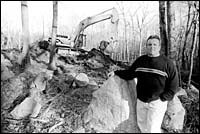
site on Tillinghast Road
Although the actual impact of East Greenwich’s new $8,100 impact fee won’t be felt until this spring’s building season, builders are bracing themselves for a cost that they fear might slow down development.
Effective Dec. 17 last year, the new ordinance put East Greenwich ahead of Coventry for Rhode Island’s highest impact fee – $7,600. The ordinance came after a $60,000 growth study by Maryland-based consulting firm Tischler and Associates. The firm set the rate and determined where the money would be allocated: approximately $4,617 (57 percent) will go to public schools, $1,539 (19 percent) for open space, $1,539 (19 percent) for parks and recreation and the remaining $400 (5 percent) would go toward public buildings.
Roger Warren, president of the Rhode Island Builders Association, said he is not surprised by the town’s hike from its previous $1,850 per lot.
Seifert Systems Invests in Energy Efficiency to Strengthen Operations
For manufacturers, energy is more than just another operating expense. It plays a critical role…
Learn More
"It seems to be the trend these things are going in," he said. "In essence it seems like a growth-control tool. If they raise it high enough they’re going to slow down building."
Gerry Zarrella, president of East Greenwich-based Zarrella Development, was equally disturbed by the newer figure.
"I don’t call it a fee, I call it a builders tax," he said. "It’s really a tax on people who have not come into town yet."
Town Manager William Sequino, Jr. said he doesn’t care what people call it.
"I think you can call it what you want to call it, and when people don’t like paying it, it’s a tax," he said. "When you build a two-bedroom house it’s $8,100 and when you build a four-bedroom house it’s $8,100, so it’s not a tax because everybody has the same fee."
Zarrella said a tax would actually be fairer. His take on the matter was that if it were actually called a tax, and taxes were raised, the townspeople would not be as likely to re-elect the town officials responsible for raising those taxes. He said new units should be taxed according to size and cost, not carte blanche.
"If I’m building a six-bedroom house I’m going to be impacting the schools and community, so I should pay this impact tax," he said. "But if I build a condo that’s for a senior, I’m not really going to impact the community as much. All the kids are moved out."
Zarrella said he plans to run for office so that might change the things to which he objects so strongly. He agrees that there should be some sort of fee, and he holds the quality of the town’s school system in high regard, but he blames the lack of commercial income for the town’s need to hike the fee so high.
"It seems that the only source for income the town has is property taxes and fees," he said. "So they raise the fees so they can have more money."
East Greenwich Building Official Donald Daily said people who are planning on building any sort of new development in the town know it’s going to be expensive anyway, and that the impact fee is not an unaffordable stretch for these people.
"I don’t think it will have that much of an effect because of the housing market," he said. "It’s going to have a big impact on a house that is $150,000, but it is not a huge extra for something that’s going to sell for $750,000, and most of the houses here are in the higher end."
Sequino agreed.
"It’s a small percentage of what the houses go for in East Greenwich," he said.
Zarrella said he disagreed with the way the fees went into action immediately after the vote occurred, and that he has four or five houses he is working on where the company will have to absorb the impact fees.
"The town should have been a little more sensitive," he said. "Even the IRS has a grace period."