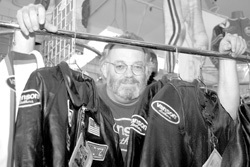
Michael van der Sleesen
Position: Owner, Vanson Leathers, Fall
River
Beyond Cash Donations: How New Forms of Giving Are Transforming Not-for-Profit Accounting
Evolving Funding Landscape for Not-for-Profits Not-for-profit organizations are being asked to do more with less,…
Learn More
Background: Started the company in 1974 in Boston, moved manufacturing
operation to Fall River in 1987 and in 1998 brought entire operation to the
city.
Residence: Lakeville, Mass.
Age: 52
Michael van der Sleesen is the founder and owner of Vanson Leathers, which
designs and manufactures handmade leather products. The company is widely known
for its protective motorcycle suits, jackets and gloves. Van der Sleesen says,
like most U.S. manufacturers, his company is at a disadvantage as it tries to
compete with overseas companies that benefit from work force costs that are
at a fraction of those in the United States. Since 2001, the company’s employee
levels dropped from 154 to 110. Sales are down from $12 million to $7 million
during the same period.
The increase in health care costs and new tariffs in Europe are making Vanson’s
job even more difficult, he said. Despite the obstacles, van der Sleesen says
his company continues to be a model in the industry because of its quality products
and innovations in design.
PBN: You really don’t draw much attention locally, at least not from those
outside the motorcycle world. How big and popular is your company?
Van der Sleesen: I like to think we are probably the largest custom
and semi-custom leather jacket maker in the world. With regards to racing suits,
we are certainly the largest producer in the United States. We sell our stuff
all over the world.
Q. Who are your typical customers? Do you appeal to the Harley riders or
Japanese-made bike riders?
A. We have traditionally focused on the European sport bike market,
the high-end sport bike market, the Japanese market, we’re focused on Buell
(the sports bike of Harley-Davidson). That is our forte. It’s the aggressive
type rider who needs the protection, knows what he is looking for and willing
to pay for it.
Q. What’s the average cost of a racing suit?
A. Around $1,250 to $1,300. We can go as high as $2,500 and as low
as $895. With a racing suit there is a lot involved. It’s not like making overalls.
There is a lot of technical design that goes into making each one.
Q. Who is your competition?
A. There are people making high-end suits. In California, there is
an outfit called Bates (Leathers) and there are some other guys here and there.
Certainly, there is a lot of foreign competition, like Kushitani in Japan.
Q. How did Fall River become your home?
A. We were in Boston and we needed to find a place that we could afford.
We also couldn’t find the people who are actually involved in this trade any
longer.
Q. Fall River, of course, has been known for its textiles and other manufacturing
but can you see that reputation slipping simply because the work isn’t there
to keep that work force strong. Also, the city has made an attempt to move toward
a service-oriented economy. Are you concerned?
A. Yes. I think the future of manufacturing is dismal.
Q. What percentage of your business goes overseas?
A. About 40 percent. We do the European Union and Japan. In the European
Union we have problems because we have this punitive duty in now and they’ve
added a supplemental duty that started at 5 percent on March 1. They’ve added
a percent to it every single month, so now we are around 11 percent. That’s
in addition to the existing duty rates going in around 7 percent, as well as
the additional fees. Our sales going into Europe have been hit pretty heavily
by that. That’s a duty that was imposed because the United States so far has
not dealt with its foreign income sales corporations that were ruled against
them by the World Trade Organization as being an illegal subsidy to exporting
businesses. So the Europeans gave the United States from September to March
to modify its tax code, which the United States government did not do. The result
has been this supplemental duty, which has really clobbered us.
Q. Do you think the manufacturers’ woes are being heard in Washington?
A. We can send a smoke signal up to the White House. The White House
talks about how they are all pro-business and how they are going to do all these
things for us, but, meanwhile, they just stand around and let something like
this happen, which is croaking us.
Q. What has this tariff meant to you in cash so far?
A. It has probably cost us three-quarters of a million dollars in
sales and cost us four or five jobs here and a couple jobs at the tannery. There
is all the talk that Washington is pro this and pro that but nothing is happening.
There is no relief. This duty will go up to 17 percent, with its 5 percent base
and 1 percent per month for a year. When we get to February of 2005 – if nothing
happens – we will be at 17 percent, and there’s existing duty and the fees too.
Plus, in Europe there is the value-added tax that is roughly another 20 percent.
That means that if we ship out a $100 coat to Europe, when it is all said and
done in February … that coat will cost the European $150. That’s a tough trade
barrier to overcome.
Q. What’s your alternative?
A. We could make stuff in Pakistan and ship it directly to Europe,
and there wouldn’t be a problem anymore. But that isn’t the point of American-manufactured
goods, now, is it?
Q. Your company says it has built its reputation by making leather goods
that are meant to last. How does this shift in society to cheap goods that are
basically disposable and easy to replace affect your company?
A. Here’s a letter I got today from a customer: “Enclosed are pictures
of the leathers I bought from you five years ago. I want to thank you because
they protected me from major injury. I went down going 185 mph at a small track
in Wichita, Kan., on April 14, 2004. I got away with only cuts and bruises.
… As you can see (the suit) is still in pretty good shape after the ordeal,
except (from the damage) from when the EMTs cut them off me…”
These letters happen all of the time and that’s why we are in business. The
goal is to make something worthwhile.
Q. Your company recently started making a second-tier product, manufactured
elsewhere, using machines and sold at a lower price. Why was that decision made?
A. We’re in the garment business, which has undergone a deflation,
probably more than most industries. Leather jackets have fallen in price relative
to the strength of the dollar and the foreign labor. In the United States we
have certain issues we are facing as a manufacturer, health care being one of
them. It’s a very tough environment for a manufacturing company. At the same
time, the market has changed. What people are willing to pay has declined.
Q. How different is this other product from what you have been making?
A. It can’t differ too much, because we have our basic philosophy.
What has set us apart from our regular competition is the fact that they are
all totally prepared by hand. If you can prepare a product by machine, not by
hand, it doesn’t give you the same leather. It doesn’t give you the same look,
the same quality … but it is a leather jacket. In some cases, that’s how people
are looking at it.
Q. Your manufacturing and design appears to be quite sophisticated in terms
of the use of computers that track the production of each suit and the analyses
of sizes. How did that come about?
A. The analyses of the measurements is something I developed. It came
down from the problem of people never having accurate measurements. Our experience
has been to get the measurements that we get and compare those ratios to a similar
population based on the height, the weight and some of the key points. And from
there we can extrapolate the measurements you have opposed to the population
bell curve and figure out which ones don’t look right.
Q. Your products have a place in professional racing and as we know marketing
is huge for any product competing in a sports market? Are you active in sponsorships?
A. We don’t give away our product to racers; you can go bankrupt that
way. We do limited sponsorship. People who use these suits choose them because
they work. There are companies who buy their position frequently. I’ve been
doing this long enough to see a lot of companies come and go. When I started
there were probably 100 different companies within Route 128 around Boston that
were involved in the leather industry. That’s all gone. There are almost none
left. It’s a little bit like the Attleboro jewelry industry.
Q. Aside from motorcycle enthusiasts, Vanson also enjoys success with trend-setters,
like actors, athletes and rappers. How big of a market is that for you?
A. It’s big, it’s really big. It is an evolving market that changes
every year. We have a lot of celebrities wearing our products. We have done
stuff for Daniel Day Lewis, Matt Damon, Schwarzenegger and LL Cool J.