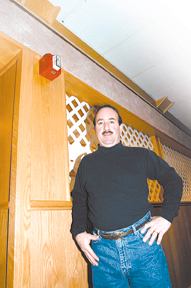
Johnston, stands below his recently
installed fire alarm.
Sprinkler
companies face challenge to keep up with the added business as Feb. 20 deadline approaches.
Area fire-protection companies are recording an upswing in consultations and
may need to beef up their work force as Rhode Island businesses race to meet
stringent new fire codes enacted after The Station nightclub tragedy.
Businesses have to comply with many of the new fire code regulations by Feb. 20, the first anniversary of the West Warwick fire that claimed 100 lives and injured many more.
Beyond Cash Donations: How New Forms of Giving Are Transforming Not-for-Profit Accounting
Evolving Funding Landscape for Not-for-Profits Not-for-profit organizations are being asked to do more with less,…
Learn More
Code changes include the elimination of grandfather clauses, which exempted older buildings from some code compliance and lowered the place of assembly occupancy rate from 76 to 50. There are also new specifications for sprinklers and fire alarms.
According to Dave Baer, vice president of sales and marketing for SimplexGrinnell, calls to his East Providence office have doubled in the last month. Prior to the surge, the branch received on average about 15 to 20 calls weekly, he said.
“It’s amazing,” said Baer, adding that the company expected increases due to the stricter regulations. “The most common question is, ‘What do I have to do?’”
SimplexGrinnell is a national provider of sprinkler, fire alarm and suppression systems. The company also offers consulting services to help a potential client get started.
Tom O’Connor, president and CEO of Fire Suppression Services Inc. in Pawtucket, said his company has “definitely seen more retail and places of assembly customers” call to inquire about budgets and timelines. He estimates a 15 percent to 20 percent increase in calls.
“So far we don’t have any signed contracts,” he said, adding that he thinks it will only be a matter of time. “You can tell there is an increase brewing.”
He thinks after Jan.1 the company will be very busy. Suppression Services also handles installing, testing, inspecting and repairing of sprinklers, alarms and suppression systems.
Should consultation calls turn into signed contracts, businesses could be faced with a wait.
“Taking calls is not the issue,” said Baer of SimplexGrinnell. “Performing the work is a different story.” He assumes the company will go through a “hiring binge” in addition to pulling personnel from other locations. SimplexGrinnell has 18 offices in the New England region.
O’Connor said for his company there will be a labor constraint.
“There are only so many licensed individuals to install sprinklers,” he said. “But our company is larger so we should be able to handle the increase. We’ve added as many apprentices as we can.”
According to the state department of labor, there are 237 fire protection masters licensed to install sprinklers.
“Who knows how many of those are working,” said Charles Wright, chief mechanical investigator for the labor department. Typically the number is less, as people are retired but want to maintain their license. The low number of licenses is “quite a concern” for the state and businesses, said Wright.
“I know companies are finding a serious shortage of people,” he said. “There are not a lot of apprentices learning the trade and the average age is 48-49. So there is an aging work force without any replacements.”
Aside from waiting for contractors, the strong demand for services could become more costly.
“Part of the problem with the law is we don’t have the installation companies to complete the work,” said Wayne Moore, principal director of operations for the New England offices of Hughes Associates. “That isn’t a reason to give blanket deadline extensions. It’s doable. But small businesses are not used to calling these people, and demand pushes prices up.”
Hughes, with a branch in Warwick, is a fire engineering consulting firm that helps with the analysis of fire hazards and the design, installation and maintenance of fire detection, suppression and communication systems, among other things.
It’s a better situation regarding fire alarm installation. A master electrician, in addition to a person with a fire alarm master license can install fire alarms. There are 1,669 master electricians and 116 fire alarm masters in the state.
Baer estimated that installing sprinklers in a small- to mid-size restaurant or nightclub may take about six people.
“Historic buildings would be the most difficult (to install equipment),” said Baer. “While restaurants and nightclubs are probably easier.”
Baer’s theory may hold true for many establishments, but not for facilities such as the Lombardi’s 1025 Club. The 27,000-square-foot Johnston landmark, under the new rules, must fully install a sprinkler system in its wood and steel structure.
Luckily, co-owner Steve Lombardi worked in the construction industry prior to the restaurant and knew whom to contact. Within a few months after The Station fire, he began consulting an engineer. Installing the sprinklers, Lombardi said, can happen, but how to keep it affordable is still debatable.
“We can do anything we want. It is just finding the funding,” added his brother Dave Lombardi.
Hooking up a sprinkler system, is not “as simple as digging a trench,” according to Lt. Timothy Hawthorne of the Cranston Fire Department’s fire prevention bureau. He says it takes three or four weeks to get a pipe in the ground, flooded and pressurized before the water main is even hooked in.
“Then it needs to be flushed to make sure nothing is stuck, and chlorine needs to be added,” he added.
The Providence Water Supply Board has not seen an upswing in calls for permits yet, according to Paul Gadoury, director of the board’s engineering division. He sees that trend changing in the near future though. After obtaining a permit, it is up to the applicants to hire contractors to complete the work. An application’s turnaround time is four to six weeks.
From a water-availability and pressure standpoint, Gadoury doesn’t foresee any problems.
“We don’t expect (all the sprinklers) to go off at once,” he said.
Aside from the logistics of complying with the codes, there is concern at the 1025 Club over how the work will be completed, considering events are booked well into 2006.
“Am I going to tell a bride no wedding because I need to install sprinklers?” said Steve Lombardi. Opening and closing ceilings, too, in between events will only drive up the costs.
Although final estimates aren’t in, the Lombardis are expecting to spend about $70,000 to $100,000 for only the sprinkler installation; they say that doesn’t include opening the ceilings or connecting to the street.
Currently, the club advertises a maximum occupancy rate of 1,200 spread over three rooms. But the owners worry it could be lowered by state fire marshals because of the new codes. If the club’s occupancy goes down, so will profits, again adding to the cost of completing renovations.
“We need more people to come in for affordability,” said Dave Lombardi. “No one puts aside money for this.”
While the two agree changes should be made to keep The Station fire from ever happening again, they think the deadlines may be a little extreme and should be phased in over a period of years.
When the Lombardis took over the hall in 1995, there were no fire alarms or extinguishers in the building. About $35,000 to $40,000 later, the alarms were hard-wired and connected by radio box to the fire station; and smoke and heat sensors and suppression systems for the kitchen hoods were operational. Patrons also sit on fire-retardant chairs on flame-spread rugs at tables with melt-away tablecloths.
The Lombardis have the option of appealing to the state’s Fire Safety Code of Appeal and Review for deadline extensions, which is something they may take advantage of.
Hawthorne said he has never heard the board deny a request, so long as the work is under way.
“We are looking for a plan of action,” he said. “And to open lines of communication.”