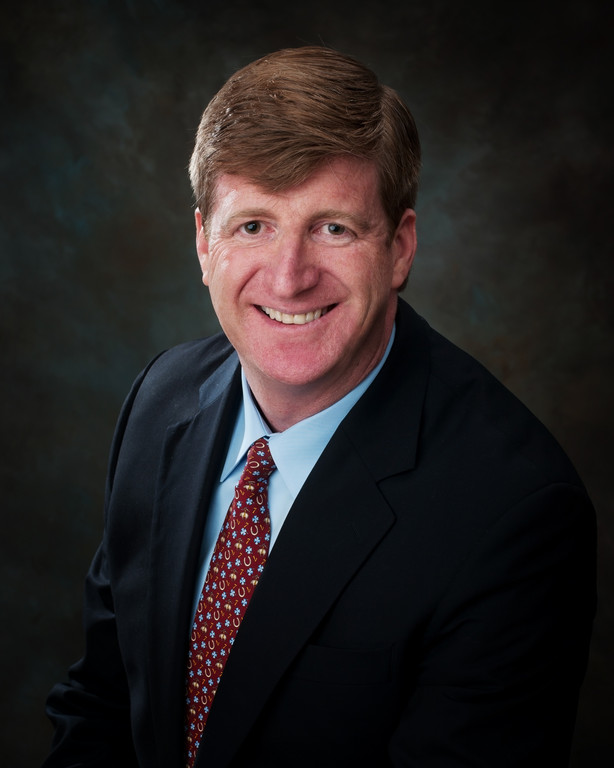
Former U.S. Rep. Patrick J. Kennedy’s new role in Rhode Island is as a private citizen, serving as a newly appointed member of the board of trustees at Bradley Hospital. He and his new wife, Amy, now reside in New Jersey, but the opportunity to be an advocate for the oldest child and adolescent psychiatric hospital in Rhode Island fits in very well within his broader advocacy for a new initiative for brain research.
Providence Business News sat down with Kennedy for an interview at Bradley Hospital on Aug. 12, where he shared his visions for things to come.
PBN: Recently, you called brain research the new frontier for scientific and health endeavors. How does joining the board of trustees at Bradley Hospital fit within that framework for your One Mind for Research campaign?
KENNEDY: We inaugurated the 50th anniversary of my uncle’s [President John F. Kennedy] moon shot speech, and his New Frontier program, by rebranding that as the new frontier in research into the last medical frontier, the brain.
I’ve always heard the brain referred to as the last medical frontier. One Mind is the notion of going to inner space, not outer space, going to galaxy of neurons, because really the brain represents a great area of unknown, and we can be the pioneers, just as astronauts were going to the moon, to discover the interventions, therapies and cures to many brain-based afflictions and illnesses
The benefit of joining a board like Bradley’s is that they are on the forefront, they are the real pioneers, especially in the area of autism, and of course, child and adolescent mental health.
Being on a board at Bradley allows me not only to serve Rhode Island, which I’m always felt a special commitment toward, but also serving an organization that has a stellar representation of being the best in its field. Bradley is not only is it the oldest child and adolescent psychiatric hospital in the nation, but it is also at the forefront of great research.
Beyond Cash Donations: How New Forms of Giving Are Transforming Not-for-Profit Accounting
Evolving Funding Landscape for Not-for-Profits Not-for-profit organizations are being asked to do more with less,…
Learn More
PBN: As a board member of Bradley, will you be working with the hospital to increase its ability to attract and secure research grants from federal and corporate sources?
KENNEDY: You bet. Part of what we’re doing at One Mind for Research is to develop a way of working in partnership with other neuroscience [institutions] to maximize the best science, so wherever the best science is, that’s where the money should go. And clearly, the best science is already going on here at Bradley.
I know about that because I represented this institution as a member of Congress for many years. I am very confident that, in representing to the broader neuroscience community, both nationally and internationally, if they want to know what the evidence base is in intervention for various developmental disabilities in neuro-psychiatric challenges for our kids, Bradley is a great place to look to.
PBN: A new neuroscience institute is planned at Rhode Island Hospital. How do you see Bradley collaborating with this initiative?
KENNEDY: The notion that we’re not more brain focused as opposed to a disease centric in our approach to neuroscience is something that we need to overcome. [I believe] Rhode Island, because of its size, can overcome those false distinctions, by [collaborating] between what’s happening at Butler Hospital in Alzheimer’s and dementia research, and what’s happening at Bradley in early developmental disabilities, and what’s happening at the VA in helping to treat traumatic brain injury and post-traumatic stress syndrome, and, through Rhode Island Hospital and the Prince Foundation, and its new neurosciences institute.
If we’re all on the same sheet of music, we can sing a better tune; we’ll be better at achieving more overall research money to the degree that we collaborate in Rhode Island.
We can become a mecca for research in the neurosciences. For us not to open up doors of collaboration is foolhardy, the future of neurosciences is going to be in sharing information about various neuro-psychiatric disorders, not silo-ing them. We need to practice that ourselves, if we intend Rhode Island to be a center of excellence for all neurosciences.
PBN: As a new husband and a new dad, how has that changed your perspective? What have you learned?
KENNEDY: My life now is really happy, I’m able to have a personal life, and I able to focus on the things that matter the most to me. This is an area that matters a lot to me. Even though I’m devoting myself to a new way of living, one that is different from that chaotic and nonstop 24/7 life, I’m still devoting my time as well to the issues of public policy that gave me satisfaction as member of Congress.
I feel that I have the best of both worlds now, I have a happy personal life, but I can also be a champion for the issues I care about. Bradley is giving me a great opportunity to do that as a board member.
My wife, Amy, is a schoolteacher. The application of better screening and diagnostics so as to better understand where a child is, and what is the best trajectory for a child’s learning capabilities, is a great source of interest for my wife as well for me
Bradley is not only a hospital, but it’s a school system. My wife is looking forward to helping me to take that Bradley message to her colleagues in education. There’s a lot that’s going on at Bradley that can better inform the education system for our country.
PBN: Can you talk about the seminar you’ll be teaching at the Warren Alpert Medical School at Brown University?
KENNEDY: The moon shot speech was an aspirational goal, one that said the only way we’re going to do this is if we work together. In a similar sense, going to inner space, a moon shot to the mind, is also aspirational, it’s a goal. It requires us all to work together. Essentially, [the seminar is about] mapping out the challenges to accomplish that goal.
The only way we’re going to achieve it is by working together, just as we did before, by integrating all the scientific aspects it took to put a man on the moon and returning him safely. We need to have that same attitude towards emerging brain research, to help our fellow Americans who are suffering as prisoners within of their own minds, because of a lack of knowledge of neuroscience.