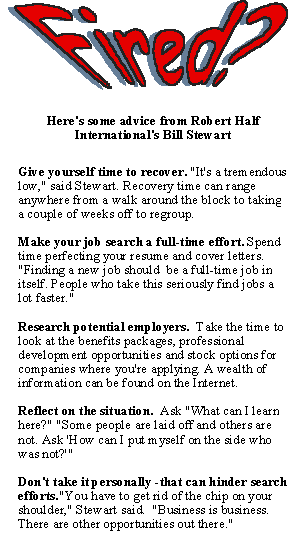
You’re fired. When placed next to each other, those two words probably comprise one of the most dreaded phrases in the English language. But in today’s economic climate, the reality is that people are hearing those words more often than they have been in years – the jobless rate in November was at its highest level since August 1995. Evolving Funding Landscape for Not-for-Profits Not-for-profit organizations are being asked to do more with less,… According to the Bureau of Labor Statistics, employment fell sharply for the second month in a row in November and the unemployment rate rose to 5.7 percent. Non-farm payroll employment dropped by 331,000, following an even larger decline in October. Since October 2000, when both measures were at their most recent lows, unemployment has risen by 2.6 million and the unemployment rate has increased by 1.8 percentage points, of which 1.4 points have come since the beginning of the recession in March. “Historically, the relationship between an employee and an employer has been ‘at will,'” said Roger Anderson, professor of management at Bryant College. “Either party can terminate that relationship at any time, for any reason.” In recent years, some states – including Massachusetts – have enacted wrongful termination laws designed to give employees a legal course of action if they have been unjustly fired. Stakes can be “quite high” for convicted violators, said Anderson, who has served as an expert witness for several such trials. “You’ve got to be careful,” he said. “You have to do it right these days.” Anderson offered a list of four suggestions for employers, when dealing with employees: Be clear about performance standards. “It’s unfair to hold someone accountable for something they don’t know about,” he said. Employees should be made aware of problems with their performance. “There should be some notice of performance deficiency and the employee given an opportunity to connect that.” ”There needs to be a fair and honest reason (to fire an employee). The employer must have the facts straight.” If an employer does find himself in a position where he must fire someone, be sure to ask ‘Is this reasonable under the circumstances?’ Deficiency in job performance is the most common reason for firings, but Anderson was quick to point out that “people seldom get fired for lack of skill. With a good attitude, skill deficiencies can be corrected.” For those who find themselves unemployed – whether the result of a firing or layoff – Anderson suggested approaching a job search “just like a job – there’s no substitute for spending time working through the process.” Bill Stewart, regional vice president of Robert Half International, also had some advice for those who find themselves looking for a job in the new year. “As far as the resume goes, our advice to people is to tell the truth,” he said. Firings – particularly in this time of economic uncertainty – are not viewed the way they used to be, but Stewart said that if a firing was the result of professional misconduct, “be prepared to have your references checked. Misconduct is misconduct, but everyone views those situations differently.”
Beyond Cash Donations: How New Forms of Giving Are Transforming Not-for-Profit Accounting