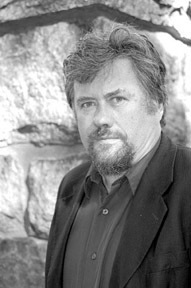
Richard McIntyre
URI professor talks about the widespread effects of globalization
Richard McIntyre
Beyond Cash Donations: How New Forms of Giving Are Transforming Not-for-Profit Accounting
Evolving Funding Landscape for Not-for-Profits Not-for-profit organizations are being asked to do more with less,…
Learn More
Age: 47
Position: Professor of economics at the University of Rhode Island
and one of the coordinators of the Fall 2003 Honors Colloquium, “The Futures
of Globalization.”
Background: McIntyre has been at URI for 17 years. He specializes in
international and labor economics and last fall worked in Paris at the research
institute “Institutions et Dynamiques Historiques de l’Economie.”
Education: Ph.D. in economics from the University of Massachusetts
Amherst, 1989
Residence: South Kingstown
The Fall 2003 Honors Colloquium, “The Futures of Globalization,” which
began Sept. 10 and ends Dec. 2, examines the future of globalism and all of
the lectures, which are free and open to the public, tap into current international
and domestic issues related to globalization.
Q. One of the subjects in the honors colloquium deals with the contrast
your colleague, Chai Kim, experienced when he visited South Korea, where many
Koreans dress in American clothing and listen to American music, but despise
America. Why does that exist?
A. The idea that Amy Chua (a colloquium speaker) had is that what
globalization does, and here what we mean is the spread of market-style capitalism
and democracy, is it creates the possibility for wealth, but also creates possibility
for huge problems. The Philippines is one example. What globalization tends
to do in countries is enriches what she calls “market dominant ethnic minorities”
– the ethnic Chinese who are in the Philippines are about 2 percent of the population,
but they own about 60 percent of all the wealth. What she does is goes around
the world and shows you that what happens when you get economic integration,
freer markets, is that it tends to enrich small ethnic minorities, but not the
majority. If you introduce democracy at the same time, you get this volatile
mix where the majority who is not getting wealthy will tend to follow these
kind of nationalist, demagogic leaders, and so you get this mix where the combination
free markets and democracy can lead to an explosion. She (Chua) says that the
United States is not an ethnic group, but at the global level we are a market-dominant
national minority, so we are increasingly looked at by the rest of the world
in the same way the Filipinos looked at the Chinese in the Philippines – that
our wealth is illegitimate, that we have too much control of the rules of the
game and we set those rules to benefit ourselves. How much of that is true and
what’s not true isn’t the issue. The issue is perception – it’s perceived to
be true by growing numbers of people.
Q. What knowledge do you hope to gain from this colloquium?
A. We felt the debate over globalization had gotten stuck in a not-very-interesting
place. You’d have people who’d say globalization is great; then you’d have people
saying it was bad, and that kind of got tired. So what we thought we’d try to
explore was not good/bad, because it’s obviously good and bad. We thought it
would be more interesting to talk about where all of this might be going, and
to focus on the future. Is the current set of economic roles and trends economically
sustainable, or is a backlash being produced? Can the institutions like the
WTO, the IMF be reformed or not? What about these organizations that have been
so involved in protests over the last couple of years – can they be an instructive
presence or do they just want to blow this thing up? We plan to do a book. We
are having preliminary discussions with publishers and we have gotten commitments
from the first four speakers to contribute chapters.
Q. What are the implications of an anti-American sentiment overseas?
A. There is a difference between American foreign policy and globalization.
The globalization debate started before 9-11 over the equities or inequities
that were arising as a result of global economic integration. The Iraq war was
extraordinarily unpopular – there were two countries in the world where a majority
of the population supported the war, and that was in the United States and Israel.
I think a lot of this happening now is a result of the war, and unfortunately,
there is an appearance, in terms of the way the rebuilding of Iraq is being
handled, that it is being handled in a way to benefit the cronies of the president
and especially the vice president, and it looks bad. I think we have to be careful.
Q. How is globalism good for some and bad for others?
A. Let’s take the example of the United States and Mexico. We have
almost 10 years with this experiment, the North American Free Trade Agreement,
and it’s a mixed bag. When it was being discussed, a lot of people were focusing
on whether it is going to create jobs or destroy jobs, and that was the wrong
debate. The number of jobs created or destroyed is trivial relative to the size
of the U.S. economy. The issues are a little more complex. For instance, in
the United States, owners of companies who now find it easier and are a lot
more secure about moving operations to Mexico, have benefited. People who have
lost employment in the United States have been hurt. In Mexico, workers with
some skills have benefited. Unskilled workers in Mexico, especially peasants,
who constitute a huge chunk of the population, have been hurt. Mexican corn
growers working a little plot of land cannot compete with American agribusiness.
There’s always change, so some people are always getting hurt and some are always
benefiting.
Q. How is globalism transforming Rhode Island?
A. One way is in the ethnic mix of the population and, of course,
you see that most in Providence. The other thing we’ve seen and it’s been a
long-term development is that 20 years ago, a few business executives could
get together with a few politicians and work out a deal to get some Washington
money and transform the city of Providence. If you look at who those executives
are now, they don’t exist because most of these corporations are owned by out-of-state
companies, including the biggest bank and the only statewide daily newspaper.
One of the things globalization does is it disconnects those who own things
from the local community. In South Kingstown, if you walk around Peace Dale,
you see all of these wonderful old stone buildings which were a legacy of the
Hazard family. They made a ton of money with the mills, but because they were
tied to the community, they gave a chunk of that money back. When ownership
is increasingly absentee ownership, and globalization makes it easier to be
one place and run things in another place, to what extent do the people who
make the money and draw money out of the community, put it back in? I don’t
think we could accomplish today the transformation of the city that you could
accomplish 25 years ago.
Q. Is there a way to regain or replace jobs that are moving overseas?
A. In terms of moving forward, you’re better off thinking about what
else you can come up with. That doesn’t mean this isn’t an issue. In the United
States, at least in theory, not always in practice, workers have the right to
organize, bargain collectively, they have the right to freedom of association.
I think those (production) jobs are going to go, but if we have increasingly
a global economy, we’re increasingly going to need international systems of
law and regulations to make that economy work. If the global economy is perceived
to be unfair, if it is perceived to operate only for the benefit of those with
power and wealth, then you can be sure that there will be a revolt. For local
economic development folks, obviously you have to look at the future, obviously
you have to figure out what it is you’re going to be able to be doing in 20
years.
Q. Are there certain jobs that we should be investing more in that would
be secure local jobs not in danger of going overseas?
A. People want higher education to do something that it can’t do.
Education and training are two different things. The notion that in terms of
middle and upper middle level jobs there is some kind of training we can give
is wrong. What we can do is give them skills that allow them to adapt. The jobs
that are going to stay here are personal service jobs – Rhode Island Hospital
can’t move to Mexico. So jobs that directly serve people, which cannot be automated
will be there. Some of those jobs that will be staying here will become better
jobs over time either because they’ll be put through unionization, or to avoid
it, the employers will provide better benefit packages and compensation.
Q. The Economic Development Corporation has been emphasizing a focus on
existing local companies. Is that more realistic than courting out-of-state
companies?
A. I’ve always thought that was a good idea, and I’ve been glad to
see this shift. Would we welcome another Fidelity – of course we would. But
those companies … oftentimes it’s not that they’re going to fall into your lap,
and you’re not going to get them that often. If they want to come here, they’ll
know it. A big corporation like that will be looking for places to locate and
if they want to be here, they’ll find us. Not that the EDC shouldn’t be doing
something, but I think it’s been a positive move to move in the direction of
looking at what’s here and what we can do with it.