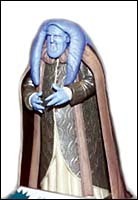
action figure.
Hasbro Inc. officials assured shareholders that its new line of Star Wars toys – to be rolled out in conjunction with next month’s movie release – will be a boon for sales this year, rather than a bust reminiscent of the last crop of Star Wars toys Hasbro released in 1999.
"This is a much, much tighter line than what we brought to market (in 1999)," Hasbro Chairman and CEO Alan Hassenfeld told shareholders and analysts during an April 22 conference call. "The strength of the Star Wars category has always been the array of action figures and the vehicles that surround them. Our line is…focused and full of action features."
Last week, the Pawtucket-based toy maker made its first shipment of toys and games based on "Star Wars Episode II: Attack of the Clones," in advance of the film’s May 16 release. It includes action figures and vehicles, board games, hand-held electronics, trading cards and role-play sets. Shipments will be largest in the second quarter, when the movie hits theaters, and the fourth quarter, when it is expected out on video.
Seifert Systems Invests in Energy Efficiency to Strengthen Operations
For manufacturers, energy is more than just another operating expense. It plays a critical role…
Learn More
Jim Silver, publisher of Toy Wishes magazine, called Hasbro’s latest batch of Star Wars toys "one of the best Star Wars lines yet."
Hassenfeld said Hasbro is gauging demand more conservatively this time around and that the product line will take up far less retail shelf space than the 1999 line. But that’s mostly because the company will be "much more selective about the type of products that we’re going to put out there," he said.
Analysts said the approach appears to be an improvement from 1999, when Hasbro launched a massive line of toys and games for Star Wars’ "Episode I: Phantom Menace."
That line – proclaimed by some to be the biggest single launch of a toy line in U.S. history – took in far less in revenue than the $800 million Wall Street had forecast for 1999. The disappointing Star Wars sales helped push Hasbro’s stock price down by more than 30 percent that year.
Of course, much of the sales malaise was blamed on the movie itself, which critics panned and many fans found disappointing, despite big box-office sales. But Hasbro officials – along with Star Wars diehards – have higher hopes for Episode II.
"From what we’ve seen of the movie, it is much more kid-directed, with more action sequences, more colorful characters – bottom line, more excitement," Hassenfeld said.
Melissa Comer Williams, a toy industry analyst at investment bank Gerard Klauer Mattison, said the company’s toy line also stands a better chance this time because Lucasfilm Ltd., owner of the Star Wars franchise, also has a tighter focus for Episode II products. In short: there should be less clutter on the shelves.
"The number of licenses and product lines from (Lucasfilm) is much more refined than it was last time, not just for toy products but also for all the ancillary products tied to the movie," Williams said. "As long as the demand (for Hasbro’s toys) is there, hopefully they’ll have a hot product."
While the refocused Star Wars line holds the potential to drive sales and earnings growth, it comes with a cost: big royalty expenses. Hasbro’s royalty expenses will jump from 7 percent of revenues in 2001 to 11 percent this year, largely because of high royalty payments for Star Wars, according to Hasbro President and Chief Operating Officer Alfred Verrecchia.
Hasbro in 1999 reportedly paid $600 million in advance royalties and turned over a 7.4 percent stake in the company to Lucasfilm in connection with a nine-year licensing deal for the toy line.
"I think the fairly high royalty expenses will probably mute the operating results of the total company this year," Williams said. "But I think (Hasbro) is being pretty conservative about the shipments for Star Wars, and to whatever extent the product line does better than expected, there is some upside potential."
Despite the Star Wars buzz, Hasbro President and Chief Operating Officer Alfred Verrecchia insisted during the conference call that "Hasbro is more than just Star Wars," and said Hasbro is committed to its strategy of deriving growth from its core brands.
Verrecchia pointed to strong first-quarter sales of Transformers robots, Nerf sports toys and the G.I. Joe brand, which saw sales spike 48 percent during the period.
"We continue to see evidence that our core-brand strategy is working," Verrecchia said.
Hasbro officials said their long-term goal is to return the company’s operating margins to its historical 11 percent range, partly by trimming $100 million in costs over the next three years. The company also plans to concentrate on improved international sales and recently placed new management in key markets abroad.
For the first quarter, Hasbro’s revenue slipped to $452.3 million, down from $463.3 million from a year earlier, which officials blamed mainly on a slowdown in Pokemon sales. Hasbro lost $17.1 million, or 10 cents per share, which was in line with analysts’ expectations. The loss narrowed from $25 million for the first quarter last year.