 to be a state that is thanking
business for being here..."" title="Gov. Don Carcieri: "We oughtto be a state that is thankingbusiness for being here...""/>
to be a state that is thanking
business for being here..."
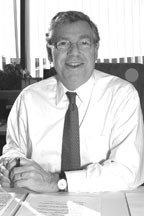
Name: Gov. Don Carcieri
Position: Governor, state of Rhode Island
Age: 60
Background: After a couple of years as a math teacher, following his
graduation from college, Carcieri spent 10 years at Old Stone Bank, rising to
the position of executive vice president. In 1981, he left the bank and moved
with his wife, Sue, and their children to Kingston, Jamaica, where he headed
the Catholic Relief Service’s West Indies operation and she taught science in
a local school. Don and Sue returned to Rhode Island in 1983 when he joined
Cookson America. Carcieri eventually became chief executive officer at Cookson
America and joint managing director of Cookson Group Worldwide. During his tenure,
the company grew from doing $300 million in sales to over $3 billion. Don and
Sue Carcieri co-founded the Academy Children’s Science Center in East Greenwich.
Education: Brown University (1965)
Residence: East Greenwich
Conclusion of a two-part interview.
Just a few months ago, few Rhode Islanders would have recognized the name Don Carcieri. The recognition factor for the retired Cookson America executive was certainly higher within business circles, but even so, as a political outsider he was widely regarded a long shot to become Rhode Island’s next governor.
But thanks to a well-run campaign that included upbeat television commercials and a promise to embark on a comprehensive “Big Audit” of state government, Carcieri, a Republican, turned an early deficit in the polls to Democratic challenger Myrth York into a comfortable 10-point victory by election night.
In this, the second installment of a two-part interview with Carcieri, who was sworn-in to office last Tuesday (Jan. 7), discusses the role that small business owners should play in turning around the state’s economy, his views on casino gambling and growing up in a small town.
He also pays homage to a mother and father who taught him family values and an appreciation for hard work.
PBN: Business owners are often criticized for not being active in the political
process. You know how hard it is to break away from their business to get to
legislative hearings. How can they help promote pro-business initiatives?
CARCIERI: It’s not necessarily going up to the State House. It’s lending
the weight. What has happened, in my judgment, is that somehow the business
community has become defensive… ‘Well, we can’t push, because (people think)
we’re a bunch of greedy people making more money than anyone thinks we should
make.’ That’s nonsense. That’s not what business is all about. It is the core
of our economic base. You can’t build an economy on government employment. You
need to build an economy on business and that’s what is going to fuel the revenues
we need to do the things we like to do. My whole message is; ‘Don’t be apologetic.’
We ought to be a state that is thanking business for being here and employing
people and creating jobs. And business needs to be out in front, saying; ‘This
kind of nonsense, we’re not going to stand for.’ I’ll give you an example that
I mentioned during the campaign. The General Assembly getting its nose involved
in labor disputes. That’s not their role. You don’t take sides. This is a labor/management
dispute. If there are public safety issues, then the governor or the system
needs to give a prod to get something resolved. But absent that, stay out. Business
has to have the fortitude to say; ‘You’re not going to be here. You may be elected
now, but I’m here. This business is here and it is going to go on to employ
people and I need to have an environment where I can flourish.’ The pendulum
has just been too much to the other way…So don’t keep your head down. If you
keep your head down and your mouth shut, you can’t gripe about what happens.
You have made it clear you do not see casino gambling as a panacea for
economic development. If the legislative commission studying the issue recommends
that a full-scale casino for West Warwick be put before Rhode Island voters,
will you continue to fight against the idea?
I will try very hard to convince them that first of all…what are you putting on the ballot? Everybody says we are going to put it on the ballot, but what is it – a Narragansett Harrah’s casino in West Warwick? A casino anywhere in the state by anyone? What are we asking the voters to approve? What if I shoot you all the data that said no matter what kind of casino you build, there is a 90 percent chance when you factor in the impact on the video lottery terminals, then we are going to lose money as a state. What if I can convince you that there is a 90 percent chance of that happening? Then we are asking the people to vote on something where the taxpayers are going to be worse off. It’s a complex issue. This year the state is going to get $170 million off just the video lottery terminals; next year it could be over $200 million. And then if you do an expansion, which they all want, $200 million is really $300 million. The best deal when Boyd (Gaming) and the Narragansetts came in a year ago was that after all the Rhode Islanders came back from Connecticut, and the Massachusetts residents using Interstate 95 through Rhode Island to get to Connecticut stopped here…When you carved up the whole pie, what was in it for the state was $110 million. Seventy percent of big casinos are coin slots. Well, then who is going to go to Lincoln Downs and Newport Jai Alai? So we are putting the $200 million to $300 million at risk. If you lose a third of the business at the other two places, then you’re net even. Just because we put one in here, it isn’t going to stop Massachusetts from putting one up. So then what you are going to end up with are two big casinos in Connecticut, one small one in Rhode Island, and two moderately sized ones in Massachusetts. In that equation, we might be better off … keeping our video lottery terminals. We’re getting 57 percent and I think it should be higher. What people don’t understand is that casinos kill the small local businesses around them, the restaurants, the gift shops, the small mom and pop type operations. It’s not an economic boon, to West Warwick, or to the state.
What do you expect will turn out to be a bigger challenge – getting elected
governor as a political novice or turning around the state’s economic fortunes?
The latter, no question. I said during the campaign that the state is like a huge tanker. You don’t turn it just like that. Changes are incremental. It’s going to be a big task. But people are excited. People are wanting to see some different things. My task is going to harness the goodwill – that general sense of wanting to see some improvement. And use that to keep an agenda moving forward.
What’s the most important lesson you learned from your parents?
I was blessed with a great sense of values. My father and my mother were both born in East Greenwich, a small town. Family was important. My father had a great sense for hard work. He quohogged summers. He worked hard. So I grew up with an appreciation for hard work and treating people well. He was a coach. So he took people and didn’t care where they were from…what their backgrounds were. It didn’t matter. When you are coaching, it is a team. You are molding a team and everyone works together. He instilled that in me. When I was a kid, he said to me; ‘Don, you can’t play for me, unless it is abundantly clear to everyone else that you should be playing.’ He took his personal integrity so strongly that he didn’t want anyone in the community to say that his kid was playing for him, only because he was his kid. So I am blessed for having grown up with values and coming from a small town. It was a wonderful place. We grew up along Marlboro Street, down below Main Street. You had Irish, Italians, Polish…everybody. We all hung out. I was Catholic; there were Jewish families…all denominations. You didn’t think about it. I was very fortunate in that regard.
Beyond Cash Donations: How New Forms of Giving Are Transforming Not-for-Profit Accounting
Evolving Funding Landscape for Not-for-Profits Not-for-profit organizations are being asked to do more with less,…
Learn More
For the complete current issue, visit our subscription Web site, or call (401) 273-2201, ext. 227 or 234.