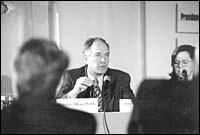
expert, and Dr. Patricia Nolan,
Health Department director.
On Thursday, March 30, at the Roger Williams Park Casino, Providence Business News held the first in a series of “Summits,” bringing business leaders, educators and government officials together to discuss topics critical to both the business community and the public at large. The inaugural panel discussion centered on health care and rising health insurance premiums.
FRANK PROSNITZ, editor of the Providence Business News
This morning joining me on the podium here are four very distinguished people. We have Dr. Candace L. Dyer, President of the Rhode Island Medical Society, Vincent Mor, who is a Ph.D. and director of the Center for Gerontology and Health Care Research and Chairman of the Department of Community Services, Professor of Medical Science at Brown University. Dr. Patricia Nolan, who is the director of the Department of Health, came to Rhode Island with some great credentials and has been a real asset here, and Max Powell who is a health care consultant and former president and CEO of United HealthCare of New England
Seifert Systems Invests in Energy Efficiency to Strengthen Operations
For manufacturers, energy is more than just another operating expense. It plays a critical role…
Learn More
DR. DYER
I’m a general surgeon and I work in a five-person group in Warwick, Rhode Island. We employ five full time people in my office, and six part time people. I run a small business, so I’m part of the business community. I never got involved in the business aspect of it, I really just wanted to practice medicine, but this past year has been a huge eye opener for me.
We’ve had some problems from a business perspective, especially this past year when we’ve had problems collecting our fees from Harvard Pilgrim and some of the other insurers. We have to pay salaries, we have to pay benefits, we have to pay rent, we have to pay outlying services such as billing and transcription, and consequently we’ve had some real problems making ends meet. I think that probably 75 percent of the physicians in the state are small business people. They’re in small groups, not big groups. Most of them are not employed, they’re self-employed. The physicians really want to spend their time taking care of patients and sometimes we’re overwhelmed with the paperwork that we have to do.
We need some sort of a unifying system where all the claims that we process are more unified from insurer to insurer. We have problems with patients who look to us to solve some of their problems when they process claims. It takes a great deal of time away from what we’re supposed to be doing, which is practicing medicine. Medicine still is a great profession, I love what I do, I enjoy getting up every morning and going to work, but it’s really been a bit of a hassle this past year and the past several years dealing with the business aspect of it.
MOR
I’m an academic, so of course I have a lot to say. But I won’t bore you too long. But I will make a few disclaimers at the outset. I study nursing homes actually, and not hospital systems and things. So my knowledge of the health care system and it’s complexity is sort of understanding how the giants affect the nursing homes and the long term care population. So, I sort of back into my knowledge about insurance and hospital mergers and competition by recognizing the effects that these forces have on the long term care sector, on the long term care providers and particularly the patients that they see. But I have been on the Governor’s Advisory Council for Health Care and also some other regional and national commissions, and so I have some vague familiarity with these issues. There’s a long list of alternative things that we could address and I chose to talk a little bit about competition.
The business mantra is competition and what it means in down health care. In many respects, I suppose that the market view is that competition holds down prices, stimulates innovation. So that people can buy on the basis of quality and not just price and that’s what people expect. Competition should exist between insurers and between payers in the health care as it does in other sectors. And yet, health care is really quite different.
I was thinking as I came down here, that no one would get very upset if the local McDonald’s on their street corner actually went out of business. Not that they ever do. And no one complains or has questions about “Oh, we have too many McDonald’s.” But we ask those questions, “We have too many this and we have too many that” in health care and what does that mean? Too many. Is it that we sort of instinctively have different sets of metrics that we’re using for health care commodities or health care factors than we’re using for other kinds of services that we purchase in the marketplace. I guess from my point of view, the nasty secret from health care is that really, there is not much in the way of competition.
Most communities, particularly these days, have very limited to no competition. Either in the insurance market or in the provider, basically the hospital systems market. This is because essentially businesses are looking for stability, if they can’t get stability what they want is market dominance to actually exert some influence on that local market so they can control their destiny to the extent possible. There’s a huge cost from an insurer’s perspective of entering into a new market, because they’ve got to sign up people who will be insured with them, they’ve got to sign up business people to take their products and then they’ve got to sign up contracts with health care providers who will service the patients who are getting the insurance from that provider.
So, there’s these big barriers to market entry, and most markets are dominated largely by local insurers and/or consolidated national markets, and that’s become even more so over the last decade. Which means that it’s not a big surprise if you think about it that there’s only most communities in the country have basically two or three major insurers, and a large number of smaller insurers, but they work almost exclusively on an indemnity basis with individual companies, who are national representation.
Now, what that means is that these two or three large insurers end up, then of course, negotiating with the hospital or the health care systems and the physicians in order to set rates. Now if the physicians and the hospitals aren’t consolidated or organized, then it becomes a monopoly situation where you can basically dictate how much you are going to be willing to pay for those kinds of services. That happens in certain markets, and it doesn’t happen in others. So, as that began to happen in the early 90’s, it wasn’t a big surprise that hospital consolidation happened rapidly thereafter in most markets.
So, hospitals began consolidating all over the country, so Rhode Island is not a unique situation. And, they’ve done it precisely because they think it’s going to lower overall costs, increase efficiency, but most important it’s going to give them a stronger bargaining position with the local insurers. So, what you end up with is the sort of multi-headed monsters, sort of battling it out with one another, these giants, and the insurers and the hospital systems. In some markets it actually ends up virtually one insurer or two insurers and one health care system.
And, then of course, there are the doctors. Now in most worlds, we think about the doctors who are essentially the front line people who relate directly to the patients, then there are the hospital systems, or the bricks and mortar guys and then there are the people who are the payers, who are marketing to you then who are then paying bills. Sometimes not very efficiently. In most markets, the doctors have not had a very strong say. This is again my opinion, and that’s partly because they get spanked somewhat more aggressively when they begin to quote, unquote, to collude to set prices and to establish a unified front in relation to how they relate to either hospitals or insurers.
So that physicians have not been anywhere near as well organized as have the insurers and the hospital systems because there’s been a fairly effective regulatory structure, an anti-trust structure, to keep them from consolidating, and that’s particularly true in certain parts of the country where the medical practice patterns are such that physicians don’t want to get into very, very large groups which is truer in other places other than New England. So, people who study monopoly in health care speak of, actually think about what’s this balance of power between the hospital systems, the physicians and the insurers, and when that balance of power becomes disrupted or there’s not a homeostasis in that balance of power, you get a lot of instability, both in prices as well as wars between the big players. That’s where government, either in a political sense, or in a regulatory sense is called in either to make approvals of these kinds of hospital consolidations or further consolidations and even approvals on the insurance side or to begin to negotiate with the payers as well as the providers, because we have to remember the government is a huge purchaser of health insurance. They purchase health insurance for all of the government workers and they purchase health insurance for all the people in the state who are insured by the federal or state programs such as Medicaid and Rhode Island Right Care.
So, the government has a big stake in this and yet, it’s rare that the government actually exerts its potential power in these negotiations.
So, the question comes down to, if there’s no market competition, then here’s where I’m just going to enumerate a bunch of questions for us to think about. If there’s not that much market competition, but we know that really people’s behavior is shaped by it on a national scope, what are we to do if there’s not competition on the local level and that’s where people get their health care, and that’s where these battles are occurring? How can the government mediate between the giants and what happens if the giants sort of sit down at the table and behind the back door say let’s collude instead of say let’s keep things steady between the insurers and the health care systems? And we won’t rock the boat, and you won’t rock the boat and we’ll sort of live with the gradual incremental cost increase ala some kind of rate setting structure, and we don’t have the influence of “competition” to sort of say, “Well, wait a minute, I can do this in a totally different way and either reduce costs or provide services in a different way,” which is what happens in other sectors of the economy.
That lack of, the issue is competition is needed for the stimulation of innovation and restructuring. In the absence of that, in a regulatory environment or in a public utility environment, we need to sit down and say, “Where is this going to come from?”
Unfortunately, I don’t have any great answers, but I do know that it is imperative that the body politic in government get involved in that, but not necessarily through some kind of micro-management approach to regulation, because it’s not clear that regulators have any better knowledge of better ways to get things done, better ways to become efficient, better ways to restructure, use information technology, to get through the sort of morass of current health care organization inefficiencies, than do the providers who are also quite content to, as long as their costs are paid, to keep going along, because at least in the hospital sector, particularly in the Northeast, virtually all markets are dominated by large non-profit health care or hospital systems.
Those non-profit systems don’t have the same “national stimulation” for “profit” and yet, they are clearly dominant actors in most markets, and are there sort of with a public mission, but that is not necessarily responsive always to the “community”, I’ll stop there.
DR. NOLAN
Well, the first one obviously is the one that Vince Mor made that regulators don’t have enough knowledge to micromanage the system, and I think that’s a very important thing to keep in mind. We have been gaining knowledge over the past year about things that we sort of knew that we should know about, but didn’t have the capacity to address.
I’d like to start with a couple of facts and figures. These come from the national survey called the Medical Expenditure Panel Survey and also from the Census Bureau’s current population survey in 1996, as well as data that we collected with your help in Rhode Island through a 1999 employer survey and our 1996 health interview survey. I’m not going to give you lots of facts and figures, just a few. In the United States as a whole, in 1996, the rate of uninsured, non-elderly persons was 17.7%. In Rhode Island, the rate of uninsured was 11.7%. So, on the whole, we have fewer uninsured people in our state than most other states around the country. We look more like the rest of New England, but we do actually better than several other New England states in terms of insurance rate. Fifty three point two percent of private U.S. business establishments offered health insurance in 1996. In Rhode Island, in our survey, which was in 1999, 77% of the firms did so. Twenty one point eight percent of United States establishments offered a choice of health plans, while in Rhode Island, 40% did so.
On the whole, larger firms offer more generous insurance. They generally have larger employer contributions and they are more likely to contribute to family coverage and to offer a choice of plans. Now, none of this is earth shaking, but it’s important to keep in mind what the context is here. On the whole, businesses in our state have been quite generous about how they offer insurance to their employees. On the other hand, your likelihood of having employer-based insurance is very much connected to your income and low income workers are much less likely to have employer based health insurance than are higher income workers.
What are the changes in health insurance and health care and mergers and their impact on the community, and how businesses should react? As you all know, one major insurer has left our market, and Harvard was not just an insurer. Harvard was also a major provider of health care services.
Between those two things, it really has made a tremendous impact on our community. It’s sort of shaken our faith in what’s going on, it disrupted thousands of people’s relationships with their primary care physician. We are all out now looking for new primary care physicians. There were payment issues, which Dr. Dyer already referred to, and it’s caused us to rethink a number of things about how health insurance is regulated and managed in our state. There are certainly other people who would argue that part of what we’re looking at is the effect of competition, the effect of poor business decisions, management questions, and what is known as the insurance cycle where the way in which pricing in the insurance industry occurs is very cyclic, as they price for competition, experience losses, spend out of their reserves, get their market share and then recoup their losses, and in that underwriting cycle is much of the other argument about why prices are changing in the insurance business right now.
I would argue that the failure of Harvard is a big lump sitting in our stomachs and causing us to feel very uneasy, but it’s not necessary to look at Harvard’s failure as a harbinger that the whole system is falling apart. There are several reasons. Virtually all individual subscribers and most employers found new health insurance sources. We did have the authority to place business and individuals in insurance coverage situation. It was not invoked.
However, there were a lot of changes in benefit packages and premium prices as businesses moved from one insurer to another. We have not yet been able to measure changes, but there is a strong belief that the new insurance contracts have higher out of pocket costs for employees and that many have higher costs for employers. In general, in various forms, employers are telling us that they want price stability and administrative simplicity, that these are very important issues from the business side.
While there are a number of health insurers in the state, there are really only two large health insurance plans that are writing most of the business in the state, and both of those insurers currently report that they are thinking neither about merging, nor about moving. I think that that’s a sign that we do have a fair amount of stability left in our system. There have been changes in our health care provider sector too, and Dr. Dyer referred to some of those. I think one of the keys one is that our hospitals are reporting declining revenue margins.
In the past decade actually, hospitals have done better more often than they’ve done worse, but right now, they are experiencing some significant declines in their margins. They relate the declining margins to decreased reimbursement rates from Medicare, that’s the federal government, and beyond the control of the state. They also relate them to static reimbursement rates from insurers. That the rates that the insurance companies are paying for hospital care are at least static, if not declining slightly. They also are concerned about slow claims payment by insurance companies and what they see as an increasing amount of uncollected revenues from patients
Slow claims payments, markedly increased administrative costs and increased costs in caring for patients. Some of those increased costs in caring for patients are the costs that go into arranging for services for your patients that you yourself don’t provide. It is becoming harder to arrange referrals, admissions and services from other health care providers. People report that they are having higher out of pocket cost for care. Specifically for pharmaceuticals. The most common concern that we are receiving from insured people as well as uninsured people right now is the rising cost of their drug care. Insurance companies also report that that is the most rapidly rising segment of costs. There is only one merger that’s really currently proposed in our state. That’s the merger between Lifespan and Care New England. It has received anti-trust clearance from the federal government and is under review by the Attorney General.
Were the Attorney General to approve the merger, the Department of Health would review it under the Hospital Conversion Act provisions. That will be a very interesting test of our knowledge of the health care system. That is a very far reaching statue and this would be the first time that the Health Department actually reviewed a proposed merger. I think one can anticipate movement of physicians and other providers because of the Harvard collapse, because of the perceived low reimbursement rates in the state, and because of retrenchment in some of our hospitals. We’ve not yet attempted to measure this, but we think we will have information on the movement of physicians when the next licensing cycle is completed in the fall. We are hearing some complaints that people who have left the Harvard Health Plan are having difficulty finding new primary care physicians. Exactly what the impacts of the recent changes, both in hospitals and in insurance companies, will be on the physician community is not easy to tell.
“What should businesses do or think about? And I have a couple of things to offer. One is, as you think about your benefit purchases, consider equity among your workers. The business community is the foundation of our health insurance system, and it is the foundation of the way we pay for health care throughout the country. Yet, as I mentioned, we know that low-income workers are much more likely to be uninsured even when they are working full time and insurance is offered by their employer. In large part because of their out of pocket costs.
When you are considering your bottom line and looking at your health care costs, you can still think about the equity issues among your workers. Secondly, I think you should consider the business value of health insurance. I’ve had this discussion with people in the business community before. One of the first benefits that tend to get cut when businesses are trying to decrease their insurance costs is substance abuse and mental health treatment.
And yet when I say to people what’s your biggest employee problem, it’s substance abuse and mental health. It’s really important to think about what’s important to your business when you’re purchasing health insurance for your workers. Obviously, in a time when you’re really competing very hard for high quality workers, you want to think about what your employees want, and you also need to think about what benefit packages really help you as a business. Third, and this is a very important issue from both my perspective and the Governor’s and Christy Ferguson’s perspective. That is, look for opportunities to pool purchasing power. This is a state of small businesses, very small businesses in some instances. If we can find ways that those small businesses can pool their purchasing power, you can offer two very important things. You get enough clout to really negotiate good prices from your health insurer, and secondly, if you purchase through a pool, you may be able to offer considerably more choice to your employees.
Choices of health plan is something that employees are looking for, and yet that’s a very expensive thing to offer, especially if you’re a relatively small business, or a 3-5 employee business, as many of the businesses in our state are. Obviously, I hope that businesses will continue to offer the high level of commitment to health insurance for their workers and the families.
MAX POWELL
I want to talk just a little bit about a project that I just recently completed working with a team of people under Dr. Mor’s direction for the Governor’s Advisory Council on Health. This was a project to kind of, at a very high level, assess the competitiveness of the Rhode Island health care system across state lines. In other words, how do we compare with our adjoining states and the particular focus was on Massachusetts because that’s from an economic development standpoint kind of a competitive market environment.
The driver behind this question, and trying to answer this question was a sense, or a concern that we in Rhode Island had been enjoying for some time very attractive rates for health insurance compared to our neighbor and could that be sustained, or at what price were we enjoying that advantage? In, well, I won’t go into all the details of that, because we don’t have time. What we learned briefly is that, as all of you in business know, there’s a difference between being competitive and being under-priced. If you’re truly competitive, you can be lower priced over the long haul. If you’re only under-priced, you can only do that for a short time before you run out of resources to be able to support that.
The bottom line is that we in Rhode Island compared to Massachusetts do not operate at a lower cost level in terms of our health care service system. But, in fact, for the last several years, at least through the end of 1998, we did operate at a lower price. And that resulted in what we saw happen in the fourth quarter of 1999. Health plans in Rhode Island, and we used as a data source, Interstudy, which is a Minneapolis based company that surveys HMOs across the country every six months and consolidates that data.
And, in comparing ourselves to our neighbor, the plans in Rhode Island for the Rhode Island market basically say that their premium rate, the list price, the price that they should charge to cover their cost of doing business is about the same as Massachusetts, and actually in recent times, a little higher. Their actual revenue, what they bring in the door, has been substantially less. The reason why their premium rates are about the same is because their costs of delivering health care services are about the same per member, per month. They incur about the same expense.
The sharp difference however, between our two states is that in Rhode Island there is a much higher proportion of that expense that is devoted to hospital services than there is devoted to physician services. That’s historically been the case in Rhode Island, back if you look at the pre Right Care days, before the Medicaid, AFDC population was moved in to RIteCare, Rhode Island was among the top three states in terms of the per capita expenditures per Medicaid eligible for hospital services and in the bottom three states in terms of it’s per capita expenditures for physician services. And that’s part of what the Right Care program was trying to correct, is to improve access to physicians for that population.
I’ll give you a few key numbers. In 1994, the Rhode Island health plans, in aggregate, showed a pre-tax profit of about sixty-three million. In 1998, they showed a loss of about eighty million. In 1994, they had roughly a hundred and eighty seven million dollars in reserves. By the end of 1998 they had about ninety eight million in reserves. If you try to do the arithmetic by the way, investment income is involved in part of this process, so you can’t make all the numbers add up, but those are bottom line numbers. A more meaningful number is that in 1994, at the end of ’94, for every member who was insured, the health plans in Rhode Island had roughly two hundred and thirty dollars in the till to guarantee the benefits. By the end of 1998, that had about been cut in half, down to one hundred and thirty five dollars. And while the plans in Rhode Island were losing eighty million dollars in 1998 the plans in Massachusetts were still making seventeen million dollars a year. Even though that was a significant drop, it stayed in positive territory
PROSNITZ
Let me ask first if there’s anybody in the audience who has a question and would like to ask it at the microphone, otherwise, I’ll go to the written versions.
The first question is concerning the dynamics of competition. This is to Dr. Mor. Concerning the dynamics of competition the Governor’s advisory council says prescription costs are thirty cents on the dollar. How does the competition issue apply in this industry? Isn’t it true that more choice in competition will bring down costs for consumers and businesses?
MOR
I am assuming that that’s just in the case of pharmaceuticals. Pharmaceutical issues are competitive prices and pharmaceuticals is actually a very complicated and interesting issue. Both because of the monopoly that a particular pharmaceutical company has during the course that its particular drug, its blockbuster drug, is under a patent, and because of the way in which pricing is done at the local level of the local pharmacies.
A new drug comes out and at least for a couple years, maybe three, although that cycle is being somewhat reduced, Pfizer will have a new drug and it will take two or three years before one of the other companies will have a drug that will be matched at it. Now when that new drug comes out from, let’s say Merck, that has the same indications, they price it at that level. They don’t price it lower because their interest is in making as much money as possible. They might price it somewhat lower, but not necessarily. And their goal then is to basically use their outreach mechanism to get as many physicians to prescribe the new drug as possible.
NOLAN
Well, it has some of the same characteristics that both Max and Vince referred to. A lot of what we’ve been doing is just trying to track what those issues are, and explain them to people. It isn’t necessarily the most common complaint I receive, by the way, but it is the place where people are complaining most about their out of pocket cost increases, and some of that was related to the Medicare program. A lot of the complaints have come from people who bought Medicare HMO plans because they offered a lot of pharmacy benefits and then found that those benefits were being reduced. The issues of drug costs are very complex and I think that both of the previous people tried to address that. A lot of it is beyond our control at the state level because of the way pharmaceutical patents are managed and pharmaceutical marketing takes place on the national level. There certainly is some direct marketing to individual people of drugs, not just to insurance companies and to physicians, where once prescription drugs were only marketed to physicians, now you’re just as likely to get direct marketing on television about your desire for a particular drug.
And those, as with cigarettes, are brand name marketing, not just consumer marketing. What we’ve really tried to do from the Health Department’s point of view is clarify for people what their benefit packages are and help them see how they can negotiate their benefit package more effectively, if they’re in a managed care plan. And where they’re not, we’ve really tried to communicate that set of issues into the whole set of discussions around where we go with health care at the state level.
MOR
I have a comment on that. In response to Dr. Nolan’s notion about marketing to individuals via television and so on, and Max’s comment about substitution. What’s clear is that is that the volume of drugs, pharmaceuticals that individual consumers are taking is going up dramatically. That is the probability of any of us taking a drug has gone up, and the number of people taking multiple drugs has gone up. That on top of the fact that there are pricing factors that have some influence, it’s a volume driven thing, just like lots of other things.
Now, Max noted that there is this notion of substitution. Many of these drugs have dramatic effects and wonderful ability to prevent hospitalization and reduce the morbidity associated with the inherent disease. However, not just the people on whom the studies were done, showing that they were effective, get the drug. So, you have, I mean, the drug might have been set for this particular group of people, but a much broader group of people get that, because they’re potentially in the pool, it’s not that it’s being marketed for a different condition, but the scope and nature of who might have the condition, who might be appropriate for the drug almost always expands.
That expansion almost always will offset and overwhelm any savings that might occur on the hospital side, and that’s basically, in the long-term care world, we call it “the woodwork effect.” That is, people who didn’t used to take the drug, or didn’t used to have the condition, will now be taking it, through some complex interchange between doctors, commercials and patients.