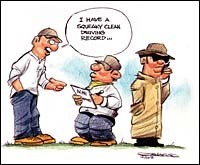
The events of Sept. 11 may have forced companies nationwide to look harder at security issues, but now as industry groups urge Congress to allow fingerprint background checks of all employees, some feel safety is intruding on privacy.
A number of industry groups, including the American Trucking Associations, are lobbying Congress for access to the Federal Bureau of Investigation’s closely guarded data on suspected terrorists and criminals, saying they need a better tool to screen their employees.
But according to some, like Steven Brown, executive director of the Rhode Island Chapter of the American Civil Liberties Union, fingerprint background checks aren’t effective and instead treat every job applicant like a criminal.
Seifert Systems Invests in Energy Efficiency to Strengthen Operations
For manufacturers, energy is more than just another operating expense. It plays a critical role…
Learn More
"We object to this on a number of grounds," Brown said. "We believe that fingerprinting is an invasion of privacy and we believe that focusing on fingerprinting is ineffective and often inaccurate. Ultimately, it becomes a diversion from a more effective means of checking a person’s work history."
Proponents of the idea, including the ATA, see it as a way of protecting individual industries and the nation from "very real threats of terrorism."
"The possibility of a truck being used as a weapon of mass destruction, while unthinkable before, is now a reality," said Duane Acklie, chairman of the Crete Carrier Corporation of Lincoln, Nebraska and chairman of the ATA based in Alexandria, Va. "While ATA and its members did not envision the evil wrought on Sept. 11 when the ATA board of directors in 1999 directed staff to pursue cargo theft deterrence legislation that would enable motor carriers to obtain criminal background information on all current and prospective employees, such legislation would be an effective step in addressing the threats we know await."
The idea of using fingerprint background checks is not a new one. Both the state and the federal government have allowed industries with employees who have a demonstrated impact on a public security or are in position of public trust to search the national crime information databases. Those industries include child-care providers, nuclear facility operations, nursing facilities, home health care agencies, and airports.
And while Acklie asserts that "motor carriers are a glaring omission" to the current federal guidelines, Brown disagreed.
"Heightened security is important, but it’s foolhardy for industries to believe that broad-based fingerprinting is the answer," Brown said. "It’s an issue that we have been dealing with for a number of years and it is certainly possible that a number of employers will use (the events of Sept. 11) as an excuse to gain access to these records. It’s a stretch."
FBI records should turn up anybody with, among other things, an arrest record, a criminal conviction, or any protective orders filed against them. According to the FBI, its Criminal Justice Information System, runs an average of 42,500 sets of fingerprints daily through the Integrated Automated Fingerprint Identification System, which links the prints to criminal records. An average 22,000 searches a day – or just over 50 percent of them — are run at the request of an employer or government licensing agent.
The idea of fingerprinting employees was first used by the American Bankers Association in the 1980s. Since then many groups including day cares and health care workers have gained access to the FBI records, though the rules vary from state to state. Following the events of Sept. 11, the federal government mandated that all airport workers be fingerprinted and checked.
And while George Nee, secretary/treasurer of the Rhode Island Chapter of the AFL-CIO, said his organization hasn’t historically been opposed to the checks, he doesn’t think widespread use of them would be supported.
"I would really like to see the rationale for this," he said. "We haven’t been opposed to this because there has always been a rationale. I don’t know how I would feel if everyone was required to do it."
Brown said mandatory testing could result in many companies breaking a state law.
"Under state law it’s illegal for a company to ask for an arrest record rather than convictions," he said. "By obtaining these they will know everything."
The result, he said, could be devastating to a potential employee.
"This type of thing makes it harder and harder for people to continue with their lives after making a mistake they have already paid the price for," he said. "It’s an idea that relies on something that can only provide a false sense of security. It’s a lazy substitute for doing a real employment check."