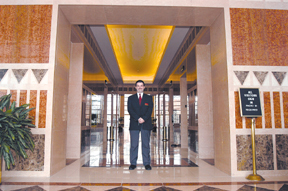
Plaza, watches over a lobby at the building.
How office buildings are protected changed forever following the Sept. 11 attacks
on the Twin Towers. Property managers have implemented new security measures,
ranging from increased personnel to high-tech tools.
“We were worried about copy-cat type events,” said John J. Macliver, president of Providence-based MPM Property Management, which manages eight “mid-rise” buildings in Providence, including One Citizens Plaza.
Fear among people working in tall city buildings required property managers to make upgrades. Marketplace pressures led to security plans that now, two and a half years after the terrorist attacks, are more precise and efficient.
Seifert Systems Invests in Energy Efficiency to Strengthen Operations
For manufacturers, energy is more than just another operating expense. It plays a critical role…
Learn More
Most large buildings have personnel keeping an eye on people coming and going. A singular evacuation plan is in place that each building tenant should know, whereas before each company may have had different plans.
MPM reacted by enhancing what, Macliver said, was an already advanced security system.
Additional security details, access cards for elevators and upgraded computer systems were installed at larger buildings under his management, he said. The cost was between 30 cents to 50 cents per square foot.
The most intense security upgrades occurred at MPM’s signature building, One Citizens Plaza, which houses local offices of New York City-based Merrill Lynch and UBS Financial Services – along with Citizens Bank.
“Many of the workers here had a direct relationship with people in the Towers,” Macliver said. “People were very nervous, not because of specific threats. There was just a sense of uneasiness.”
Wes Cotter, spokesman at Providence-based Gilbane Properties Inc., said company officials limited entrance points and created an environment where managers and tenants are vigilant about safety at its buildings, including the 29-floor One Financial Plaza and the 19-floor FleetCenter.
“But, we can’t divulge details,” he said. “We don’t want to compromise the safety and security measures in place.”
Jim Crumbley, senior risk consultant for AMSEC International based in Winchester, Va., said Sept. 11 fostered an attention to security that still persists today.
“Security had been a mid-level management concern prior to 9-11,” he said. “After the attacks, it reached the board level.”
He said the attack opened the eyes of company executives because staffs trying to work while afraid, if they went to work at all, could hurt the bottom line. The concern was to develop strategies that would keep the doors open during or get them open after an incident.
Gary Salmans, critical incident planning practice leader for risk consulting at New York City-based Marsh Risk Consulting, said employees working in high-rise buildings are steadily becoming more apathetic to security as time elapses from Sept. 11.
“Whereas 95 percent to 100 percent of people would evacuate during a fire alarm a month after 9-11, only 50 percent to 60 percent would do the same now,” he said. “Going back to a pre-9-11 mode is the most dangerous area we could get into.”
However, building managers have remained on top of security issues, he said. They’ve come up with procedures in case of emergencies not only dealing with terrorism threats but also other challenges facing a building like fires and day-to-day security.
“The lessons we’ve learned have led to templates of best practices,” he said. “By controlling access and egress, for instance, building managers have solved 87 percent of the security issues.”
Jim O’Neil, director of security for the 46-floor and 36-floor International Place towers in Boston, said right after the Sept. 11 attacks, building managers in Boston were quick to spend money on security items they thought would ease fears.
He cites a building that spent $5,000 a week to have a bomb-sniffing dog and attendant in the lobby.
Money was also spent on security consultants who seemingly came out of the woodwork after the attacks. There were former FBI agents out of the security profession for years giving advice that O’Neil says did not mesh with new insurance and code regulations.
“Many of these systems weren’t manageable,” he said. “Building managers that did well took increased security measures gradually. They also made tenants a part of the conversation.” Although virtually no legislation has been put in place addressing security at high-rise buildings, O’Neil said things are changing a little in Boston.
The city has created the Corporate Emergency Access System, a program in which key company workers can get into their high-rise building after the immediate risk of an emergency event has passed.
The system was first introduced in Buffalo, N.Y., so key employees could get a company up and running quicker after a snowstorm. Identifications of these workers are kept on file with the city and they have permission to go into a building, though the effects of a snowstorm or other event may not be completely cleared. “I think you’ll see more of these systems in other cities,” O’Neil said.