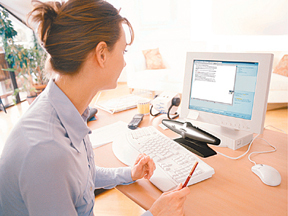
Computer software for making invitations and personalized stationery, headset-free microphones that allow the speaker to dictate documents, and voiceover IP technology that makes the telephone obsolete are the latest in gadgets designed to make working from the home office much easier.
All the technology was developed or expanded upon with investment from the Slater Center for Interactive Technologies.
Swyx, a Germany-based company that developed a voiceover IP program to connect a phone system to the Internet and a home-based user, is expanding into the United States and Rhode Island through the center.
Acoustic Magic, which developed microphones for computer dictation and other uses, is based in Sudbury, Mass. And Mountaincow, a husband and wife team that provides software packages for stationery and invitations, is based in Providence.
Voiceover IP systems virtually eliminates the need for an office phone, according to Thorne Sparkman, executive director of the Slater Center for Interactive Technologies.
“There are two plugs under your desk – one for the computer and one for the phone,” he said. “Your office has two networks – one for the computer and one for the phone, and there’s no reason why the phone stuff can’t go through the computer.”
Vonage, a broadband phone company based in New Jersey, offers digital phone service through the computer. This way, whether you’re at home on your laptop or computer or traveling and want to make a call or perform other related tasks, this is possible without a phone. Regardless of where you might make a call, the number is still registered as a Rhode Island number, Sparkman said – even if you’re making a call in California.
“It’s quite easy to get your voicemail to come through your e-mail,” he said. The message comes through as an e-mail file with an attachment and plays on the computer. The system can also record calls and store messages. “It’s a virtual private network. No matter where your laptop goes, that’s your home number.”
Swyx developed a PBX (private branch exchange) with similar features, called SwyxWare. A PBX is the system that provides menu choices when you make a phone call to a company number, Sparkman said. Swyx was one of the pioneers of this technology, which can be used to extend the menu options and other services through the Internet by connecting the worker to the office system.
“It makes you more efficient on the phone,” Sparkman said. Most office phones have many buttons, most of which people never use, he added. With Vonage and the PBX technology, “when the phone rings, you know exactly who’s calling you. You can pick up calls from wherever you are.” And with telecommuting and home-based business, this technology is gaining momentum.
After purchasing a software package from the selection on the Mountaincow Web site, buyers can design, lay out and print their own holiday cards, personalized stationery or invitations. The program also allows customers to manage multiple projects at once, import addresses to a mailing list and keep track of R.S.V.Ps and gifts received.
Acoustic Magic’s microphone technology allows the speaker to walk around the room while dictating, using voice recognition. It also filters out background noise more than a standard microphone. According to CEO Bob Feingold, doctors use it to dictate reports, businesspeople use it to record meetings and dispositions, and can be used for voiceover IP.
“With (regular) microphones, you don’t appreciate how much noise they pick up, like noise from the computer,” he said. “With the array microphone, it’s actually a series of eight microphones that operate together to form a (voice recognition) beam, like a searchlight.”
The microphone can be used anywhere there is voice-recognition capability, Feingold said – program and command operations through the computer, home automation and robotics. If the user wants to command the computer, there are software packages that he or she must download first, he added.
“In the home office, if the user does do dictations or is just responding to e-mails or writing letters, this does all kinds of things” through voice recognition, Feingold said. “You’re free to move around.”
If using the microphone for Internet video conferencing, “it becomes a high quality speaker phone. It’s a multifunctional microphone, and as home offices use (shared) software more, you can use this for voiceover IP and doing spreadsheets.”
Beyond Cash Donations: How New Forms of Giving Are Transforming Not-for-Profit Accounting
Evolving Funding Landscape for Not-for-Profits Not-for-profit organizations are being asked to do more with less,…
Learn More